Showing posts with label litigation. Show all posts

Wednesday, January 7, 2015

China encourages environmental groups to sue polluters

The Guardian (UK) via AFP: China on Wednesday granted public interest groups more power to sue those that flout environmental protection laws, the country’s highest court said, as Beijing steps up efforts to curb pollution that regularly chokes major cities.

Social groups that work to fight polluters judicially will gain special status and have court fees reduced, the Supreme People’s Court said on its website. They will also be allowed to sue firms or individuals across China, regardless of where the organisation is based.

The term the court used for the groups covers both NGOs and government-backed organisations, although it was not immediately clear whether independent environmentalists will benefit from the regulations.

China has more than 700 registered and regulated environmental protection groups, the official Xinhua news agency cited a ministry official as saying. The new rules came into force on Wednesday, the court said, adding that they were issued “in response to questions on the matter”.

A side effect of the country’s meteoric economic rise of recent decades has been severe pollution in major cities, leading to increased public
dissatisfaction that has unnerved the ruling Communist Party. Recent studies have shown that roughly two-thirds of China’s soil is estimated to be polluted, and that 60% of underground water is too contaminated to drink...

Beijing smog, shot by Kevin Dooley Kevin Dooley, Wikimedia Commons via Flickr, under the Creative Commons Attribution 2.0 Generic license

Friday, May 23, 2014

Lloyd’s US chief on board with climate change

Don Jergler in Insurance Journal: Despite risking offense to non-believers, Hank Watkins didn’t hesitate when he was asked if climate change was upon us. Watkins, president of Lloyd’s America, talked about an extensive report Lloyd’s of London just released, “Catastrophe Modeling and Climate Change.”

 “Everybody that produced this report on our behalf is in agreement that climate change is here,” he said. “I’d say the majority of them also suggested that man has certainly had a hand in that. We’re not suggesting that it’s happened over time, and there’s no cause and effect.”

The stance that the world’s oldest insurance firm is taking may not be too far out in the limb, because Lloyd’s headquarters is in the United Kingdom, a region of the world where the nation and its European neighbors seem have embraced the concept of climate change more so than other industrialized countries.

It’s one in a line of several reports and actions on climate change. Earlier this month the White House’s National Climate Assessment report was released as part of President Barack Obama’s effort to prepare the nation for the impacts of a changing climate now and in the future.

That report, which was guided by a 60-member federal advisory committee and was reviewed by experts, federal agencies and the National Academy of Sciences, was attacked by some as a political move timed so that Obama could renew his call for a national energy tax.

Farmers Insurance in April filed nine class actions against nearly 200 communities in the Chicago area arguing that local governments should have known rising global temperatures would lead to heavier rains and did not do enough to fortify their sewers and stormwater drains....

A storm drain in use, image by Robert Lawton, Wiukimedia Commons, Creative Commons 2.5 license

Sunday, April 27, 2014

Taiwan typhoon victims lose compensation suit

Terra Daily via AFP: A Taiwanese court on Friday rejected a group compensation claim filed by victims of a deadly typhoon in 2009 against local authorities for alleged negligence. A district court in the southern city of Kaohsiung ruled that the city government and a local township office did not have to pay Tw$590 million ($19.67 million) jointly sought by relatives of 175 people who died when their village was destroyed during Typhoon Morakot.

Morakot, the worst storm to hit Taiwan in half a century, left more than 600 dead, including 400 people from Hsiaolin village in Kaohsiung that was buried by mudslides triggered by torrential rains. The disaster plunged President Ma Ying-jeou into his worst political crisis since taking office in May 2008, amid widespread public criticism that his government's response was late and inefficient.

Surviving residents of Hsiaolin village filed the compensation suit in 2011, arguing that authorities failed to efficiently monitor mudslides and evacuate the village in time, resulting in massive deaths and financial losses.

The court, however, ruled that it was impossible for the officials to predict the occurence of mudslides that buried the village. The villagers said they would appeal the decision....

The landslide has completely blocked the Wugan Riverbed in Nantou County,caused by typhoon Morakot on 8th August,2009. Shot by Yiken, Wikimedia Commons,  under the Creative Commons Attribution-Share Alike 3.0 Unported license 

Monday, March 24, 2014

Putting climate polluters in the dock

Desmond Brown in IPS: Can Caribbean governments take legal action against other countries that they believe are warming the planet with devastating consequences? A former regional diplomat argues the answer is yes. Ronald Sanders, who is also a senior research fellow at London University, says such legal action would require all Small Island Developing States (SIDS) acting together.

He believes the Hague-based International Court of Justice (ICJ) would be amenable to hearing their arguments, although the court’s requirement that all parties to a dispute agree to its jurisdiction would be a major stumbling block.

“It is most unlikely that the countries that are warming the planet, which incidentally now include India and China, not just the United States, Canada and the European Union…[that] they would agree to jurisdiction,” Sanders told IPS. “The alternative, if countries wanted to press the issue of compensation for the destruction caused by climate change, is that they would have to go to the United Nations General Assembly.”

Sanders said that the Caribbean Community (CARICOM) countries could “as a group put forward a resolution stating the case that they do believe, and there is evidence to support it, that climate change and global warming is having a material effect… on the integrity of their countries.

“We’re seeing coastal areas vanishing and we know that if sea level rise continues large parts of existing islands will disappear and some of them may even be submerged, so the evidence is there.” Sanders pointed to the damaging effects of flooding and landslides in St. Vincent and the Grenadines, St. Lucia, and Dominica as 2013 came to an end...

A mudslide in Nicaragua caused by 1989's Hurricane Mitch, US Geological Survey

Sunday, February 16, 2014

Closely-watched GM farm case begins in Australia

Seed Daily via AFP: An Australian farmer who lost his organic produce licence has taken his neighbour to court over contamination from his genetically modified canola crop in a closely-watched test case. Steve Marsh's case against his neighbour Michael Baxter began in Western Australia's Supreme Court on Monday, seeking damages and a permanent injunction to protect his farm from future contamination.

Marsh lost organic certification on 70 percent of his land in 2010 after swathes and seed from Baxter's farm blew onto his property, resulting in "great financial hardship and an uncertain future". His legal team said the case could set an important benchmark on farming.

"As far as we know, this is the first court case of its type anywhere in the world. It will test the legal rights of farmers to choose how and what they farm on their land," said lawyer Mark Walter.

"The case is about freedom of choice, for both farmers and for consumers. It is important that farmers retain their rights to farm GM-free food as this in turn will protect consumers' ability to purchase GM-free food."

Baxter's defence team argues that Marsh's farm, where oats and other grains are grown and sheep graze, cannot be directly affected by the GM canola because he does not grow canola himself....

Making hay in the 1930s in Australia

Thursday, September 12, 2013

Indonesian farmers take legal action against president over haze

Terra Daily via AFP: Indonesian farmers in a province at the centre of Southeast Asia's worst smog outbreak for years have filed a lawsuit against the president in response to the haze crisis, activists said Wednesday. Environmental groups Tuesday filed the class-action lawsuit at the Jakarta High Court on behalf of farmers from five villages in Riau province on Sumatra island.

They argue President Susilo Bambang Yudhoyono has not done enough to curb activities, such as slash-and-burn land clearance and logging, that lead to climate change, and their lives are being deeply affected. In June, raging fires set to clear land in Riau cloaked the province and neighbouring Malaysia and Singapore in smog, with the haze hitting the worst levels for more than a decade.

Riau is at the centre of Indonesia's booming palm oil industry, and illegal slash-and-burn clearance is common, as it is the quickest and cheapest method for land to be converted for use as plantations. A coalition of green groups filed the lawsuit, including forest protection group Jikalahari, which said the severe haze this year had prompted the action and had "deeply affected the communities"...

NASA image of smoke over Sumatra

Monday, March 25, 2013

Georgia state senators push litigation in Tennessee border dispute

Jeff Gill in the Gainesville Times examines the brilliant new way of addressing water and climate issues – an asinine legal battle against a neighboring state that has water. It’s even better when their justification involve a two-century-old survey: The Georgia Senate has approved a resolution seeking to resolve a longstanding border dispute with Tennessee and shore up Georgia’s water supply in the process.

Today’s vote was 48-2, with an amendment added, directing the attorney general to start litigation if no agreement is reached with Tennessee. In essence, the legislative measure would allow Tennessee to keep 66 square miles and Georgia to take in 1 1/2 acres and give access to the Tennessee River.

“The Tennessee Valley Authority has identified the Tennessee River as a likely source of water for North Georgia,” said Sen. David Shafer, R-Duluth. ”Yet the State of Tennessee has used mismarked boundary lines to block our access to this important waterway.”

Georgia’s streams and creeks “feed the Tennessee River,” Shafer said. “In fact, over 6 percent of the water of the Tennessee River originates in Georgia.” House Resolution 4 now returns to the House for agreement on amendments made by the Senate.

The dispute stems from an 1818 survey that improperly placed the Georgia-Tennessee boundary one mile south of the mutually agreed-upon border at the 35th parallel….

A beautiful example of Finley's important 1827 map of Tennessee. Depicts the state with moderate detail in Finley's classic minimalist style. Shows river ways, roads, canals, and some topographical features. Offers color coding at the county level. Title and scale in upper left quadrant. Finley's map of Tennessee is particularly interesting and important due to its portrayal of the rapidly changing American Indian situation in the south eastern part of the state. In 1827 a substantial part of southeastern Tennessee and northwestern Georgia was a confined territory assigned to the Lower Creek and Cherokee nations. Finley's map details the borders of this country as defined by the Tennessee and Hiwasssee Rivers. Also notes American Indian villages and missionary stations, including the Brainerd Mission, within and adjacent to the Cherokee territory. Just four years after this map was made the Creek and Cherokee would forcibly relocated westward in the infamous Trail of Tears. Engraved by Young and Delleker for the 1827 edition of Anthony Finley's General Atlas .

Saturday, October 13, 2012

Drought demands wiser water decisions

Erica Gies in the Daily Climate: Midway through October, almost 64 percent of the contiguous United States remains in some form of drought, as the nation's most widespread drought since 1956 continues to threaten drinking water supplies, crops and livestock.

...The summer's epic Midwest drought has eased in the region's east, where Ohio, Indiana, and Illinois suffer only moderate drought. But farther west, Iowa still endures extreme drought, while Nebraska, Kansas and Oklahoma are gripped by exceptional drought.

...Droughts come and go, of course, but water scarcity is a looming problem, as growing populations increase demand and climate change makes supplies more erratic.  U.S. communities are responding in a number of ways that could be adopted across the nation:

A frequent response to water scarcity is lawsuits. In June, the U.S. Supreme Court declined to take a long-running case in which Alabama, Florida, and Georgia fought over the waters of Lake Lanier, allowing a lower court ruling to stand giving the Atlanta metro area much of the water. Of course, the problem with lawsuits is they don't increase water supply; they just reallocate it.

...Cooperative watershed management is an effective approach that considers an entire watershed for what it is: an integrated, natural system, as opposed to a mere source of a human commodity. It aims to meet the needs of all users in the water system, including cities, farmers, energy producers, plants and animals.

...Between 1950 and 2005, the U.S. population doubled while domestic, commercial and industrial water consumption tripled. However, conservation measures are closing this gap. Between 2005 and 2009, our population increased 5 percent while water withdrawals increased by just 2 percent, according to the U.S. Geological Survey....

A dry riverbed in California, shot by NOAA, Wikimedia Commons, public domain

Monday, August 20, 2012

Belo Monte dam construction halted by Brazilian court

Jonathan Watts in the Guardian (UK): Opponents of the world's biggest new hydroelectric project - the Belo Monte dam in Brazil - notched up a rare victory this week, when a federal appeals court ordered construction to be suspended until indigenous groups are properly consulted about the project.

The judgment on Tuesday may prove only a temporary reprieve but it is seen as a scathing verdict on the government's efforts to rush forward with the Xingu River project in the Amazon, which - despite controversy - is one of the pillars of Brazil's efforts to reduce dependency on fossil fuels. It is also a setback for developers, led by Electrobras, which now face expensive delays or daily fines of up to R$500,000 (£166,00) if they do not comply with the court order.

About 12,000 construction workers are due to work on the dam this year, which is eventually expected to produce 11,000 megawatts of electricity - the third biggest hydro-electric generating capacity in the world after China's Three Gorges and Brazil's Itaipu dams. But the project has faced strong legal challenges and protests by conservationists and local tribes.

The project - initially conceived during the years of Brazil's dictatorship - was supposed to have gone through an extensive environmental impact assessment before the start of construction, but judges from Brazil's regional federal tribunal have accepted a lower court ruling that Congress acted illegally in authorising the dam without due consultation with the indigenous groups that might be affected.

"The court's decision highlights the urgent need for the Brazilian government and Congress to respect the federal constitution and international agreements on prior consultations with indigenous peoples regarding projects that put their livelihoods and territories at risk. Human rights and environmental protection cannot be subordinated to narrow business interests" said the author of the ruling, federal judge Souza Prudente...

Fires along the Xingu River in Brazil, from NASA

Sunday, February 5, 2012

Island nations want climate change in world court

Dawn.com (Pakistan) via AP: Small island nations, whose very existence is threatened by the rising sea levels brought about by global warming, are seeking to take the issue of climate change before the International Court of Justice. Johnson Toribiong, president of Palau, said Friday his country and other island nations had formed an expert advisory committee to bring the issue before the U.N. General Assembly. That would allow the world court in the Hague to determine the legal ramifications of climate change under international law.

”If 20 years of climate change negotiations have taught us anything, it’s that every state sees climate change differently. For some, it is mainly an economic issue … for others it’s about geopolitics and their past or future place in the global economy, but for us it’s about survival,” Toribiong said.

”Pacific countries are in the red zone, a swell of ocean where waters have risen two or three times higher than anywhere else in the world. That differential might explain why we speak about climate change so urgently and we look to everyone in every corner of the United Nations to find a solution,” he added.

Michael Gerrard, director of the Center for Climate Change Law at Colombia University and a member the advisory committee, said the idea is to have a court determination compelling developed nations to control emissions of the greenhouse gases believed to cause global warming in the absence of an international treaty.

Gerrad said that the big emitter nations could then be found liable under the international law principles of transboundary harm, when physical activities in one country impact adversely upon another, and the preservation of statehood _ something that becomes exceedingly difficult if a country is submerged between the rising oceans....

Aerial view of uplifted limestone islands, so called "Rock Islands" in Palau, shot by NOAA

Wednesday, November 30, 2011

Alaskan community revives legal bid for global warming damages

Felicity Carus in the Guardian (UK): A native American community in remote Alaska this week revived legal efforts to hold some of the world's largest energy companies accountable for allegedly destroying their village because of global warming. The so-called "climigration" trial would be the first of its kind, potentially creating a precedent in the US courts for further climate change-related damages cases.

Attorneys acting for the 427 Inupiat people living in Kivalina made representations before an appeals panel in San Francisco on Monday, to claim climate change-related damages from Exxon Mobil, BP America, Chevron, Shell, Peabody Energy, the world's largest coal provider, and America's largest electricity-generating companies including American Electric Power and Duke Energy.

Kivalina's location at the tip of a barrier reef 70 miles north of the Arctic Circle puts the village on the frontline of extreme weather from the Chukchi Sea, which normally freezes over from November to June.

"Kivalina's existence as a community depends on the sea ice that forms around the village in fall, winter, and spring. This protects it from the coastal storms that batter the coast of the Chukchi Sea," Kivalina's lawyers told the panel. "However, due to global warming, this landfast sea ice forms later in the year, attaches to the coast later, breaks up earlier, and is less extensive and thinner, subjecting Kivalina to greater coastal storm waves, storm surges and erosion..."

An aerial view of Kivalina shows how vulnerable it is, shot by the US Army Corps of Engineers

Friday, June 24, 2011

Black carbon is the latest environmental battleground

Patti Epler in the Alaska Dispatch: The U.S. Environmental Protection Agency is being threatened with legal action by environmentalists again, this time over its failure to reduce black carbon that’s ends up on sea ice and glaciers. The Center for Biological Diversity on Wednesday notified EPA of its intent to sue if the agency doesn't start taking some action within 60 days.

Participants at the recent Arctic Council meeting, a gathering of eight Arctic nations in Nuuk, Greenland, identified black carbon emissions in the far North as coming from old diesel engines and woodstoves. The black particles absorb heat and warm the atmosphere while in the air, and then spread over the ice and snow, absorbing heat and increasing melting.

The environmental group called on EPA to take action to reduce and ultimately regulate the particulates in February 2010, but the agency never responded, according to the letter of intent to sue filed Wednesday in Washington, D.C.

Matt Vespa, a senior attorney with the center in San Francisco, said the EPA needs to first identify the problem through monitoring and measuring and then consider ways to reduce the pollutants. In Alaska, he said, local sources tend to be the older diesel engines and cook stoves that burn wood or coal. The problem could be stopped with filters, for instance, that reduce particulate emissions or requiring stoves that use natural gas instead of other fuels, he said…

A 1942 picture of a worker at a carbon black plant n Sunray, Texas

Thursday, June 9, 2011

Bangladesh laying constitutional groundwork to seek climate damages

Ali Sanwar in Reuters Alertnet: Bangladesh looks likely to be the first country to include in its constitution a provision for redressing damage resulting from climate change. The country’s parliament is expected to approve a report by its committee for constitutional reforms that would insert an obligation for the government to act on climate change into Article 15 of the country’s constitution.

The article outlines the state’s obligation to meet the basic necessities of life. The measure could lay the groundwork for the government to impose penalties on individuals or institutions within Bangladesh who are found guilty of contributing to climate-related damages.

The 15-member committee was formed in 2010 in response to an order by the Bangladesh High Court that the constitution be restored to its original 1972 form. The court held that changes by successive military governments had destroyed much of the constitution’s “basic character.”

Hasanul Huq Inu, a member of parliament and of the constitutional reform committee, said that the revised constitution will include an amendment addressing climate change and the environment. Parliament is expected to vote on the reform during its current session. The amendment states, “The state shall take appropriate response measures, including mitigation and adaptation, against anthropogenic-accelerated global-warming-induced climate change and sea-level rise.”

“One of the big achievements so far has been that there is complete consensus among the committee members on the issue,” Inu said….

Tuesday, April 12, 2011

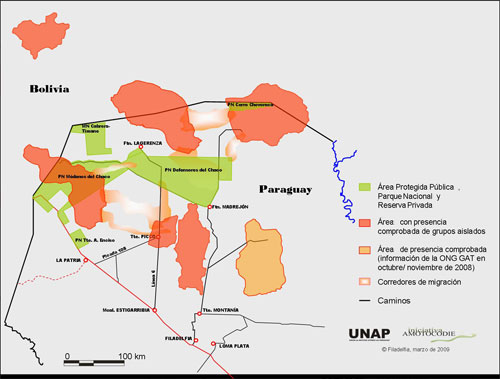
NGO sues to save forest for Paraguay natives

France 24: An NGO supporting the rights of native Paraguayans said Monday that it filed complaints with environmental authorities over the destruction of forests in the northwestern Chaco region. The Support Group for the Totobiegosode (GAT) says that 3,600 hectares (8,900 acres) of virgin forest in land where Paraguay's Ayoreos-Totobiegosode Indians live has been destroyed.

"It is the last redoubt of the Ayoreos-Totobiegosode indians in Paraguay," said Jorge Vera, a member of the non-governmental organization that filed the suit. Vera said the complaint was filed at the office of the environmental prosecutor and the Secretariat of the Environment.

Vera alleged that two Brazilian firms, River Plate and BBC S.A., are responsible for the destruction, and said that indigenous groups, local residents and foreigners made the government offices aware of the forest destruction, in part based on satellite photographs….

A map of areas of the Paraguay Chaco, where hints of presence of small bands of uncontacted Ayoreo Indians were found, as of 2009, indicated in red. Image by Union of Native Ayoreos of Paraguay (UNAP), Wikimedia Commons, under the Creative Commons Attribution 3.0 Unported license

Tuesday, March 22, 2011

Supreme Court may shape future of climate change litigation

Property & Casualty 360: While the Obama administration and several conservative organizations oppose climate litigation, feeling that the elected branches are better positioned to provide a sustainable national energy strategy, the U.S. Supreme Court will have its chance to make a mark on the discussion beginning in April.

In an NU article, “Will The Insurance Industry Dodge Climate Nuisance Liability Bullet?” which appears in this week’s Specialty Markets Insight newsletter, William F. Stewart, a partner in the National Insurance Coverage Group of Nelson Levine de Luca & Horst in Blue Bell, Pa., writes about the case, Connecticut v. American Electric Power Co., et al, also called AEP. In the case, Mr. Stewart explains, “several states and environmental groups filed suit against power companies seeking an abatement of ‘the public nuisance of global warming.’”

Plaintiffs alleged that the utilities’ combustion of fossil fuels had contributed to elevated levels of atmospheric carbon dioxide, which led to conditions such as beach erosion, droughts and floods. Mr. Stewart notes that the case was dismissed by a New York Federal District Court, but the Second Circuit Court of Appeals reversed that decision.

…Mr. Stewart writes, “If affirmed, AEP threatens to open up a Pandora’s Box of global warming suits, as well as associated coverage litigation. Under the Second Circuit’s ruling, any entity with ‘special’ climate-related harm—harm that is different in kind or in scope from the general public—would have standing to pursue large [greenhouse gas] emitters.”

Calling it possibly the most important environmental case in a decade, Mr. Stewart says the AEP decision threatens to create a “highly undesirable balkanization of environmental regulation between one jurisdiction and the next.”…

Sculpure ornament of a judge adorning the walls of the Sterling Law Buildings at of the Yale Law School of Yale University. Picture by Henry Trotter, 2005

Monday, March 21, 2011

Bayer ordered to pay $136.8 million in U.S. rice case

Martinne Geller in Reuters: A unit of Germany's Bayer AG has been ordered by a court in Arkansas to pay $136.8 million to Riceland Foods over the contamination of U.S. long grain rice stocks with a genetically modified strain from Bayer that decimated exports more than four years ago. The judgment, handed down by a jury in Stuttgart, Arkansas, includes $125 million in punitive damages to Riceland, a farmers cooperative.

Bayer said it is "disappointed" with the verdict and is considering its legal options. It said the punitive damages exceed what is permitted by Arkansas law and will therefore be limited to the statutory cap of $1 million. The judgment also includes $16.9 million in compensatory damages, with Bayer CropScience accountable for 70 percent, or $11.8 million, according to the plaintiff's attorney.

"We believe it's the largest punitive award in Arkansas in any case," said attorney Barry Deacon with the Jonesboro, Arkansas law firm Barrett & Deacon…

A Bayer advertisement in Leverkusen, shot by H005

Friday, February 18, 2011

Flood studies bring climate change lawsuits a step close

EurActiv: A leading climate professor says that new evidence which further reinforces the connection between global warming and extreme rainfall is "extremely important" in setting out a methodology which could one day be used to sue energy companies for climate damage.

Two studies were published in the journal Nature on 16 February, using complex computer simulation models to assess the contribution of planet-warming gases to intense precipitation events. One paper found that greenhouse gas emissions substantially increased the risks of the autumn 2000 floods in the UK. In nine out of ten cases, their model saw the flood risk increased by more than 20%, and in two thirds of cases, the increase was over 90%.

Professor Carlo Jaeger of the Potsdam University for Climate Impact Research, who compiled a study linking carbon emissions to the 2003 heatwave in Europe, told EurActiv that the methodology used in the study had "dramatic consequences," even if it was still evolving.

"It is extremely important that we have a method which enables us to assess fractions of probability, to assess how strongly the dice was loaded because in court, that's actually how liability issues are settled," he said. "If you have an accident, a court [might] ask: 'What was the contribution of the manufacturing supplier or whatever to this accident?' Damages are then allocated by such proportions."

The autumn 2000 deluge, which flooded more than 10,000 homes, took place amid the wettest British autumn since records began in 1766 – and caused £1.3 billion of insurance losses. If climate change could be conclusively shown to have enhanced the probability of flooding by 20%, then the same proportion of the damages could theoretically be recouped in damages from companies that had contributed to it.

"Whether this will ever happen, whether this has a chance of success, is another story," Professor Jaeger admitted. The computer systems involved in the study depended heavily on seasonal forecasting which is not always reliable, he said….

Emblem from the 1648 book of emblems Icones mortis by Georg Philipp Harsdörffer

Sunday, January 30, 2011

Drying of West brings new era of water wars

The Press Democrat via the Economist: …The main reason why Lake Mead, currently only 40 percent full, has been getting emptier is a decade-long drought. Whether this is a cyclical and normal event, or an early sign of climate change, is unclear. But even if the drought ends, most scientists think global warming will cause flows on the Colorado River to decrease by 10 percent to 30 percent in the next half-century, says Douglas Kenney, the director of a water policy program at the University of Colorado Law School.

The other reason, says Kenney, is the rapidly increasing demand for the river's water. The Colorado provides much or most of the water for many cities and farms in seven states — Colorado, Wyoming, Utah, New Mexico, Nevada, Arizona and California — before it peters out in the sands of Mexico.

…That is why Las Vegas is a canary in the mine shaft, as Pat Mulroy, the boss of the Southern Nevada Water Authority, puts it. The Las Vegas valley gets its water through two long channels drilled through the rock. The first taps the lake at 1,050 feet above sea level, the second at 1,000 feet. Lake Mead's water level is now near its record low, at 1,086 feet. Within a few years, it could leave Las Vegas' first intake, or even both, dry.

The threat to Sin City is a good example of the four dimensions — physical, legal, political and cultural — of water in the West. For the physical, the standard response is to summon the engineers. Mulroy already has them digging a third intake at 890 feet. Given the weight of the water on top, this is fiendishly difficult, and it will not be ready until 2014. Mulroy also wants to pipe ground water from the rural and wetter northern counties of Nevada to Las Vegas, but that has caused a vicious row.

Another response is to call in the lawyers. This was the preferred approach a century ago, in the era of the “water wars.” Starting with the Colorado River Compact of 1922 and continuing with statutes, a treaty with Mexico and case law until the 1960s, a truce was achieved. Called the Law of the River, the resulting regime determines who along the river has what right to how much water....

Lake Mead, bathtub ring, this time by Cmpxchg8b, who has released the image into the public domain

Sunday, January 23, 2011

Dogs of law are off the leash

Richard Ingham in AFP: From being a marginal and even mocked issue, climate-change litigation is fast emerging as a new frontier of law where some believe hundreds of billions of dollars are at stake. Compensation for losses inflicted by man-made global warming would be jaw-dropping, a payout that would make tobacco and asbestos damages look like pocket money.

Imagine: a country or an individual could get redress for a drought that destroyed farmland, for floods and storms that created an army of refugees, for rising seas that wiped a small island state off the map.In the past three years, the number of climate-related lawsuits has ballooned, filling the void of political efforts in tackling greenhouse-gas emissions.

Eyeing the money-spinning potential, some major commercial law firms now place climate-change litigation in their Internet shop window. Seminars on climate law are often thickly attended by corporations that could be in the firing line -- and by the companies that insure them.

But legal experts sound a note of caution, warning that this is a new and mist-shrouded area of justice. Many obstacles lie ahead before a Western court awards a cent in climate damages and even more before the award is upheld on appeal….

Francesco Hayez, 1844, L'ultimo abboccamento di Jacopo Foscari (con suo padre, il doge Francesco Foscari). In the Pitti Palace, Florence

Monday, January 10, 2011

Supreme Court won't hear global warming case

Joanne Wojcik in Business Insurance: The U.S. Supreme Court decided Monday not to review a pivotal global warming case brought by coastal residents seeking damages for property damage caused by Hurricane Katrina.

In Ned Comer et al. vs. Murphy Oil USA et al., a group of Mississippi property owners alleged that greenhouse gas emissions of Murphy Oil USA—through more than 100 oil, coal and chemical companies—contributed to climate change and furthered the property damage caused by Hurricane Katrina in 2005.

The plaintiffs sought damages under Mississippi common law, including public and private nuisance, trespass and negligence allegations. A federal district court in Mississippi dismissed the assertions on grounds that they presented a political question that could not be decided by the courts. However, a three-judge panel of the 5th U.S. Circuit Court of Appeals in New Orleans reversed the lower court’s ruling in October 2009 and allowed the claims to proceed....