Showing posts with label Paraguay. Show all posts

Friday, September 6, 2013

At least five dead in South America cold snap

Terra Daily via AFP: At least five people have died due to a cold snap in South America, which has also killed thousands of cattle and damaged crops, authorities said Wednesday. In Bolivia, heavy snowfall claimed at least three lives and thousands of families were reeling from a sudden dip in temperatures over the past week, according to regional officials.

Two of the dead were farmers who perished in the high up Ancomilla region of the department of Potosi, according to local mayor Jaime Choque. Bolivia's Social Defense Ministry ministry said on Tuesday that an earlier victim died trying to save their livestock in the village of Huayllas in the central region of Cochabamba.

Four of the Andean nation's nine departments have suffered bad weather, leaving roads blocked and thousands affected. An official report Tuesday said the snow had hit 15 municipalities, affecting almost 3,500 families.

In neighboring Paraguay, two people died from hypothermia due to the chill that has also killed 4,000 cattle and affected 30 percent of the country's wheat crops, according to official reports released Wednesday....

Panoramic view shows the mountainous scenery of Chile’s Chajnantor Plateau, with snow and ice scattered over the barren terrain. The main peaks from right to left are Cerro Chajnantor, Cerro Toco, Juriques, and the distinctive conical volcano Licancabur. Also barely visible is the ALMA astronomy facility. Shot by ALMA (ESO/NAOJ/NRAO), Wikimedia Commons, under the Creative Commons Attribution 3.0 Unported license

Wednesday, March 21, 2012

Drought spreads to Brazil, crop yields hit

Terra Daily via UPI: Drought has spread from Argentina and Paraguay to Brazil and is hitting soy yields at a time of concerns that regional economic growth may suffer as pressures mount on commodity prices.

Argentine yields of soy were affected by drought and labor disputes in that country are making farmers and grain traders jittery. Drought caused widespread economic dislocation in Paraguay, which was also hit by cattle disease.

Analysts said drought-related developments in Brazil had led to lower yield estimates, slicing about 2.8 million tons off an original estimate of 67.1 million tons for this year's harvest. The revised estimates are subject to further review, said the analysts.

Soy oil has gained importance in the energy market as a feedstock for the booming international biofuels sector....

Biodiesel from soy, shot by Leandro Maranghetti Lourenço, Wikimedia Commons, under the Creative Commons Attribution-Share Alike 3.0 Unported license

Friday, February 3, 2012

Deforestation threatens Brazil's wetland sanctuary

Terra Daily via AFP: The Pantanal, a stunning biodiversity sanctuary in central-western Brazil, is threatened by intensive farming and deforestation, a leading environmental group warned as the world marked World Wetlands Day on Thursday. Often referred to as the worlds largest freshwater wetland system, the Pantanal extends through millions of hectares of Brazil, eastern Bolivia and eastern Paraguay.

It includes sanctuaries for migratory birds, nursery grounds for aquatic life, and refuges for such creatures as the yacare caiman, deer, and jaguar. Some 4,500 different species live in the Pantanal. A leading environmental group, the World Wildlife Fund for Nature (WWF), is sounding the alarm about the growing threat to the region posed by intensive farming, deforestation, urban growth and the proliferation of hydro-electric dams.

As evidence the group cites a three-year study by 30 experts from Brazil, Paraguay, Bolivia and Argentina, the counties that share the Paraguay river, which flows from its headwaters in Mato Grosso about 2,600 kilometers (1,620 miles) to its confluence with the Parana River in Argentina.

"The Pantanal is under threat," said biologist Glauco Kimura, who coordinates the Water for Life program at WWF. "This may seem surprising but it is the sad reality. Our study shows that 14 percent of the Paraguay River basin must be urgently protected," Kimura said....

An aerial view of the Pantanal by Alicia Yo, Wikimedia Commons, under the Creative Commons Attribution ShareAlike 3.0 License

Sunday, January 22, 2012

Drought worsening in Argentina, Paraguay

Terra Daily via UPI: Drought conditions are worsening in Latin America, especially Argentina and Paraguay, and may become a flash point for political and rural unrest, latest data and sector analysis said. In Argentina's politically fraught agriculture sector, anger over what farmers' representatives see as ineffective policies of President Cristina Fernandez de Kirchner surfaced again in pronouncements by farmers' representatives.

Fernandez is accused of refusing to increase a state emergency fund for tackling the drought. The president has also turned down pleas for a fiscal review to ease the tax burden of farmer communities. "Farmers are always expected to pay up but are never entitled to government help," Argentine Agrarian Federation chief Eduardo Buzzi said. "The government wants farmers approaching the counter in order to pay, not asking for money."

Farmers' representatives say Fernandez is even less responsive to their demands and expectations since last year's landslide victory. Buzzi said the distressed farmers, especially those with small or medium-sized holdings, expected the government to drop export duties on grain and oilseed exports....

A field of soy in Paso de La Arena, Argentina, shot by Arielex, public domain

Tuesday, April 12, 2011

NGO sues to save forest for Paraguay natives

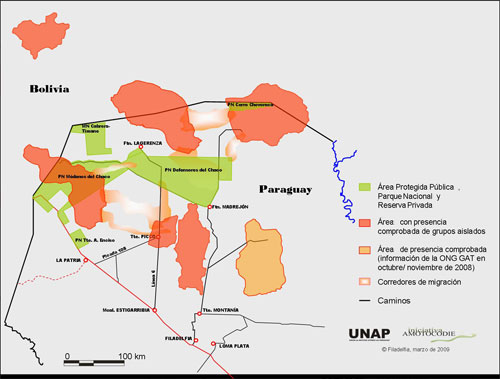
France 24: An NGO supporting the rights of native Paraguayans said Monday that it filed complaints with environmental authorities over the destruction of forests in the northwestern Chaco region. The Support Group for the Totobiegosode (GAT) says that 3,600 hectares (8,900 acres) of virgin forest in land where Paraguay's Ayoreos-Totobiegosode Indians live has been destroyed.

"It is the last redoubt of the Ayoreos-Totobiegosode indians in Paraguay," said Jorge Vera, a member of the non-governmental organization that filed the suit. Vera said the complaint was filed at the office of the environmental prosecutor and the Secretariat of the Environment.

Vera alleged that two Brazilian firms, River Plate and BBC S.A., are responsible for the destruction, and said that indigenous groups, local residents and foreigners made the government offices aware of the forest destruction, in part based on satellite photographs….

A map of areas of the Paraguay Chaco, where hints of presence of small bands of uncontacted Ayoreo Indians were found, as of 2009, indicated in red. Image by Union of Native Ayoreos of Paraguay (UNAP), Wikimedia Commons, under the Creative Commons Attribution 3.0 Unported license

Friday, June 18, 2010

Activists call for a pause in the expansion of farming in Paraguay's Gran Chaco

Natalia Ruiz Diaz in IPS (Tierramérica): Extensive cattle farming in northwestern Paraguay is the leading cause of deforestation in the Gran Chaco, one of the world's leading regions in biodiversity and South America's second largest forested area, after the Amazon. The non-governmental Guyra Paraguay Association reported to the Secretariat (ministry) of Environment (SEAM) that deforestation last year totalled 267,000 hectares, 17 percent more than in 2008, just in the northern provinces of Boquerón and Alto Paraguay.

The association's study also found that in the first quarter of this year, 18,000 hectares of forested land disappeared from this rich ecosystem, located in the centre of South America, with 80 percent of that loss occurring inside Paraguayan territory.

The Gran Chaco is a semi-arid expanse of dense thorn scrubland that covers more than one million square kilometres: 25 percent in Paraguay, 62 percent in Argentina, 12 percent in Bolivia, and the remaining one percent in Brazil.

Eladio García, director of integrated environmental monitoring at SEAM, told Tierramérica that government regulation of the area is difficult due to the lack of resources. "There is a complete lack of awareness about respect for natural resources," said García, who noted the private landowners' violations of the country's existing land-use and land management laws.

Forestry Law 422/73, which regulates management and use of renewable natural resources, establishes that 50 percent of forests must be maintained on farms that are in preservation zones, and 25 percent on farms that are not.

The Pojoauju Association, an umbrella of dozens of non-governmental organisations, issued a statement earlier this month urging an "ecological pause" to logging in the area in order to establish a balance between economic production and forest preservation….

A landscape in Paraguay's Gran Chaco, shot by Ilosuna, Wikimedia Commons, under the Creative Commons Attribution 1.0 Generic license