Showing posts with label indigenous_people. Show all posts

Saturday, July 11, 2015

Africa: Indigenous knowledge key to climate change adaptation

Michel Nkurunziza in AllAfrica.com via the New Times: Scientists have called for the integration of indigenous knowledge to combat global warming and enhance adaptation to climate change. According to researchers from East Africa, on-farm experiences by smallholder farmers and pastoralists and indigenous knowledge can contribute effectively to coping with climate change.

The scientists made this proposal while presenting their findings at the UNESCO scientific conference currently taking place in Paris, France, under the theme, "Our Common Future under Climate Change." "We need to harness indigenous knowledge and revive traditional natural resource governance of landscapes.

There is less appreciation of pastoralists' ideas, for example. Being connected to environmental resources the pastoralists' society is sensitive to climate change and, therefore, responds to th
e change as they deal with pasture and water," Benoit Hazard, an anthropologist from Institut National des Sciences Humaines et Sociales in Kenya, who is currently conducting research on resilience in East Africa said.

"We have traditional societies with specific knowledge to link things with ecological conditions, who know where water sources are and how to adapt. They need to be supported to mix their knowledge with agriculture practices. In Kenya, some have become agronomists."...

Animal husbandry in the Congo, USAID photo by L. Rose

Friday, January 23, 2015

Indigenous people measure carbon that satellites miss

Bjorn Carey in Futurity via Stanford University: Indigenous people govern about half of all remaining undeveloped land on the planet. New research with indigenous people in the Amazon suggests they may outperform satellites in measuring the true carbon storage potential of the rainforest. That finding could influence how indigenous people in Guyana and elsewhere manage their forests and may lead to greater opportunities for these communities to engage in carbon offset programs.

The project, described in the journal Forest Ecology and Management, grew out of efforts to engage indigenous peoples to gain better understanding of ecosystems that have been relatively undisturbed by modern civilization. ...“The people know the trails really well, and some of them will walk two days to get to their plot and make measurements,” Fragoso says. “They can make really good measurements in really isolated areas, where government workers would never get to. Generally, professional scientists will not travel these distances on foot to verify carbon estimates.”

While satellite observations would most likely identify each of these plots as “forest” and assigned them a standardized value for carbon storage, the field workers identified 11 habitat types with trees, each of which requires a different set of calculations for determining its carbon storage potential. Because they could be more specific about the biomass of each vegetation type making up a plot, they were able to calculate that forests in Guyana contain 20 to 40 percent more carbon than previously estimated.

...These areas probably play a much larger role in the global climate than previously assumed, Fragoso says, and indigenous people need to be better represented at global climate talks. These land-owners have more carbon storage at their disposal to sell as carbon credits to governments and corporations looking to offset their greenhouse gas-producing activities.

...This is the first model for turning indigenous people into field researchers capable of producing scientifically rigorous calculations for carbon, says Fragoso, who is now planning to share the concept with other indigenous nations around the world.

Rainforest in Guyana, shot by Loriski, Wikimedia Commons, under the Creative Commons Attribution-Share Alike 3.0 Unported license

Thursday, January 1, 2015

Climate change threatens Quechua and their crops in Peru’s Andes

Fabiola Ortiz in IPS: In this town [Pisac] in Peru’s highlands over 3,000 metres above sea level, in the mountains surrounding the Sacred Valley of the Incas, the Quechua Indians who have lived here since time immemorial are worried about threats to their potato crops from alterations in rainfall patterns and temperatures.

“The families’ food security is definitely at risk,” agricultural technician Lino Loayza told IPS. “The rainy season started in September, and the fields should be green, but it has only rained two or three days, and we’re really worried about the effects of the heat.”

If the drought stretches on, as expected, “we won’t have a good harvest next year,” said Loayza, who is head of the Parque de la Papa or Potato Park, a biocultural conservation unit created to safeguard native crops in the rural municipality of Pisac in the southeastern department or region of Cuzco.

In the Parque de la Papa, which is at an altitude of up to 4,500 metres and covers 9,200 hectares, 6,000 indigenous villagers from five communities – Amaru, Chawaytire, Pampallaqta, Paru Paru and Sacaca – are preserving potatoes and biodiversity, along with their spiritual rites and traditional farming techniques.

The Parque de la Papa, a mosaic of fields that hold the greatest diversity of potatoes in the world, 1,460 varieties, was created in 2002 with the support of the Asociación Andes. This protected area in the Sacred Valley of the Incas is surrounded by lofty peaks known as ‘Apus’ or divine guardians of life, which until recently were snow-capped year-round.

“People are finally waking up to the problem of climate change. They’re starting to think about the future of life, the future of the family. What will the weather be like? Will we have food?” 50-year-old community leader Lino Mamani, one of the ‘papa arariwa’ – potato guardians, in Quechua – told IPS....

Ruined terraces near Pisac, shot by Martin St-Amant (S23678), Wikimedia Commons,  under the Creative Commons Attribution 3.0 Unported license

Wednesday, December 10, 2014

Black Mesa mines: Native Americans demand return of their ancestors' bones

Leslie Macmillan in the Guardian (UK): In 1967 the Peabody coal company came to the Navajo and Hopi reservations in northern Arizona and Utah to excavate a strip mine – but the land it leased from the tribes was on an ancient tribal burial ground. So, as required by law, it hired archeologists and for the next 17 years a dig known as the Black Mesa archeological project – the largest in North American history – unearthed more than one million artefacts, including the remains of 200 Native Americans.

Now the bones and artefacts are at the centre of a debate between tribes people who say ancestral remains and archeological ruins have been desecrated, and a coal company and government officials who are planning a new dig.

Native American groups and the Sierra Club are suing the US government to protect ancient Indian burial sites as one of the world’s biggest coal companies, Peabody, seeks a lifetime mining permit for the land it leases from the tribes. “I am incensed that my ancestors were dug up, ground up and send off to universities to be studied,” said Vernon Masayesva, a plaintiff and former Hopi tribal chairman.

Peabody says it has taken good care of the artefacts and bones. The collection is curated “with the express wishes of both tribes” and “in compliance with federal law,” said Beth Sutton, a company spokesperson.

But a report by the Army Corps of Engineers, which surveyed the collection early last decade at the University of Illinois, where it is housed, found the curation to be “substandard in every respect”. Rodents and spiders “were a problem”, according to the report, which notes that facilities had been broken into and artefacts were missing.

What’s more, Alan Downer, a former historical preservation officer for the Navajo Nation, said the tribe had never authorised any remains to be loaned to a professor, Debra L Martin, who teaches at the University of Nevada at Las Vegas. He said he was “shocked to find out” about eight years ago, that she had had the bones since 1980...

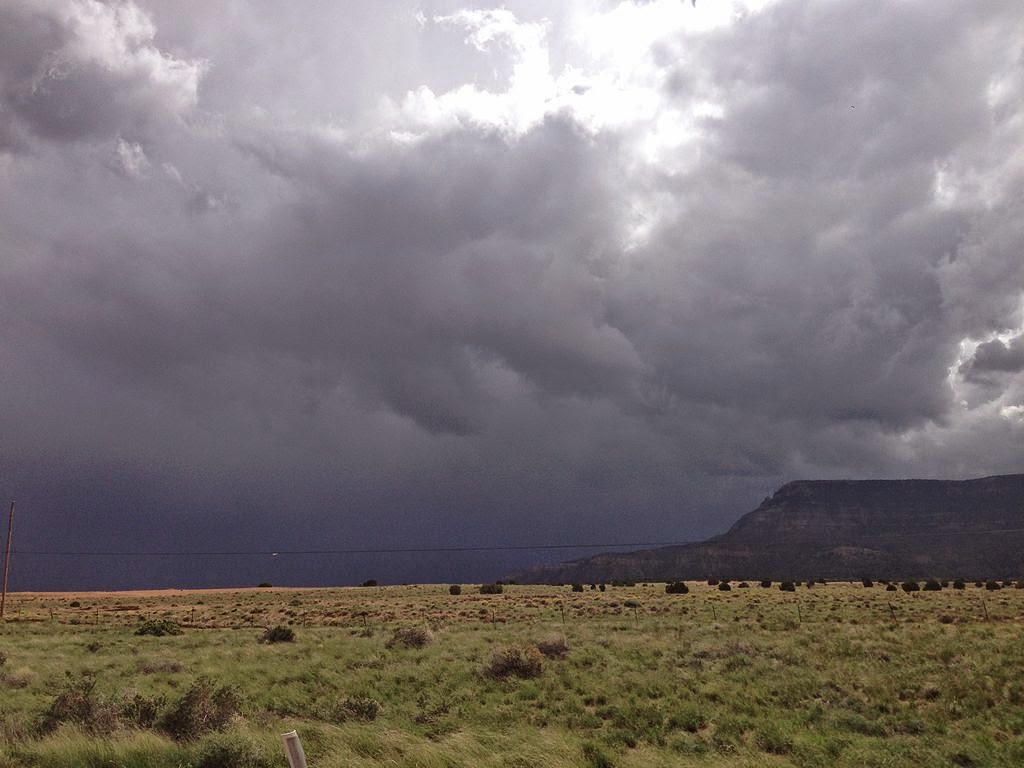
A thunderstom of Black Mesa, near Kayenda, Arizona. Shot by Famartin, Wikimedia Commns, under the Creative Commons Attribution-Share Alike 3.0 Unported license

Friday, August 1, 2014

Kyrgyzstan revives pre-Soviet traditions for climate adaptation

Sophie Yeo in Responding to Climate Change: In early April, the villagers of Samarkandek, Kyrgyzstan, react with a curious enthusiasm to the sight of apricots coming into bloom. As soon as the flowers emerge, old and young gather for the Festival of Blooming Apricots to recite poetry, sing and dance in celebration of the oncoming harvest. ...

The festival began four years ago, inaugurated by Akylbek Kasymov, founder of environmental charity Foundation Bio Muras in Kyrgyzstan. It is more than an attempt at cultural revival. Kasymov hoped that, by bringing together elders with younger generations, they would be able to pass on their old traditions, once practised by pastoral communities, but now fading fast.

The Kyrgyz people have started to realise that such skills, now all but vanished from their collective memory, could prove vital in helping them deal with the changes that climate change is set to impose on their landscape and their way of life.

...Indigenous knowledge spans an array of themes, which evolved to make nomadic life in Kyrgyzstan’s mountainous landscape more comfortable, including skills such as building and decorating a yurt, raising cattle on natural fodder, and traditional recipes such as kuurma tea. But on top of that, it also includes knowledge on how to live sustainably and deal with the vagaries of the earth and weather: skills such as grafting, planting and caring for livestock....

The Alai Mountains in Kyrgyzstan, shot by Nihongarden , Wikimedia Commons, under the Creative Commons 3.0 license

Friday, July 25, 2014

Forest rights offer major opportunity to counter climate change

Carey L. Biron in IPS: The international community is failing to take advantage of a potent opportunity to counter climate change by strengthening local land tenure rights and laws worldwide, new data suggests.

In what researchers say is the most detailed study on the issue to date, new analysis suggests that in areas formally overseen by local communities, deforestation rates are dozens to hundreds of times lower than in areas overseen by governments or private entities. Anywhere from 10 to 20 percent of worldwide greenhouse gas emissions are attributed to deforestation each year.

The findings were released Thursday by the World Resources Institute, a think tank [in Washington] , and the Rights and Resources Initiative, a global network that focuses on forest tenure.

“This approach to mitigating climate change has long been undervalued,” a report detailing the analysis states. “[G]overnments, donors, and other climate change stakeholders tend to ignore or marginalize the enormous contribution to mitigating climate change that expanding and strengthening communities’ forest rights can make.”

Researchers were able to comb through high-definition satellite imagery and correlate findings on deforestation rates with data on differing tenure approaches in 14 developing countries considered heavily forested. Those areas with significant forest rights vested in local communities were found to be far more successful at slowing forest clearing, including the incursion of settlers and mining companies.

In Guatemala and Brazil, strong local tenure resulted in deforestation rates 11 to 20 times lower than outside of formally recognised community forests. In parts of the Mexican Yucatan the findings were even starker – 350 times lower....

Misol-Há Waterfall in Mexico, shot by Jorge Mori, Wikimedia Commons,  under the Creative Commons Attribution-Share Alike 3.0 Unported license

Wednesday, July 16, 2014

Indigenous mountain farmers unite on climate change

Bhrikuti Rai in SciDev.net: Farmers from 25 indigenous mountain communities in ten countries have come together to share traditional knowledge that could help them to mitigate climate change and to lobby governments for greater recognition of their unique knowledge.

The International Network of Mountain Indigenous Peoples was formed at a workshop in Bhutan last month (26 May-1 June). It includes communities from Bhutan, China, India, Kyrgyzstan, Papua New Guinea, Peru, the Philippines, Taiwan, Tajikistan and Thailand.

Member communities from Bhutan, China and Peru had already agreed to exchange seeds at a meeting held in Peru earlier this year (26 April-2 May). The agreement was extended to the other members at the most recent meeting.

The farmers say the network will enable communities to access new seed varieties that are more resilient to pests and drought; will help increase their crop diversity; and will reduce their dependence on corporate-owned seeds.

“Learning about experiences and strategies from other farming communities — based on local knowledge systems — through this network reaffirms people’s beliefs and faith in their own systems, values and traditional knowledge,” says Reetu Sogani, an activist who works with the International Institute for Environment and Development’s (IIED’s) Smallholder Innovation for Resilience project, which was involved in the workshop....

Terrace farms on Bolivia's Cordillera Central, shot by Christopher Walker, Wikimedia Commons via Flickr, under the Creative Commons Attribution 2.0 Generic license 

Saturday, July 5, 2014

Ecuadoran indigenous march to protest water policy

Space Daily via AFP: Scores of indigenous demonstrators marched on Quito Tuesday, to protest against President Rafael Correa's government and losing control of water on their traditional lands.

Lawmakers in Congress last week approved a new law that gives the state exclusive control over all water resources. It spelled a de facto end to indigenous councils that administered water resources on traditional lands.

"We are marching against (government) policies that go against the Ecuadoran people, ... namely approval of the water management law," said Vicenta Minda, an indigenous Saraguro woman who marched from the south for 10 days.

Indigenous groups say this is the government's way of making sure mining interests get what they want; many indigenous communities have opposed mining in some areas where the water they fish and drink was polluted by potentially toxic chemicals used in mining.

"We are the ones who built our communal water systems, so we should be the ones who decide on rights ... Now the state should be in charge? Faced with that we are saying: civil disobedience," added Carlos Perez, who leads Ecuarunari, an association of indigenous groups from the highlands. Ecuador has other indigenous groups in its Amazon lowlands and coast...

A mountain lagoon in Ecuador, shot by Ekem, Wikimedia Commons, under the Creative Commons 3.0 license

Thursday, July 3, 2014

World Bank and UN carbon offset scheme 'complicit' in genocidal land grabs - NGOs

An appalling crime covered by Nafez Ahmed in the Guardian (UK): Between 2000 and 2010, a total of 500 million acres of land in Asia, Africa, Latin America and the Caribbean was acquired or negotiated under deals brokered on behalf of foreign governments or transnational corporations.

...The concentration of ownership of the world's farmland in the hands of powerful investors and corporations is rapidly accelerating, driven by resource scarcity and, thus, rising prices. According to a new report by the US land rights organisation Grain: "The powerful demands of food and energy industries are shifting farmland and water away from direct local food production to the production of commodities for industrial processing."

Less known factors, however, include 'conservation' and 'carbon offsetting.' In west Kenya, as the UK NGO Forest Peoples Programme (FPP) reported, over a thousand homes had been torched by the government's Kenya Forest Service (KFS) to forcibly evict the 15,000 strong Sengwer indigenous people from their ancestral homes in the Embobut forest and the Cherangany Hills.

Since 2007, successive Kenyan governments have threatened Sengwer communities in the Embobut forest with eviction. A deadline for residents to leave the forest expired in early January, prompting the most recent spate of violence. The pretext for the eviction is that the indigenous Sengwer – labelled wrongly as 'squatters' – are responsible for the accelerating degradation of the forest.

...The devastating plight of Kenya's indigenous peoples is symptomatic of the flawed approach to conservation on the part of international agencies.

...A damning new report from the Rights and Resources Initiative (RRI) based in Washington DC thus warns that the UN and World Bank approach to REDD is paving the way for large-scale "carbon grabs" by foreign governments and investors, putting at risk the land rights, livelihoods and lives of indigenous communities....

Mt. Elgon Forest in Kenya, shot by Kristina Just, Wikimedia Commons via Flickr, under the Creative Commons 2.0 license

Friday, June 27, 2014

India and China farmers back new climate adaptation alliance

Sophie Yeo in Responding to Climate Change:  A network of 25 indigenous communities from 10 countries has come together to share traditional knowledge on how to adapt to climate change. Countries in the network include China, Peru, Bhutan, Kyrgyzstan, India, Tajikistan and Papua New Guinea.

Seed sharing between the groups will ensure that farmers grow crops that are resilient and diverse enough to withstand major damage in the face of unusual weather. “We are from different communities but we have similar problems relating to climate change,” said Akylbek Kasymov, an economist at Kyrgyz National Agrarian University, and leader of the Kyrgyz delegation at a workshop for indigenous people in Bhutan.

The International Network of Mountain Indigenous People was created by communities from mountainous regions, speaking 22 languages between them, to swap ideas, information, and even seeds, so they can be resilient in the face of a changing climate.

These mountainous regions will face similar problems as the impacts of climate change become more severe, threatening the livelihoods and traditions of their indigenous communities. These problems include melting glaciers, changes in rainfall patters, failing crops and more pests and diseases.

For instance, in Papua New Guinea, agriculture is the largest economic activity, and its natural climate means that most of its crops are fed by the rain. At a recent meeting in Bhutan, Papuan farmers highlighted how changing rainfall patterns mean that the islanders have a growing need for irrigation to keep their crops alive. Local knowledge of this system is lacking. Through the network, indigenous communities will be able to help each other by sharing this kind of information....

Tajik craft customs, from an 1860 Russian image

Thursday, May 29, 2014

Melding science and tradition to tackle climate change

IRIN: In the latest of several partnerships between tradition and modern science aimed at improving resilience to climate change, pastoralists and meteorologists in Tanzania are working together to produce weather forecasts better suited to farmers. The hope is that by drawing from both indigenous knowledge and contemporary weather forecasting techniques, crop yields could be increased.

“We wanted to see if the two can complement or supplement each other,” Isaac Yonah, a senior officer coordinating community meetings employed by the Tanzania Meteorological Agency (TMA), told IRIN by phone. Using traditional indicators such as the movement of red ants, the flowering of mango and other trees, the migration of termites and patterns and colours in the sky, farmers in Sakala village of Ngorongoro District compare their two-weekly forecasts with those released by the TMA.

“This is done… to validate how accurate their forecast is and to come up with a consensus [forecast]. In the last three seasons, more than 80 percent accuracy in the findings has been witnessed,” said Yonah. The project is a partnership between TMA, Hakikazi Catalyst (a non-profit organization), and the UK-based International Institute for Environment and Development (IIED).

“Strengthening such practices could enhance the resilience of communities which are most vulnerable to climate change. Upscaling the projects will see the knowledge gap between traditional and scientific bridged,” said Yonah....

Red ant shot by William Cho, Wikimedia Commons via Flickr, under the Creative Commons Attribution-Share Alike 2.0 Generic license 

Friday, April 4, 2014

Indigenous societies' 'first contact' typically brings collapse, but rebounds are possible

A press release from the Santa Fe Institute: It was disastrous when Europeans first arrived in what would become Brazil -- 95 percent of its population, the majority of its tribes, and essentially all of its urban and agricultural infrastructure vanished. The experiences of Brazil's indigenous societies mirror those of other indigenous peoples following "first contact."

A new study of Brazil's indigenous societies led by SFI researcher Marcus Hamilton paints a grim picture of their experiences, but also offers a glimmer of hope to those seeking ways to preserve indigenous societies.

Even among the indigenous societies contacted in just the last 50 years, says Hamilton, “all of them went through a collapse, and for the majority of them it was disastrous,” with disease and violence responsible in most cases, and with lasting detrimental effects. “That’s going on today -- right now.”

Brazil is “a tragic natural experiment,” Hamilton says: several hundred native tribes contacted by outsiders remain, according to Instituto Socioambiental, a non-governmental organization that reports census data on 238 of those societies going back a half-century or more. That volume of data makes possible a detailed analysis of the health and prospects of the surviving contacted -- and uncontacted -- societies, an analysis that wouldn’t be possible any where else in the world.

Using a method called population viability analysis, the researchers found that contact by outsiders is typically catastrophic, yet survivable. While first contacts in Brazil led to population declines of 43 percent on average, that decline bottomed out an average of eight or nine years after contact, following which population numbers grew as much as four percent a year -- about as much as possible. Projecting those results into the future suggests that contacted and as-yet uncontacted populations could recover from a low of just 100 individuals....

A 1779 engraving by John Webber of riests traveling across Kealakekua bay for first contact rituals. Each helmet is a gourd, with foliage and tapa strip decoration. A feather surrounded akua is in the arms of the priest at the center of the engraving. 

Tuesday, April 1, 2014

Food insecurity a growing challenge in Canada's northern and remote Aboriginal communities

Seed Daily via SPX: A new expert panel report on food security in Northern Canada, has found that food insecurity among northern Aboriginal peoples requires urgent attention in order to mitigate impacts on health and well-being. Aboriginal Food Security in Northern Canada: An Assessment of the State of Knowledge, released by the Council of Canadian Academies, addresses the diversity of experience that northern First Nations, Inuit, and Metis households and communities have with food insecurity.

Aboriginal households across Canada experience food insecurity at a rate more than double that of non-Aboriginal households (27% vs. 12%, respectively). Recent data indicate that Canadian households with children have a higher prevalence of food insecurity than households without children.

A 2007-2008 survey indicated that nearly 70% of Inuit preschoolers aged three to five lived in food insecure households, and 56% lived in households with child-specific food insecurity. Preliminary evidence also indicates that more women than men are affected. The Panel concluded that lasting solutions require collaboration and the continued involvement of those most affected by food insecurity: people living in the North.

"To fully understand the issue of food security, consideration must be given to the many factors that influence life in the North, such as environmental change, culture, governance, and economies," said Dr. Harriet Kuhnlein, Chair of the Expert Panel. There are no silver-bullet solutions - that is why cooperation among all the key actors including local communities, governments, businesses and institutions is essential....

Photo by that incomparable photographer of the Arctic, Ansgar Walk, Wikimedia Commons, under the Creative Commons Attribution-Share Alike 3.0 Unported license

Friday, March 7, 2014

Reef fate in hands of chiefs and researchers — for now

Jan Piotrowski in SciDev.net: Trust and strong relationships between researchers and traditional tribal leaders of small pacific islands allows for quick and effective implementation of science-based strategies that slow the decline of coral reefs, an international conference has heard.

Coral reefs recovered far quicker when scientists worked directly with leaders of local communities — rather than national governments — on changing the damaging land-use practices that pollute coastal waters, said Robert Richmond, a professor of marine biology at the University of Hawaii, United States.

...But these strategies can only be a stopgap as the rising sea levels, water temperatures and acidification — which could spell the end for many reef ecosystems — will need to be addressed by an international climate change agreement, he said.

For local populations dependent on ever-diminishing coral reefs for survival, conservation laws take too long to devise, and are difficult to enforce and monitor in remote regions, Richmond tells SciDev.Net.

Local chiefs have the ability to quickly change damaging practices but researchers must first work to build trust before their advice will be considered, he adds. “Many times, the local level is much more efficient than national governance. Working at a local level means communities can act immediately,” Richmond says....

Hawaii's Pearl and Hermes atoll, US Fish and Wildlife photo

Thursday, February 6, 2014

After slowdown, global fight for land rights at tipping point

Carey L. Biron in IPS: Global trends towards a strengthening of legal rights over land for local and indigenous communities appear to have slowed significantly in recent years, leading some analysts to warn that the fight for local control over forests has reached an inflection point with a new danger of backtracking on previous progress.

The past five years have seen less than 20 percent of global forestland put under community control compared to the previous half-dozen years, according to new research released Wednesday by the Rights and Resources Initiative (RRI), a Washington-based coalition of 140 international organisations. Further, the group says that far fewer legal safeguards were put in place during this latter period, while those laws that have been passed have been weaker.

 “If private companies and governments from the developed countries don’t weigh in, all of this progress could be lost – this could be it,” Andy White, RRI’s coordinator, told IPS. “Even though there’s a lot of talk on this issue right now, no one is really investing – not the donors, not the big companies, not the developed country governments. No one is putting money behind the words to help developing countries to do the mapping, the registries, the consultations that will be required to get this done.”

The slowdown comes despite a significant uptick in the public discussion over land and indigenous rights, with multinational corporations, national courts and Western donors increasingly acknowledging the issue’s importance and pledging to strengthen safeguards for forest tenure. Development workers say this disconnect between words and actions highlights both a lack of prioritisation on land rights and, given the rising rhetoric, an opportunity for future action....

Aztec drums in the 16th century Florentine Codex

Thursday, January 16, 2014

Peru blocks plans for new indigenous reserve as oil production starts

David Hill in the "Andes to the Amazon" blog in the Guardian (UK): Two key Peruvian state institutions are blocking plans to establish a reserve for indigenous people living in "voluntary isolation" (IPVI) between the Napo and Tigre rivers in the Amazon rainforest. Opposition to the proposal was condemned by national indigenous organisation AIDESEP after a meeting, held in December, of a cross-sector government commission set up to create such reserves.

In June last year Peru's vice-ministry of inter-culturality (VMI), the state entity responsible for indigenous peoples, officially recognised the existence of IPVI in the Napo-Tigre region and supported the proposal to create the reserve. According to the VMI's memo 190-2013:

This communiqué gives favourable qualification for the recognition of indigenous peoples in isolation, probably related to the Arabela, Iquito, Taushiro, Zápara, Waorani and Abirija peoples, and the categorisation of the Curaray, Napo, Arabela, Nashiño, Pucacuro, Tigre and Tributaries' Indigenous Reserve, details of which are in the attached documentation.

Memo 190 was sent by the then vice-minister of inter-culturality, Paulo Vilca Arpasi, to the then president of the cross-sector commission, Hernán Coronado Chuecas, together with 357 pages of reports, maps, letters and sworn testimonies principally supporting the IPVI's existence.

However, the proposed reserve is almost entirely overlapped by oil concessions including, most significantly, lot 39, run by Repsol, and lot 67, run by London- and Paris-based Perenco together with Vietnamese state oil and gas company PetroVietnam....

Bora people in Peru, shot by Jorge G. Mori, public domain 

Thursday, December 12, 2013

Ecuador's government shuts down indigenous rights organization over oil battle

Jeremy Hance in Mongabay: Last Wednesday, the government of Ecuador shutdown the indigenous rights NGO, Fundación Pachamama, in Quito over the group's opposition to oil drilling in indigenous areas. More than a dozen government officials showed up at Pachamama's office with a resolution by the Ministry of Environment that officially dissolved the organization, the first such moved by the government which in June passed an Executive Decree that tightened governmental oversight of the country's NGOs.

The Ecuadorean government, under Rafael Correa, contends that Pachamama was involved in physically harassing an ambassador from Chile and a businessman following a recent presentation on oil concession in the Amazon. But Pachamma denies the allegations, instead accusing the government of violence.

"We reject violent demonstrations that come from any sector. We neither support nor engage in any violent act. We cannot be blamed for acts in which we have not participated," Maria Belén Páez, the president of Fundación Pachamama, said in a statement. "For our work in defending rights, we have been attacked publicly and violently by those who hold political power, and this has been widely disseminated by the media under government control. That is violence. It is also violence to dissolve an organization unexpectedly, without legal cause, without due process that guarantees self-defense."

Pachamama says it will take its case to court and file an appeal to the InterAmerican Commission on Human Rights. Pachamama, which is the name of an indigenous Earth goddess, works to empower Amazonian communities...

A view in Ecuador's Yasuni area, shot by Geoff Gallice, Wikimedia Commons via Flickr, under the Creative Commons Attribution 2.0 Generic license

Tuesday, November 12, 2013

Indigenous leaders abandon faith in UN to find climate solution

Douglas Fischer in the Daily Climate: Tribal elders from the United States, Greenland and Mexico spoke of the need for individual action rather than government edicts, and of the difficulty – and urgency – of replacing economic questions with moral ones.

As United Nations delegates gather in Warsaw in the 19th annual effort to craft a global climate treaty, indigenous leaders from across North America met half a world away and offered a prophecy: The solution to climate change will never come via the UN talks.

They spoke of grandfathers and grandmothers, of battles with alcoholism and disenfranchisement, of a world that's changing around them and a need to do something for their grandchildren. Most of all, though, they talked of a need for a new direction in an increasingly unsustainable world.

Organized by the Bozeman, Mont.- based American Indian Institute, the gathering drew about 65 people from across North America. Here amid the hills and mesas that painter Georgia O'Keeffe made famous, these elders presented a different palette with which to look at environmental woes. They placed little faith in the weighty United Nations process that opened Monday and will draw thousands of people to Warsaw over the next two weeks to try to find a way to stem emissions of greenhouse gases.

"I have nothing to say to them," said Angaangaq, an Inuk known here as Uncle and who since 1975 has been "runner" for his elders in Greenland, spreading their words worldwide. "Not one of those United Nations people responsible has ever changed."

...The dismissal of the UN was all the more striking given that it came from those who, in the 1970s, spearheaded the quest to have the world body recognize indigenous rights.  Forty years later, they have moved on. ...

Shot of the mesa at Ghost Ranch in New Mexico by Brian Thomas, released under the Creative Commons Attribution-Share Alike 2.0 Generic license

Monday, November 4, 2013

Forest people ‘can gather carbon data’

Alex Kirby in Climate News Network: You don’t have to be a sophisticated scientist equipped with all the latest gizmos in order to work out just how effective a particular forest is as a carbon sink, a critical way of soaking up greenhouse gases

The job, researchers believe, can be done just as accurately by the people who live in the forests, most of whom probably have neither modern instruments nor scientific training. And the forests themselves will probably gain as well, because the local people will have more reason to feel they are buying into the trees’ conservation and so will have an incentive to protect them and work with conservationists from outside the forests.

The study, Community Monitoring for REDD+: International Promises and Field Realities, was published in a special issue of the journal Ecology and Society and was carried out by researchers at the Nairobi-based World Agroforestry Centre (ICRAF) and colleagues from Europe and south-east Asia.

It is on the agenda at the Oslo Redd Exchange, which aims to improve the workings of the UN’s Redd+ programme (Reducing Emissions from Deforestation and Forest Degradation). The team studied some of south-east Asia’s most complex, carbon-rich forests: lowland forest in Indonesia, mountain rainforest in China and monsoon forest in Laos and Vietnam....

River, village and forest. Puncak, West Java, Indonesia. Shot by What's in a name..., Wikimedia Commons via Flickr, under the Creative Commons Attribution 2.0 Generic license

Tuesday, October 8, 2013

Climate change concerns raised for Māori health and economy

Michael Sergel in Pacific Scoop (New Zealand): Climate change was top of the agenda at the Pacific Islands Forum last month – and it is an issue that strikes at the heart of the traditions of tikanga Māori across Aotearoa.

More than 10 years of research by Taihoro Nukurangi, the National Institute of Water and Atmospheric Research, has found the effects of climate change will particularly affect the fishery, agriculture and forestry models that are core to the Māori economy and iwi tradition.

The institute conducted extensive hui consultation with iwi and government agencies on what could be an extremely important issue for the future of Māori society.

University of Auckland Te Kupenga Hauora Māori researcher Dr Rhys Jones (Ngāti Kahungunu) has also studied the potential impact of climate change – focusing on the impact on hauora, health and wellbeing.

“[Aotearoa] will be relatively insulated from the effects of climate change compared to other Pacific countries – but any impact will be borne disproportionately by Māori, Pacific Islanders and lower socio-economic groups,” he explained.

Children were particularly vulnerable to the effects of climate change, he claimed. “They are smaller, less able to cope with heat extremes and natural disasters, and spend more time outdoors – and that puts them at greater risk.”...

Tiki shot by Abaconda Management Group, Wikimedia Commons via Flickr, under the Creative Commons Attribution-Share Alike 2.0 Generic license