Showing posts with label rights. Show all posts

Wednesday, December 10, 2014

Black Mesa mines: Native Americans demand return of their ancestors' bones

Leslie Macmillan in the Guardian (UK): In 1967 the Peabody coal company came to the Navajo and Hopi reservations in northern Arizona and Utah to excavate a strip mine – but the land it leased from the tribes was on an ancient tribal burial ground. So, as required by law, it hired archeologists and for the next 17 years a dig known as the Black Mesa archeological project – the largest in North American history – unearthed more than one million artefacts, including the remains of 200 Native Americans.

Now the bones and artefacts are at the centre of a debate between tribes people who say ancestral remains and archeological ruins have been desecrated, and a coal company and government officials who are planning a new dig.

Native American groups and the Sierra Club are suing the US government to protect ancient Indian burial sites as one of the world’s biggest coal companies, Peabody, seeks a lifetime mining permit for the land it leases from the tribes. “I am incensed that my ancestors were dug up, ground up and send off to universities to be studied,” said Vernon Masayesva, a plaintiff and former Hopi tribal chairman.

Peabody says it has taken good care of the artefacts and bones. The collection is curated “with the express wishes of both tribes” and “in compliance with federal law,” said Beth Sutton, a company spokesperson.

But a report by the Army Corps of Engineers, which surveyed the collection early last decade at the University of Illinois, where it is housed, found the curation to be “substandard in every respect”. Rodents and spiders “were a problem”, according to the report, which notes that facilities had been broken into and artefacts were missing.

What’s more, Alan Downer, a former historical preservation officer for the Navajo Nation, said the tribe had never authorised any remains to be loaned to a professor, Debra L Martin, who teaches at the University of Nevada at Las Vegas. He said he was “shocked to find out” about eight years ago, that she had had the bones since 1980...

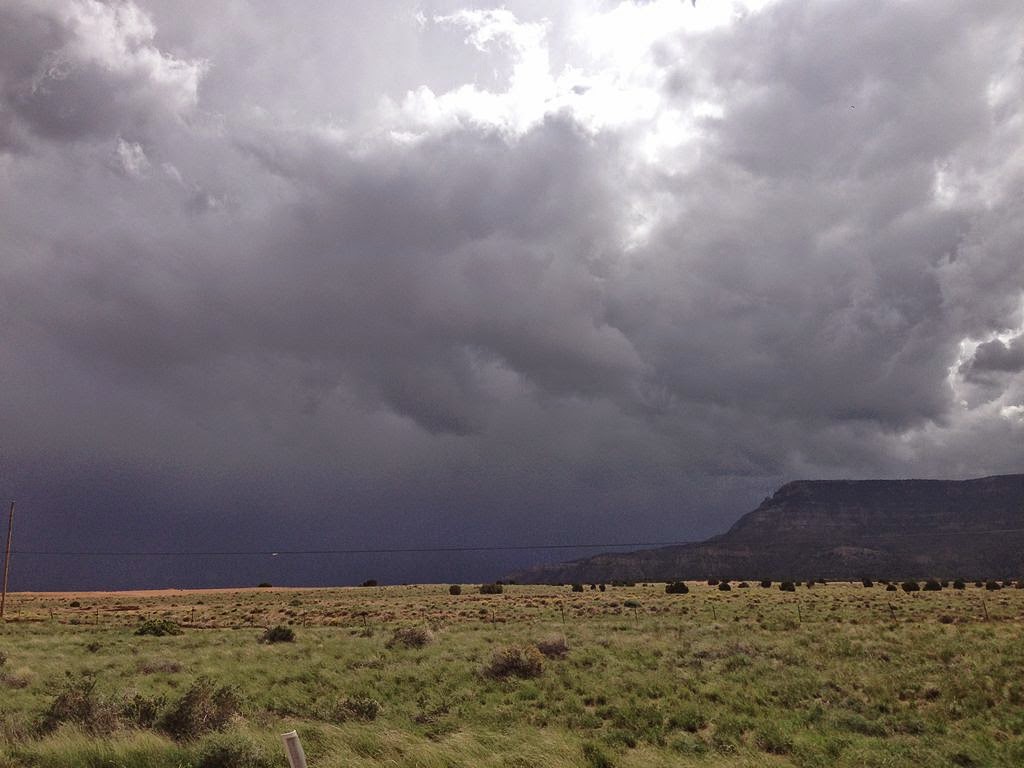
A thunderstom of Black Mesa, near Kayenda, Arizona. Shot by Famartin, Wikimedia Commns, under the Creative Commons Attribution-Share Alike 3.0 Unported license

Tuesday, April 29, 2014

Technology praised for assisting land tenure reform

Arthur Allen  SciDev.net: Rapid technological changes are opening new frontiers in land tenure reform, a recent World Bank conference has heard, but some land tenure experts and community activists are sceptical about how much these technologies will help development.

Geographic information, obtained from satellites, drones, databases and other sources such as traditional surveys and presented in computerised form, enables governments, companies and communities to rapidly access information about land ownership, boundaries and value that may help expand socioeconomic development, some speakers said.

“If property rights are not clearly defined, you have no basis for sustainable development,” Rexford Ahene, a World Bank consultant and an economist at Lafayette College, United States, told SciDev.Net, reflecting on the bank’s interest in land administration. The 2014 Land and Poverty Conference, organised by the bank, was held in Washington DC, United States, last month (24-27 March).

Several countries presented reports about their progress in registering land and creating title deeds and land ownership maps. Rwanda demarcated 10.4 million plots — its entire landmass — in a three-year project that ended in 2012. In Indonesia, a US$333 million project, using drones and satellite data, began last year to demarcate and list the land titles for a pilot area. Land registrations also help expand market-based economies and give governments a clearer picture of their tax base, Ahene told SciDev.Net.

Rwanda, for example, expanded its annual land tax income from two to ten billion Rwandan francs (around US$2.9 million to US$14.4 million) between 2011 and 2013. About one per cent of Rwandan land is now bought and sold each year, and title registration is facilitating economic activity, said Thierry Hoza Ngoga, manager of the Land Technical Operations Division within the Rwanda Natural Resources Authority....

A NASA image of Rwanda (with yellow boundary added)

Thursday, March 27, 2014

African women push for equality in land and resource rights

Elias Ntungwe Ngalame at the Thomson Reuters Foundation: ....[M]illions of female African farmers ... are disadvantaged by cultural practices and laws that deny them equal access to land. But African women’s rights activists are intensifying their efforts to push governments to speed up land reform processes and establish clear legislation securing women’s rights to own, access and control land and other natural resources.

According to Gregory Muluh, coordinator of the Grassfield Project, a government initiative assisting women farmers in Cameroon’s northwest, the country still has no law that protects land tenure for women.

“Even if people know that refusing women the right to own land is wrong, there is nowhere to complain, and women end up swallowing a bitter pill,” Muluh told Thomson Reuters Foundation during a visit to the Grassfield Project last year. “Instituting a legal provision to safeguard the rights of women to land ownership is imperative if we really want them to contribute fully to development.”

The African Women's Network for Community Management of Forests (REFACOF), an international NGO, believes only reforms that include legal safeguards giving women equal say in decisions made by customary and state authorities on managing land and forest resources will boost gender equality on the continent.

“We know that wherever land rights are being ignored, women are indisputably the most affected. Banding together and raising awareness of these issues is the first step toward ensuring all women’s rights are recognised,” Cécile Ndjebet, president of REFACOF, told Thomson Reuters Foundation....

A farmer at the women’s agricultural cooperative of Walikaly village in Siguiri Prefecture, Guinea. Shot by Laura Lartigue for USAID

Thursday, February 6, 2014

After slowdown, global fight for land rights at tipping point

Carey L. Biron in IPS: Global trends towards a strengthening of legal rights over land for local and indigenous communities appear to have slowed significantly in recent years, leading some analysts to warn that the fight for local control over forests has reached an inflection point with a new danger of backtracking on previous progress.

The past five years have seen less than 20 percent of global forestland put under community control compared to the previous half-dozen years, according to new research released Wednesday by the Rights and Resources Initiative (RRI), a Washington-based coalition of 140 international organisations. Further, the group says that far fewer legal safeguards were put in place during this latter period, while those laws that have been passed have been weaker.

 “If private companies and governments from the developed countries don’t weigh in, all of this progress could be lost – this could be it,” Andy White, RRI’s coordinator, told IPS. “Even though there’s a lot of talk on this issue right now, no one is really investing – not the donors, not the big companies, not the developed country governments. No one is putting money behind the words to help developing countries to do the mapping, the registries, the consultations that will be required to get this done.”

The slowdown comes despite a significant uptick in the public discussion over land and indigenous rights, with multinational corporations, national courts and Western donors increasingly acknowledging the issue’s importance and pledging to strengthen safeguards for forest tenure. Development workers say this disconnect between words and actions highlights both a lack of prioritisation on land rights and, given the rising rhetoric, an opportunity for future action....

Aztec drums in the 16th century Florentine Codex

Sunday, October 13, 2013

Huye families in Rwanda given relocation deadline

Jean Pierre Bucyensenge in AllAfrica.com via the New Times (Rwanda): Authorities in Huye District have issued a directive to 44 households and business owners in Rwabuye neighbourhood on the outskirts of Huye town to relocate to safer areas.

The decision, which has been backed by the District Advisory Council, gives residents until the end of the month to relocate. The area, adjacent Rwabuye marshland, is prone to floods, Mayor Eugene Muzuka said.

He said the district has ruled out the possibility of compensating the residents, saying it's for their safety from disasters that they are being asked to move. "They have settled in a marshland, which is naturally not suitable for habitation," Muzuka said. "In addition, some businesses that use electricity, such us grinding mills, expose the locals to extreme risks of accidents in case of floods." However, he said the district will assist the most vulnerable residents to get new homes, while those in the 'middle class' will be given plots to start afresh. The rest are on their own.

Sources said concerned individuals in the area have been given relocation notices and that the affected and most vulnerable are likely to be moved to Tonga, in Ngoma Sector.

However, some residents said they will not relocate without compensation. Joas Rutangana, a resident, said he is worried of relocating without consideration of his property. "If they decide to enforce the directive, it means they will have decided to ignore our rights [to these properties] and we will then become homeless," Rutangana said....

Thursday, September 26, 2013

Climate, human rights key to new development goals

Liz Ford in the Guardian (UK): Decisions on what should be included in future development goals must be accompanied by a robust agreement on climate change and a stronger emphasis on human rights, according to the former Irish president Mary Robinson.

Robinson, a human rights campaigner and founder of the Mary Robinson Foundation for Climate Justice, said the two major concerns ahead of 2015, when the millennium development goals (MDGs) expire, are creating equitable sustainable development goals and signing a global agreement that would limit global warming to 2C.

"The serious urgency between now and 2015 is to achieve a global agreement on the sustainable development goals and a robust climate agreement to stay below 2 degrees celsius, or preferably 1.5 degrees celsius," Robinson told the Guardian between meetings at the UN general assembly (UNGA) on Wednesday. Robinson said framing future universal development goals on the principles of human rights, which member states agreed this week, could make a big difference to people's lives.

"When the MDGs were developed, the idea was to keep them simple and not to complicate them. We didn't do as well as we should have. Human rights is about targeting the very vulnerable … making governments more accountable and [ensuring] the participation by people on how goals will be implemented.

"The MDGs did give us goals that governments and civil society and business have worked to, and now we realise they can be much more effective if we have some other issues [included]."...

Mary Robinson at the WEF, shot by World Economic Forum, Wikimedia Commons via Flickr, under the Creative Commons Attribution-Share Alike 2.0 Generic license

Friday, August 9, 2013

Killings of Brazil's indigenous Indians highlight tensions of land disputes

Jonathan Watts in the Guardian (UK): Celso Rodrigues was walking by a river near his home in Mato Grosso do Sul, when he was ambushed by a gunman in a balaclava, shot with a pistol and then finished off with a rifle. It might have been just another killing in Brazil, which has one of the world's highest murder rates. But Rodrigues's case has attracted international attention because he was a member of the Guarani ethnic group, which is at the heart of a fierce national dispute over indigenous rights.

In recent months, the national guard has been dispatched, a senior official has resigned and protests from both sides – tribes and landowners – have moved closer to the office of President Dilma Rousseff. ...The killings add to a rising death toll. According to a report this month from the Missionary Indigenous Council, 452 indigenous people were murdered between 2002 and 2010, sharply up on the 167 killed during the previous eight years. More people have died in Mato Grosso do Sul – a "wild west" border region that has been colonised by ranchers and soya growers – than in any other state.

Lawyers, anthropologists and indigenous rights campaigners have sent a letter to Rousseff, reminding her that the Indians are trying to take back land that was confiscated from them and distributed to powerful families during the dictatorship era.

...There are also growing fears that indigenous groups will be further marginalised because the government is reliant on ruralista (agriculture lobby) votes in Congress and is desperate to jumpstart an economy that slumped last year.

Conflicts have intensified in many other areas over land seizures for farms, mines and infrastructure projects. The Munduruku indigenous group in Para state has threatened to go to war over government plans to build a cascade of hydroelectric dams on the Tapajós river. Many tribes are opposing the construction of Brazil's biggest dam, the Belo Monte, on a site that has been occupied by protesters several times....

Kadiwéu woman from Nabileque River, Brazil. Photo from the Boggiani collection. Published in 1892/ Dr. R. Lehmann-Nitsche

Saturday, March 9, 2013

African governments giving land away quickly, recognizing land rights slowly

Seed Daily via SPX: While African governments are moving gradually towards protecting the land rights of rural people and indigenous communities, they are moving quickly to give away community forests and other lands for development. These conflicting choices are the focus of two new reports and a regional dialogue on forests, governance, and climate change.

"Governments across West and Central Africa are now in a bind and divided, with some ministries choosing to hand over natural resources to agribusiness and mining, and others seeking to protect the rights of their citizens and respect recent commitments," said Andy White, Coordinator of Rights and Resources Initiative (RRI).

"Which view will win out? There is a true need for speed in safeguarding these communities before all available land is handed out for the sake of 'quick-fix' development and exploitation."

"What communities on the ground in Cameroon see is no different from what is unfolding in other neighboring countries," said Samuel Nguiffo, Secretary General of the Center for Environment and Development (CED), Cameroon. "The slow pace of good intentions-the efforts to protect communities of subsistence farmers who have no wealth except for the land that they cultivate-has been overtaken by greed and power. Real economic development brings wealth to all, not just the elite."

RRI released two reports scrutinizing land transactions in West and Central Africa as well as the legal reforms that would protect the communities whose land is targeted by these transactions....

Monday, February 11, 2013

Investors who trample land rights risk bottom line

Seed Daily via AFP: Companies that invest in land and resources in emerging economies risk financial and public relations disasters if local inhabitants feel they are getting ripped off, consultants warned in a report last week. The report was released by a group known as the Munden Project and founder Lou Munden said: "When we looked at companies involved in international land acquisitions, we found that they experience an astonishing amount of financial damage."

This ranged from "massively increased operating costs, as much as 29 times above a normal baseline scenario, to outright abandonment of functional operations when they ignore pre-existing or customary local land rights."

The report was entitled "The Financial Risks of Insecure Land Tenure: An Investment View," and Munden emphasised that the financial risks were many and varied from delays in construction timetables to the expropriation of assets "following the loss of insurance coverage."

He commented that "even more troubling, the escalation of risk can be extremely rapid", and that conventional techniques for managing risk were inadequate for coping with insecure local land tenure.

Projects go wrong when local people feel they have not been adequately compensated and are being deprived of their land, jobs, water and forests.

This can lead to disruption of many kinds, from roadblocks to frequent acts of sabotage and other forms of violence....

A walk for land rights in Chambai, India, in 2009, shot by Ekta Parishad, Wikimedia Commons,  under the Creative Commons Attribution-Share Alike 3.0 Unported license

Tuesday, July 19, 2011

New studies suggest lack of meaningful land rights threaten Indonesian forests

EurekAlert: New research released today at a high-level forestry conference in Indonesia—opened by Vice President Boediono—suggests that Asia’s largest forest nation is paying a high price for failing to give local communities enforceable rights to contested forests, causing significant economic losses owing to its highly undervalued forestland, and leading it to lose out to regional competitors.

“There is ample evidence that communities are reliable managers of natural resources and forests, yet for some reason Indonesia has yet to embrace the concept of local tenure rights with any seriousness,” said Dominic Elson, an independent consultant for Trevaylor Consulting. “Until addressed, it will be hard to make more than token progress on the pressing issues facing the land use sector, such as deforestation, conflict and misguided investments that undermine development. This will not only have poor outcomes for the forests, biodiversity and climate change – it will also have profound implications for the economy and long-term social development.”

Elson’s paper is one of several presented this week in Lombok by the Rights and Resources Initiative, at a major international forestry conference co-organized by the Indonesian Ministry of Forestry, the International Tropical Timber Organization (ITTO) and RRI

….Previous research by RRI and others has shown that where Indigenous Peoples and forest communities are given control of forestlands, they are better stewards than governments. A study released on Wednesday by RRI confirms this finding, suggesting that granting greater control to local forest communities has been a vital element in the turn-around accomplished by China, South Korea, Vietnam and India, which in the last 20 years have had significant success with restoring vast areas of forest….

Kubu people in a cabin in the woods in the Upper Tebo, April 1921 photo by Tassilo Adam

Wednesday, July 13, 2011

Expanding land rights to boost growth, cut emissions

Amantha Perera in IPS: Indonesia has assumed a target to cut greenhouse gas emission rates by half and achieve an economic growth rate of seven percent by changing the way it manages its vast forest land, and giving greater control over land to local communities.

"We may at this juncture start hearing the term Community Managed Forest which is a more comprehensive concept," Kuntoro Mangkusubroto, from Indonesian President Susilo Bambang Yudhoyono’s special delivery unit, told a high-level international conference on forestry held in Lombok, 1060 km south of Jakarta.

At the conference the Indonesian government announced the new allocation of 89,000 hectares for community-managed forest areas. "Some say that we need more land allocated for this purpose, I see that as a step in the right direction," Mangkusubroto said.

The policy change towards community control of land is a major shift for a government that is still the largest owner of land. Of the 190 million hectares of land in the country, the Indonesian government controls 133 million hectares, or 70 percent.

Experts say that the government control of land is a colonial legacy, when the centre began to exert control over indigenous populations. "This is our chance to untangle our convoluted past and make a lasting difference," Mangkusubroto said.

"The state remains the predominant actor in the region’s forests, but the trend toward local control now emerging is incredibly important," said Andy White, coordinator for Rights and Resources Initiative, a U.S.-based land tenure advocacy body....

Between 1890 and 1905, a chopped forest and drainage canal under construction at a tobacco plantation in what is now Indonesia, from the Tropenmuseum Collection

Monday, June 20, 2011

Bolivia has granted our planet legal rights, but how to enforce them?

Gabrielle Banks in Pittsburgh Post-Gazette reports on a legal development that may not be so momentous now, but could be a harbinger: … Bolivia is taking a novel approach to natural stewardship by giving Mother Nature a voice and turning the American model on its head with a Bill of Rights for Mother Nature.

…Lawmakers in the landlocked country had a lot to tackle: the effects from generations of deforestation; unregulated silver, gold and tin mining; melting Andean glaciers and the iconic, evaporating Lake Titicaca. In 2010, Bolivia ranked 137th out of 163 countries in annual environmental performance index by Yale and Columbia universities. Iceland, Switzerland and Costa Rica lead the ranks while the U.S. is 61st, between Paraguay and Brazil.

Evo Morales Ayma, Bolivia's first indigenous president, called on world leaders at United Nations' climate talks to drastically reduce their carbon emissions in an effort to curb global warming. This spring, Mr. Morales, who is a socialist and former leader of the coca-growers union, got congressional approval for a Bill of Rights for Mother Earth, that grants nature the same rights and liberties as human beings and treats resources as blessings.
It says Mother Earth has the right to exist, continue life cycles and be free from human alteration, the right to pure water and clean air, the right to equilibrium, the right not to be polluted or have cellular structures modified and the right not to be affected by development that could impact the balance of ecosystems.

The government, in turn, must create policies that protect nature and communities, promote clean and sustainable resources and prevent climate change. It must defend Mother Earth from exploitation and commodification of its resources that would affect climate change. It must promote peace and encourage the elimination of nuclear, chemical and biological weapons and weapons of mass destruction. The ministry of Mother Nature will oversee enforcement…

Tuesday, April 20, 2010

Will REDD+ reduce rights of forest-dwellers?

Liz Kalaugher in Environmental Research Web: Over the last quarter-century, developing countries have begun to shift the management of their forests to a more local level. In many cases this has brought increased rights to local people, lower costs and better forest protection. But now, the uptake of large-scale REDD+ (Reducing Emissions from Deforestation and Forest Degradation) schemes to act against climate change could encourage governments to recentralize forest governance.

"This has clear implications for equity by potentially reducing local rights to forests," Ted Webb of the National University of Singapore told environmentalresearchweb. "It may also have important long-term implications for conservation because large-scale, centralized management has limitations to effectiveness and efficiency."

…"We found that nobody had really addressed the obvious tensions between the fact that massively funded REDD+ programmes focusing on forest conservation appeared to require heavy central government control, and that decentralization of forest governance represented the relinquishing of control by the governments to local levels," he said. "Emissions reductions can be achieved with protected areas but they are also needed outside protected areas, where decentralized management has been extensive in many countries."

Although centralized governance can protect forests and enhance regrowth, it's costly to enforce, limited to within-park boundaries and can cause resentment in excluded users, say the researchers. But a national approach appears essential for REDD+ schemes to enable reliable monitoring and reporting for carbon-accounting purposes and to ensure permanence….

Forest in Sai Yok National Park, Kanchanaburi, Thailand, shot by Ananda

Wednesday, March 10, 2010

Gender justice imperiled by climate change and disaster

Thalif Deen in IPS/TerraViva: The negative fallout from climate change is having a devastatingly lopsided impact on women compared to men, from higher death rates during natural disasters to heavier household and care burdens.

…Amy North, a researcher working on gender, education and global poverty reduction initiatives at the Institute of Education in the University of London, told IPS climate change is also exacerbating existing gender inequalities, with a devastating effect on the quality of life of poor women and girls. In many parts of the world, women and girls are responsible for collecting water and firewood.

…June Zeitlin, a former executive director of WEDO, has cited a study by the London School of Economics analysing disasters in 141 countries that provides decisive evidence that gender differences in deaths from natural disasters are directly linked to women's economic and social rights. That is, gender inequalities are magnified in disaster situations. So when women lack basic rights, more women than men will die from natural disasters.

…In an interview with IPS, North said that in East Africa - a region that is acutely feeling the effects of climate change, with widespread drought resulting in critical shortages of food and water - research suggests that increased poverty levels is having serious consequences for the education of girls.

In Kenya, participants in the Gender, Education and Global Poverty Reduction Initiatives project have noted that increased poverty associated with drought has affected school attendance, with girls being more likely to be withdrawn from school than boys. In neighbouring Uganda, the food crises associated with climate change have been linked to higher rates of early marriage for girls, as they are exchanged for dowry or bride price. These "famine marriages" - as they are called - not only lead to girls dropping out of school, but also make them vulnerable to sexually transmitted infections and related reproductive complications.

….Stefan Wallin, Finland's minister of culture and sport, told delegates last week that one of his country's "strong areas of emphasis" concerns decision-making processes on matters affecting climate change.…Finland, he said, has argued that climate targets are reachable only "if the knowledge and views of both women and men are included, and if both women and men are committed to the goals."…

Fulbe women in the East Province of Cameroon, shot by Elaine Pearson, Wikimedia Commons

Monday, June 1, 2009

Conference examines human-rights side of climate change

Vivian Luu in the Daily of the University of Washington: More than 40 legal experts gathered at the UW School of Law last week to look into how future laws and policies could affect victims of climate change. Legal scholars, leaders of non-governmental organizations (NGO) and policy makers convened for “Three Degrees: The Law of Climate Change and Human Rights Conference” to confront the humanitarian crisis that could come hand-in-hand with climate change. The conference aimed to influence policy makers who will attend the U.N. Climate Change Conference later this year in Copenhagen, Denmark.

Conference panelist Alex Steffen is founder of Worldchanging, an online publication about sustainability. He said that although environmental sustainability is a design and engineering problem, there is more to the issue. “Our lack of progress toward sustainability is entirely a political problem,” Steffen said.

…“First, we must educate ourselves about the impacts of climate change,” Robinson said. “Second, countries must take responsibility for their contribution to climate change.” UW atmospheric sciences professor David Battisti said climate change is also a human-rights issue because it could impact half of the world’s population….

A gavel, shot by Avjoska, Wikimedia Commons, under the Creative Commons Attribution 3.0 Unported License

Wednesday, September 24, 2008

Does nature have rights? Ecuador may say yes

The Guardian (UK): The South American republic of Ecuador will next week consider what many countries in the world would say is unthinkable. People will be asked to vote on Sunday on a new constitution that would give Ecuador's tropical forests, islands, rivers and air similar legal rights to those normally granted to humans. If they vote yes - and polls show that 56% are for and only 23% are against - then an already approved bill of rights for nature will be introduced, and new laws will change the legal status of nature from being simply property to being a right-bearing entity.

The proposed bill states: "Natural communities and ecosystems possess the unalienable right to exist, flourish and evolve within Ecuador. Those rights shall be self-executing, and it shall be the duty and right of all Ecuadorian governments, communities, and individuals to enforce those rights."

Thomas Linzey, a US lawyer who has helped to develop the new legal framework for nature, says: "The dominant form of environmental protection in industrialised countries is based on the regulatory system. Governments permit and legalise the discharge of certain amounts of toxics into the environment. As a form of environmental protection, it's not working. In the same way, compensation is measured in terms of that injury to a person or people. Under the new system, it will be measured according to damage to the ecosystem. The new system is, in essence, an attempt to codify sustainable development. The new laws would grant people the right to sue on behalf of an ecosystem, even if not actually injured themselves."

Until now, all legal frameworks have been anthropocentric, or people-based. To file an environmental lawsuit requires a person to provide evidence of personal injury. This can be extremely difficult. To provide a conclusive link, say, between a cancer and polluted drinking water is, legally speaking, virtually impossible….

Get off my lawn -- the law is on my side. So says this American saltwater crocodile. This photograph was taken at La Manzanilla, Jalisco State in Mexico, on the Pacific Coast, by Tomás Castelazo. Wikimedia Commons, under the Creative Commons Attribution ShareAlike 2.5 License