Showing posts with label algae. Show all posts

Sunday, April 12, 2015

Satellite eyes on threat to US freshwater

A press release from NASA: NASA has joined forces with the U.S. Environmental Protection Agency, National Oceanic and Atmospheric Administration, and U.S. Geological Survey to transform satellite data designed to probe ocean biology into information that will help protect the American public from harmful freshwater algal blooms.

Algal blooms are a worldwide environmental problem causing human and animal health risks, fish kills, and taste and odor in drinking water. In the United States, the cost of freshwater degraded by harmful algal blooms is estimated at $64 million annually. In August 2014, officials in Toledo, Ohio, banned the use of drinking water supplied to more than 400,000 residents after it was contaminated by an algal bloom in Lake Erie.

The new $3.6 million, multi-agency effort will use ocean color satellite data to develop an early warning indicator for toxic and nuisance algal blooms in freshwater systems a
nd an information distribution system to aid expedient public health advisories.

“The vantage point of space not only contributes to a better understanding of our home planet, it helps improve lives around the world,” said NASA Administrator Charles Bolden. “We’re excited to be putting NASA’s expertise in space and scientific exploration to work protecting public health and safety.”

Ocean color satellite data from NASA’s Aqua, the USGS-NASA Landsat, and the European Space Agency’s Sentinel-2 and -3 are currently available to scientists, but are not routinely processed and produced in formats that help state and local environmental and water quality managers. Through this project, satellite data on harmful algal blooms developed by the partner agencies will be converted to a format that stakeholders can use through mobile devices and web portals.

“Observations from space-based instruments are an ideal way to tackle this type of public health hazard because of their global coverage and ability to provide detailed information on material in the water, including algal blooms,” said Paula Bontempi of the Earth Science Division at NASA Headquarters in Washington....

A toxic algae bloom in Lake Erie in 2011, viewed by a NASA satellite

Sunday, March 1, 2015

Pollution is driving force behind growth of nuisance algal scums

A press release from the University of Nottingham: Potentially toxic microbes which pose a threat to our drinking water have undergone a dramatic population explosion over the last 200 years as a result of pollution, research involving experts from The University of Nottingham has found.

The study, published in the journal Ecology Letters, looked at more than 10
0 lakes in lowland and alpine areas of North America and Europe and found that populations of cyanobacteria — also known as blue-green algae — have significantly increased since the 1800s.

The research, conducted in collaboration with academics at McGill University in Canada and other collaborators, is the first study to show that a rise in the algae’s available nutrient sources nitrogen and phosphorus — commonly resulting from industrial fertilisers and sewage discharge — is the biggest potential culprit responsible for the increase in such a large number of lakes, across such a large geographical area. The study also found that climate change can exacerbate this problem, with water management challenges likely to increase in a future warmer world.ry

Most municipal water treatment plants do not regularly look for cyanobacterial toxins in the water supply. However, municipalities with a known history of blooms typical monitor their surface water supplies for cyanobacteria. When detected, the cells can be removed by adding chemicals that bind them together, so they can be separated out. Although this removes the cells, the cells may already have broken down releasing toxins into the water.

In addition, environmental costs associated with this alga were estimated to exceed $100 million per year in both the UK and Australia....

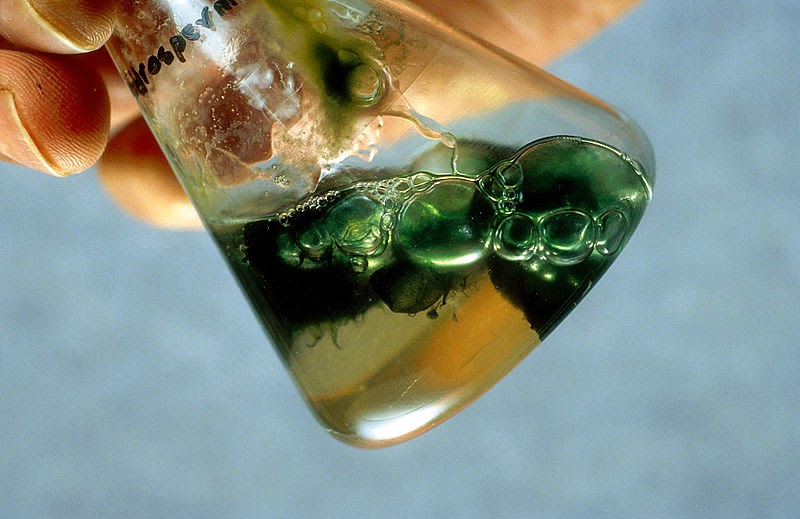
Cyanobacteria in a flask, from CSIRO, Wikimedia Commons, under the Creative Commons Attribution 3.0 Unported license

Monday, October 20, 2014

Lake Erie increasingly susceptible to large cyanobacteria blooms

A press release from the University of Michigan: Lake Erie has become increasingly susceptible to large blooms of toxin-producing cyanobacteria since 2002, potentially complicating efforts to rein in the problem in the wake of this year's Toledo drinking water crisis, according to a new study led by University of Michigan researchers.

Since the detection of the toxin microcystin left nearly half a million Ohio and Michigan residents without drinking water for several days in early August, discussions of ways to prevent a recurrence have largely focused on the need to reduce the amount of phosphorus fertilizer that washes off croplands and flows into western Lake Erie to trigger harmful cyanobacteria blooms.

In a study published online Oct. 8 in the journal Water Resources Research, scientists from U-M and the National Oceanic and Atmospheric Administration conclude that microcystin-producing cyanobacteria in Lake Erie are becoming more sensitive to phosphorus and that reductions may have to cut far deeper than recently proposed targets.

"Our results suggest that current phosphorus loading targets will be insufficient for reducing the intensity of cyanobacteria blooms to desired levels, so long as the lake remains in a heightened state of bloom susceptibility," said lead author Daniel Obenour, formerly of the U-M Water Center and now at North Carolina State University. Other authors are Don Scavia of U-M and Andrew Gronewold and Craig Stow of the National Oceanic and Atmospheric Administration.

...Though the total amount of phosphorus entering the lake seems to be the best predictor of bloom size, that variable alone doesn't fully explain the observed size increase during the study period examined by the team, 2002 to 2013....

NASA image of a toxic algae bloom in Lake Erie

Friday, August 22, 2014

Viruses take down massive algal blooms - and a whole lot of carbon dioxide

Scientific Blogging: ...Using a combination of satellite imagery and laboratory experiments, researchers have evidence showing that algae is sucking up climate-warming carbon dioxide from the atmosphere and sinking it to the bottom of the ocean.  And for that, we can thank one other thing people dislike: viruses.

Viruses infecting those algae are driving the life-and-death dynamics of the algae's blooms, even when all else stays essentially the same. According to results reported in Current Biology, a single North Atlantic algal bloom, about 30 kilometers in radius, converted 24,000 tons of carbon dioxide from the atmosphere into organic carbon - a process known as carbon fixation.

Two-thirds of that carbon turned over within a week as that bloom grew at a very rapid rate and then quickly met its demise. A closer look at those algae revealed high levels of specific viruses infecting their cells. To put that in context, Assaf Vardi of the Weizmann Institute of Science in Israel says that this patch of ocean fixes about as much carbon as an equivalent patch of rainforest and then almost immediately turns much of it over.

"This is, of course, only one patch out of numerous co-occurring patches in other parts of the Atlantic Ocean," adds Ilan Koren, also of the Weizmann Institute, not to mention those algal blooms that appear in other seasons and ecosystems. "While the impact that viruses have on the entire ecosystem was previously estimated to be very large, we provide the first approach to quantify their immense impact on open ocean blooms."

Important questions remain about the ultimate fate of all that carbon taken in by algal blooms, the researchers say. Much of it is probably recycled back to the atmosphere by bacteria. But it's also possible that the virus-infected algae release sticky sugars and lipids, leading their cells and the carbon within them to sink faster to the ocean floor. "If the latter scenario is true, it will have a profound impact [on] the efficiency of carbon dioxide 'pumping' from the atmosphere to the deep ocean," Vardi says. "This carbon will then have a better chance [of being] buried in the ocean sediment."...

An algal bloom off the Volga delta in the Caspian Sea, shot by NASA

Monday, August 4, 2014

Toxic algae contaminates Toledo’s water

Environment News Service: More than 400,000 residents of Toledo, Ohio’s fourth largest city, are without water following the detection of the toxin Microcystin in the public water system, caused by an algal bloom in the area.

On Saturday, Governor John Kasich, a Republican, declared a state of emergency for Lucas County, where Toledo is located, and neighboring Wood and Fulton counties. This declaration allows state government to maximize the use of its resources to support local authorities in addressing this situation. The state Emergency Operation Center was activated Saturday.

State and local officials are working together to arrange for drinking water to be shipped into the affected areas. Eleven water distribution sites at fire departments and schools are open today, the second day of the emergency, but residents must bring their own containers to most of them.

To date, 33,000 gallons of potable water have been produced by the Ohio National Guard, and 15,000 additional gallons in collapsible containers have been distributed along with 9,000 cases of water. Additional deliveries are arriving on a regular basis.

The American Red Cross of Northwest Ohio is activating volunteers to assist with bulk distribution of water. Water at retail stores has been restocked...

Toledo's skyline at Sunset, shot by Northern Magnolia, Wikimedia Commons, under the Creative Commons Attribution-Share Alike 3.0 Unported license 

Monday, May 27, 2013

US equipped to grow serious amounts of pond scum for fuel

Environmental Research Web: A new analysis shows that the nation's land and water resources could likely support the growth of enough algae to produce up to 25 billion gallons of algae-based fuel a year in the United States, one-twelfth of the country's yearly needs.

The findings come from an in-depth look at the water resources that would be needed to grow significant amounts of algae in large, specially built shallow ponds. The results were published in the May 7 issue of Environmental Science and Technology, published by the American Chemical Society.

"While there are many details still to be worked out, we don't see water issues as a deal breaker for the development of an algae biofuels industry in many areas of the country," said first author Erik Venteris of the Department of Energy's Pacific Northwest National Laboratory.

For the best places to produce algae for fuel, think hot, humid and wet. Especially promising are the Gulf Coast and the Southeastern seaboard. "The Gulf Coast offers a good combination of warm temperatures, low evaporation, access to an abundance of water, and plenty of fuel-processing facilities," said hydrologist Mark Wigmosta, the leader of the team that did the analysis.

Algae, it turns out, are plump with oil, and several research teams and companies are pursuing ways to improve the creation of biofuels based on algae — growing algae composed of more oil, creating algae that live longer and thrive in cooler temperatures, or devising new ways to separate out the useful oil from the rest of the algae....

Spirogyra shot by Bob Blaylock, Wikimedia Commons, under the Creative Commons Attribution-Share Alike 3.0 Unported license

Thursday, April 11, 2013

Extreme algal blooms: The new normal?

Space Daily: A research team, led by Carnegie's Anna Michalak, has determined that the 2011 record-breaking algal bloom in Lake Erie was triggered by long-term agricultural practices coupled with extreme precipitation, followed by weak lake circulation and warm temperatures. The team also predicts that, unless agricultural policies change, the lake will continue to experience extreme blooms. The research is published in the online early edition of the Proceedings of the National Academy of Sciences the week of April 1, 2013.

"The perfect storm of weather events and agricultural practices that occurred in 2011 is unfortunately consistent with ongoing trends, which means that more huge algal blooms can be expected in the future unless a scientifically guided management plan is implemented for the region," remarked Michalak.

Fresh water algal blooms can result when excessive amounts of phosphorus and nitrogen are added to the water, typically as runoff from fertilized agriculture. These excess nutrients encourage unusual growth of algae and aquatic plants....

A toxic algae bloom in Lake Erie in 2011

Friday, October 5, 2012

Lakes react differently to warmer climate, study finds

PhysOrg: A future warmer climate will produce different effects in different lakes. Researchers from Lund University in Sweden have now been able to explain that the effects of climate change depend on what organisms are dominant in the lake. Algal blooms will increase, especially of toxic blue-green algae.

The study in question has been carried out by a group of researchers at the Department of Biology at Lund University. The research team is specifically focusing on predictions regarding how our water resources will be like in the future, in terms of drinking water, recreation, fishing and biodiversity. They have now published findings on the impact of a warmer climate on lakes in the journal Nature Climate Change.

"The most interesting and unexpected result from the study is that the reaction to climate change will vary between lakes; this has been observed previously but has puzzled researchers. We have shown that the variation is dependent on what organisms are dominant in the lake", says Lars-Anders Hansson, Professor of Aquatic Ecology at Lund University.

In lakes without fish, a warmer climate will lead to clear water without algal blooms. However, the results will be different in lakes containing fish. There, the warmer climate will benefit the fish, which will eat up large quantities of crustaceans (zooplankton). These crustaceans keep the algae in check. When the number of crustaceans falls, the algae will be free to multiply, and algal blooms will increase. "Since most lakes close to humans contain fish and are also already eutrophicated, we can expect to have to deal with algal blooms even more in the future", says Lars-Anders Hansson....

A lake in Sweden, shot by Freestyle nl, Wikimedia Commons, under the Creative Commons Attribution-Share Alike 3.0 Unported license

Sunday, May 6, 2012

Nutrient supply after algal bloom determines the succession of the bacterial population

Max-Planck Gesellschaft (Germany): Algal blooms can considerably interfere with summer holidays by the sea. In the coastal zone of temperate regions a spring algal bloom is not a sign of excessive nutrient input, but most of all a consequence of the more intense solar irradiation in spring. When algal blooms end, the algae die and their remnants constitute an important nutrient supply for the whole ecosystem. Researchers from the Max Planck Institute in Bremen, along with their co-authors from the University of Greifswald, the Jacobs University, and the Alfred Wegener Institute for Marine and Polar Research, examined an algal bloom in the North Sea and identified the microorganisms involved in the degradation of algal remnants. With their findings, the researchers discovered a solution for the so-called Plankton paradox: by specializing in different degradation processes, bacteria apparently occupy separate ecological niches in the sea.

For their analyses the scientists filtrated several hundreds of litres of seawater on a regular basis for almost a year off the station ”Kabeltonne”, a long-term station of the Biologische Anstalt Helgoland that is part of the Alfred Wegener Institute. “Pelagic microorganisms, the so called bacterioplankton, are critical for the breakdown of the dead algal biomass. Especially the dynamic succession in the bacterioplankton caught our attention. Specialized bacterial populations accompany different phases of the algal bloom”, says Hanno Teeling from the Max Planck Institute As the scientists could show, processes within the bacterial population control the degradation of the algae.

His colleague Bernhard Fuchs who has been investigating the diversity and bacterioplankton composition for many years at the Max Planck Institute, adds: “For the first time we performed a high resolution analysis of the microbial community at genus level. We could not only identify the bacterial groups but also their functional tools, the enzymes that are involved in the breakdown of the algal bloom”.

The results of the study may help the scientists to resolve the so-called plankton paradox: How can so many plankton species coexist in a seemingly homogeneous habitat without competing for nutrients in a way that eliminates certain species? Rudolf Amann, Director of the Max Planck Institute explains: ”The secret at the level of the microorganisms is the heterogeneity of the microniches that the different groups inhabit. Thus, the specialized populations complement each other in the degradation of the organic matter.”...

An algal bloom in the Bay of Biscay,shot by NASA

Wednesday, April 11, 2012

Coral reefs may be able to adapt to climate change with help from algae

Science Daily: A new study by scientists at the University of Miami's Rosenstiel School of Marine & Atmospheric Science suggests that many species of reef-building corals may be able to adapt to warming waters by relying on their closest aquatic partners -- algae. The corals' ability to host a variety of algal types, each with different sensitivities to environmental stress, could offer a much-needed lifeline in the face of global climate change.

Using a highly sensitive genetic technique, Ph.D. student Rachel Silverstein analyzed 39 coral species from DNA collected in the Indo-Pacific and Caribbean collected over the last 15 years. Most of these species had not previously been thought capable of hosting more than one type of the single-celled symbiotic algae, called zooxanthellae, which live inside the coral and help to supply them with energy.

Silverstein's results revealed that at least one colony of all 39 species tested had at least two varieties of algae, including one thought to be heat tolerant. Over half of the species were found to associate with all four of the major types of algae found in corals.

"This study shows that more coral species are able to host multiple algal symbionts than we previously thought," said Andrew Baker, associate professor at UM's Rosenstiel School and co-author of the study. "The fact that they all seem to be capable of hosting symbionts that might help them survive warmer temperatures suggests they have hidden potential that was once thought to be confined to just a few special species."

..."Although our study shows that different coral species do tend to have preferences in their algal partners, the fact that these preferences are not absolutely rigid means that we cannot ignore the possibility that most corals might change partners in response to environmental changes in the future," said Silverstein....

A Red Sea coral reef, shot by Hagainativ, Wikimedia Commons, under the Creative Commons Attribution-Share Alike 3.0 Unported license

Sunday, February 20, 2011

US study predicts prolonged toxic algal outbreaks due to climate change

Xinhua: Climate change could prolong toxic algal outbreaks by 2040 or sooner, posing a health threat to humans, a new study suggests. Using cutting-edge technologies to model future ocean and weather patterns, a team of U.S. researchers from the National Oceanic and Atmospheric Administration (NOAA) the University of Washington looked at blooms of Alexandrium catenella, more commonly known as "red tide," which produces saxitoxin, a poison that can accumulate in shellfish.

If consumed by humans, saxitoxin can cause gastrointestinal and neurological symptoms including vomiting and muscle paralysis or even death in extreme cases, the researchers said in the study published Saturday by the American Association for the Advancement of Science (AAAS).

Longer harmful algal bloom seasons could translate to more days the shellfish fishery is closed, threatening the vitality of the 108-million-dollar shellfish industry in Washington state, according to the study. The team predicted that places like Washington State's Puget Sound would experience longer seasons of harmful algal bloom outbreaks in the "imminent" future.

"Changes in the harmful algal bloom season appear to be imminent and we expect a significant increase in Puget Sound and similar at- risk environments within 30 years, possibly by the next decade," said Stephanie Moore, Ph.D., with NOAA's West Coast Center for Oceans and Human Health….

An algal bloom off the Danish coast, view by NASA satellite

Monday, May 31, 2010

Algal blooms hit the poor of India hard

Science Daily: The problem of toxic algae is not just confined to northern countries. In India algal blooms are threatening poor people's access to food and their livelihoods, a problem that has been exacerbated by global warming. With funding from the Swedish Research Council for Environment, Agricultural Sciences and Spatial Planning and the Swedish International Development Cooperation Agency, researchers from the University of Gothenburg are to attempt to reduce the effects of algal blooms.

As in many other developing countries near the equator, millions of people in India depend on the sea as a source of income and food. Exports of farmed tiger prawns and other aquatic organisms are an important part of the Indian economy, and mussels and oysters are often the main source of protein for many poor people.

But marine farming in India is beset with problems. When pathogenic bacteria, viruses and toxic algae attack, the farmed prawns are treated with antibiotics, which results in resistance. It is also common for the water in the aquaculture ponds to be treated with environmentally harmful chemicals.

Global warming is predicted to make harmful algal blooms larger and more numerous, as higher temperatures lead to more precipitation and a greater run-off of nutrient salts into the marine environment. The south-west coast of India is particularly exposed in this respect, and it is here that a research project from the University of Gothenburg is to monitor the impact of climate change on algal blooms, with funding from the Swedish Research Council for Environment, Agricultural Sciences and Spatial Planning.

The background is that the Indian authorities are investing heavily in developing mussel and oyster farms in the hope that they will be able to increase export revenue and produce an environmentally friendly, protein-rich food for the country's sizeable population. Systematic monitoring that can predict when and where algal blooms will occur is needed if the investment is to pay off….

The Dutch port of Tuticoran in 1752, now the Coromandel Coast in India

Monday, April 19, 2010

‘Black box’ plankton and carbon fixation in the open ocean

National Oceanography Centre (UK): Carbon fixation by phytoplankton in the open ocean plays a key role in the global carbon cycle but remains to be fully understood. Scientists at the University of Warwick (UoW) and the National Oceanography Centre (NOC) in Southampton have now identified the dominant smallest algae and determined their contributions to carbon fixation in the subtropical and tropical northeast Atlantic Ocean.

Blue-green algae, or cyanobacteria, grow in vast numbers in the sunlit surface waters of the oceans, the photic zone. They use sunlight to ‘fix’ carbon by converting carbon dioxide into sugars and other organic compounds through photosynthesis.

Cyanobacteria belong to the ‘picophytoplankton’, the tiniest phytoplankton. They are considered to dominate carbon fixation in the open ocean, with species belonging to the genera Prochlorococcus and Synechococcus being particularly abundant.

Like all bacteria, cyanobacteria are prokaryotes, distinguished from eukaryotes by the absence of a cell nucleus. However, although much less abundant than cyanobacteria, the photic zone also has a high biomass of small eukaryotic phytoplankton capable of carbon fixation.

“The eukaryotic phytoplankton community has been a ‘black box’ in terms of its composition as well as contribution to carbon fixation,” says Professor Dave Scanlan of UoW; “Determining how much carbon different groups fix into biomass is required for a full understanding of the Earth’s carbon cycle,” adds Professor Mikhail Zubkov of the NOC…..

…Zubkov recently showed that small eukaryotic phytoplankton can obtain carbon by feeding on bacteria, supplementing carbon fixed through photosynthesis. It is likely that some of the organic carbon of prymnesiophytes and other eukaryotic phytoplankton is eventually exported from the photic zone to the deep ocean, rather than being returned to the atmosphere in the form of carbon dioxide….

Image of plankton from the NOC website

Thursday, August 20, 2009

Algae chokes estuaries on south coast as England enjoys hottest day of year

Steve Connor in the Independent (UK): A combination of calm, sunny weather and high concentrations of nitrate pollutants running into the sea from local farms and sewage works has caused thick mats of green algae to form at a dozen sites on the south coast.

The Environment Agency said yesterday that it was concerned that the seaweed could cause long-term damage to the unique wildlife of some of the most important coastal mudflats which are being slowly starved of oxygen by the algae as it spreads over wide areas of the southern shoreline.

…Sunny weather has helped the algae to grow. Near the Isle of Wight, the seaweed has formed layers up to a foot deep and the mud underneath has turned black because of lack of oxygen, said Dave Lothian, a marine scientist at the Environment Agency who is tracking the extent of the problem. "It's hard to gauge how bad it is this year but we know of several sites in and around the Solent that are affected. The point is, this is an unnatural state because there shouldn't be so much seaweed," Mr Lothian said.

….Algae grows rapidly in the presence of nitrates from agricultural fertilisers and the effluent from sewage-treatment plants. There are two forms of marine algae that are affected by nutrient run-off from the land. One is the microscopic plants or phytoplankton that can result in toxic "red tides", and the other is the larger algal seaweeds that grow near estuaries and have no roots to anchor themselves to the seabed….

An old pony by the Solent, shot by Jim Champion, Wikimedia Commons, under the Creative Commons Attribution ShareAlike 3.0 License

Sunday, December 21, 2008

Can large-scale pumps inject oxygen and life into the lifeless seabed of the Baltic?

Even if the answer is yes, is this a good idea? From Science Daily: Can large-scale pumps inject oxygen and life into the lifeless seabed of the Baltic? This is what a pilot study, conducted by researchers at the University of Gothenburg, will try to establish, with the help of SEK 20 million from the Swedish National Environmental Protection Agency (Naturvårdsverket) and the Swedish Research Council Formas. The Baltic Sea is actually characterised by a high phosphate content and by a considerable algal bloom during the summer. But it has not always been like that.

During the 1990s the phosphorus content in the Baltic fell by a third, a reduction which coincided with a marked thermocline which increased the oxygen content down to a depth of 120 m. These circumstances show that it should be possible to bring about a rapid reduction in the eutrophication symptoms in the Baltic proper, by adding water that is rich in oxygen in an artificial way and mixing the bodies of water intensively.

The question is whether it is possible to maintain the Baltic in this oxygen rich state, by continuously adding oxygen rich water to the deep water. This is what will now be investigated in a pilot project conducted by researchers from the University of Gothenburg. The project, called Box, is receiving support amounting to SEK 20 million from Formas and the Swedish National Environmental Protection Agency (NaturvÃ¥rdsverket)….

Hugo Knorr's 1880 painting, Ostseestrand

Friday, July 11, 2008

Could pond scum undo pollution, fight global warming and alleviate world hunger?

Science Daily: Three plant biologists at Rutgers' Waksman Institute of Microbiology are obsessed with duckweed, a tiny aquatic plant with an unassuming name. Now they have convinced the federal government to focus its attention on duckweed's tremendous potential for cleaning up pollution, combating global warming and feeding the world.

…At the behest of the Rutgers scientists and their colleagues from five other institutions, the U.S. Department of Energy (DOE) will channel resources at its national laboratories into sequencing the genome of the lowly duckweed. The DOE's Joint Genome Institute announced on July 2 that its Community Sequencing Program will support the genomic sequencing of duckweed (Spirodela polyrhiza) as one of its priority projects for 2009 directed toward new biomass and bioenergy programs.

According to the researchers, duckweed plants can extract nitrogen and phosphate pollutants from agricultural and municipal wastewater. They can reduce algae growth, coliform bacterial counts and mosquito larvae on ponds, while concentrating heavy metals, capturing or degrading toxic chemicals, and encourage the growth of other aquatic animals such as frogs and fowl. These plants produce biomass faster than any other flowering plant, serve as high-protein feed for domestic animals and show clear potential as an alternative for biofuel production.

Todd Michael, a member of the Waksman Institute and an assistant professor of plant biology and pathology at Rutgers, The State University of New Jersey, led the multi-institutional initiative to have the DOE's Joint Genome Institute perform high-throughput sequencing of this smallest, fastest growing and simplest of flowering plants.

"The Spirodela genome sequence could unlock the remarkable potential of a rapidly growing aquatic plant for absorbing atmospheric carbon dioxide, ecosystem carbon cycling and biofuel production," said Michael, who is also a member of the faculty of the School of Environmental and Biological Sciences….

Photo by "Abubiju," Wikimedia Commons, under the terms of the GNU Free Documentation license, Version 1.2