Showing posts with label index. Show all posts

Saturday, November 8, 2014

Analysing heat waves – new index allows predicting their magnitude

A press release from the Joint Research Centre: JRC scientists have developed a new index to measure the magnitude of heat waves, in cooperation with colleagues from five research organisations. According to the index projections, under the worst climate scenario of temperature rise nearing 4.8⁰C, extreme heat waves will become the norm by the end of the century. Heat waves like the one that hit Russia in summer 2010, the strongest on record in recent decades, will occur as often as every two years in southern Europe, North and South America, Africa and Indonesia.

The Heat Wave Magnitude Index is the first to allow comparing heat waves over space and time. It takes into account both the duration and intensity of heat waves and can serve as a benchmark for evaluating the impacts of future climate change. Results also show that the percentage of global area affected by heat waves has increased in recent decades, and the probability of occurrence of extreme and very extreme heat waves is projected to increase further in the coming years.

The index is based on an analysis of daily maximum temperatures, which was carried out to classify the strongest heat waves that occurred worldwide during three study periods (1980-1990, 1991-2001 and 2002-2012). In addition, a combination of models is used to project the future occurrence and severity of heat waves, under different scenarios as established in the latest Assessment Report of the Intergovernmental Panel on Climate Change (IPCC).

Taking into account the disastrous effects of the 2003 and 2010 heat wave events in Europe, and those of 2011 and 2012 in the USA, results show that we may be facing a serious risk of adverse impacts over larger and densely populated areas if mitigation strategies for reducing global warming are not implemented...

Earth on the stove, shot by Lesserland, Wikimedia Commons, under the Creative Commons 0.0 license

Monday, January 27, 2014

Notre Dame launches the Global Adaptation Index

Laura Henson in New Security Beat: In 2008 and 2010, the price of many basic food stuffs soared, sparking a series of riots and food crises around the world. People in the poorest countries – those living with the smallest margins – were most affected, while the economies of developed nations were able to absorb the price changes. According to Notre Dame’s Global Adaptation Index, how climate change will impact different countries depends not only on their vulnerability to its physical changes, but also their ability to absorb these impacts. [Video Below]

The ND-GAIN Index, which ranks countries according to both their exposure to climate change and their readiness to adapt, show some of the world’s poorest countries are a full century behind the wealthiest, in terms of preparedness, putting not only millions of people but private assets at risk as well.

The ND-GAIN Index launched at the Wilson Center on December 12 during a two-day conference focused on security and the private sector’s role in climate change mitigation and adaptation. “We’re seeing new shifts in the way the world focuses its attention,” said former U.S. Ambassador to the United Nations Thomas R. Pickering. “Certainly economics, over the last dozen years, has become as much of a center pivot of international activities and action
as the traditional role of political diplomacy and indeed national security. And of course, the truth is, they’re intimately linked and intertwined.”

Marcus King, director of research at the George Washington Elliott School of International Affairs, dubbed climate change an “instability accelerant” and identified three “mega-trends” that could threaten national security over the next 20 years: uneven demographic growth, climate change-induced scarcity (especially water scarcity), and the rise of violent extremists. “These trends converge most alarmingly in the Middle East, North Africa, and the Horn of Africa,” he explained.

...Still, “it’s really hard to forecast something like armed conflict,” said Patrick Regan, professor of international relations at the University of Notre Dame. “We just don’t know enough about the drivers of civil war to do that effectively, in a way like you can population or income.”...

Tuesday, December 17, 2013

Climate change adaptation investments are good for business

Natalie Tang at TriplePundit: Shared-value investments can increase much-needed climate change resiliency in the most vulnerable countries, according to top thought leaders from public and private sectors who met to discuss opportunities for innovation and resiliency at Norte Dame Adaptation Index’s (ND-GAIN) Annual Meeting held December 12, 2013 in Washington D.C.

The ND-GAIN Index annually ranks more than 175 countries based on their vulnerability to climate change and their readiness to adapt to natural disasters exacerbated by shifting weather patterns.  Their mission is to enhance the world’s understanding of the importance of adaptation and facilitate private and public investments in vulnerable communities.

According to this year’s data, which was released at the annual meeting, “it will take more than 100 years for the poorest countries to reach the readiness levels that the richest countries have already attained” stated Associate Professor Jessica Hellmann, who leads Norte Dame University’s climate adaptation program.  Hellmann posited that while countries are becoming more resilient, adaptation is not happening fast enough, in part due to a lack of investment.

...The ND-GAIN index is an open source, navigation tool to compare overall vulnerabilities of different countries and also specific metrics, such as infrastructure, health, or water, to get a better understanding of risks and opportunities as they relate to individual businesses. Despite the potential to prevent investments in already marginalized countries, Hersh hopes the information will instead open dialogue with governments and lead to partnerships to push for increased adaption strategies that will serve the needs of both parties....

Thursday, November 15, 2012

Cities of Dhaka, Manila, Bangkok, Yangon and Jakarta face highest climate change risks – Maplecroft Risk Atlas

Maplecroft News: Multinational companies operating in the Asian growth economies will be exposed to spiralling environmental risks over the coming decades, according to Maplecroft’s 5th annual Climate Change and Environmental Risk Atlas , which identifies Dhaka, Manila, Bangkok, Yangon, Jakarta, Ho Chi Minh City and Kolkata as the cities facing the most risk from the onset of climate change.

Maplecroft’s Climate Change Vulnerability Index (CCVI), which forms a central pillar of the Atlas, classifies seven cities as ‘extreme risk,’ out of a list of 50 that were chosen for their current and future importance to global business. Dhaka, Bangladesh, (ranked 1st), Manila, the Philippines (2), Bangkok, Thailand (3), Yangon, Myanmar (4), Jakarta, Indonesia (5), Ho Chi Minh City, Viet Nam (6) and Kolkata, India (7) emerged as the most at risk from the changing temperatures and weather systems that are forecast to take hold in the coming years.

The CCVI has been developed by Maplecroft to identify risks to populations, company operations, supply chains and investments in 197countries down to a level of 25km2. It evaluates exposure to climate related natural hazards; the sensitivity of populations; development; natural resources; agricultural dependency; research and development; government effectiveness and education levels.

With strong economic growth of above 5% forecast for countries such as the Philippines, Viet Nam, Indonesia and India in the next few years, the relevance of climate change to populations and business in the major commercial centres should not be underplayed, states Maplecroft in its analysis.
“As global corporations expand into the emerging growth markets, their operations and supply chains will become exposed to a complex set of climate risks that have the potential to disrupt business continuity,” states Maplecroft’s Head of Maps and Indices, Helen Hodge. “It is essential for companies to identify where suppliers, assets and personnel are most at risk and plan for the long term.”...

Manila Bay at night, shot by Waiting for serendipity, Wikimedia Commons, under the Creative Commons Attribution 3.0 Unported license

Tuesday, November 6, 2012

Changes afoot in the Phosphorus Index

American Society of Agronomy: Phosphorus (P) is both an essential nutrient in agricultural fields and a contributor to poor water quality in surface waters. To encourage improved P management in fields, the P Index was proposed as a risk assessment tool in 1992. After 20 years of use, modifications, and growing pains, does the P Index accurately assess the risk of P loss?

...“The objective of the original P Index was to identify fields that had high risk of P loss and then guide producers’ decisions on implementing best management practices,” says Nathan Nelson, ASA and SSSA member and co-author of the special section’s introductory paper. “The P Index has developed into a widely used tool to identify appropriate management practices for P application and fields suitable for such application.”

...Because the P Index can be used to guide conservation practices, the USDA-National Resource Conservation Service (NRCS) adopted it as part of their management planning process. The NRCS, then, left it up to each state to develop their own P Index best suited for their environments and concerns.

...The inconsistencies of indices across states, along with a perceived lack of improvement in water quality in some regions, are now bringing the accuracy of the P Index into question. With different calculations in place, a set of factors may be categorized as low risk in one state and medium, or even high, risk in another. These discrepancies become especially obvious along state borders.

Researchers understand the need to improve P indices and have made it a priority to base any changes on sound scientific data....

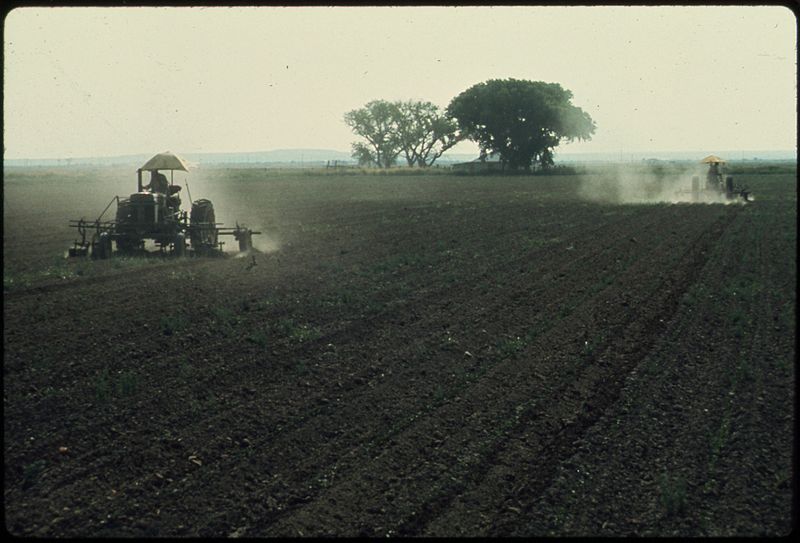
Tractors a Texas field in 1972

Tuesday, October 30, 2012

Index aims to guide adaptation investment

Jon Christianson in AlertNet: Channeling private investment toward climate adaptation will be crucial to supplement public funds and raise the tens of billions of dollars needed each year, say the authors of an index intended to help guide that investment and highlight investor opportunities.

The Global Adaptation Institute (GAIN) Index, launched in 2011 and updated this month, evaluates the vulnerability of countries to climate change and their readiness to withstand its impacts, based on a wide range of data, from efforts to control corruption to variations in crop yields.

The data and rankings are intended to provide a factual base for public and private investors to make good decisions about where to most effectively invest money, according to Juan José Daboub, a former managing director of the World Bank.

“The goal of this is try to bring everyone to the same table,” said Bruno Sanchez-Andrade Nuño, GAIN’s director of science and technology. According to Nuño, all of the data and formulas used to draw GAIN’s conclusions can be found on the site’s website....

Thursday, October 11, 2012

Vulnerability to natural disasters quantified

Andrew Wagaman in New Europe: Countries most vulnerable to natural disasters are not necessarily the ones facing the most environmental degradation, a new report finds. According to WorldRiskReport 2012, prepared by the UN University’s Institute for Environment and Human Security (UNU-EHS) and released on 11 October, the risk of any given country depends on the economic, social and institutional conditions of its society. The report ranks the risk of 173 countries based on an index that quantifies structural susceptibility, coping capacity and adaptation capacity along with exposure to natural hazards.

Areas especially vulnerable include Oceania, Southeast Asia, and especially Central America and the Caribbean. The South Pacific island of Vanuatu ranked the most at-risk, while Qatar ranked the least. Of the EU member states, the Netherlands is the most vulnerable, ranking No. 51 overall.

UNU-EHS director Jakob Rhyner emphasized that the rankings should not be seen as an instrument of reproach but one of public awareness and, hopefully, support. “We must go a step further and address the root causes of vulnerability,” Rhyner said. “If a country is hit, how well can it expect to support itself?”

Released two days before the International Day for Disaster Reduction (13 October), the report argues that both politics and sciences have paid too little attention to disaster risk. The costs of natural disasters continue to rise – in 2011, about 366 billion dollars were spent on them. This is not just because of progressing environmental degradation but also bad decision-making. Earthquakes cannot be prevented, but vulnerability to them can be reduced.

The index’s four components contain 28 indicators within them. Susceptibility is measured by things like access to sanitation, water and food, poverty and GDP per capita. Coping capacity is measured by governance strength, medical services and types of available insurance. Adaptive capacity – the capacity to learn from past disasters – is measured by literacy rates, gender parity in education and government and environmental protection....

The Taichung skyline, shot by Howard61313, Wikimedia Commons, under the Creative Commons Attribution-Share Alike 3.0 Unported license

Sunday, September 30, 2012

Climate change could cripple southwestern US forests: Trees face rising drought stress and mortality as climate warms

Science Daily: Combine the tree-ring growth record with historical information, climate records, and computer-model projections of future climate trends, and you get a grim picture for the future of trees in the southwestern United States. That's the word from a team of scientists from Los Alamos National Laboratory, the U.S. Geological Survey, the University of Arizona, and other partner organizations.

If the Southwest is warmer and drier in the near future, widespread tree death is likely and would cause substantial changes in the distribution of forests and of species, the researchers report this week in the journal Nature Climate Change. Southwestern forests grow best when total winter precipitation is high combined with a summer and fall that aren't too hot and dry.

The team developed a Forest Drought-Stress Severity Index that combines the amount of winter precipitation, late summer and fall temperatures, and late summer and fall precipitation into one number. "The new 'Forest Drought-Stress Index' that Williams devised from seasonal precipitation and temperature-related variables matches the records of changing forest conditions in the Southwest remarkably well," said co-author Thomas W. Swetnam, director of the UA Laboratory of Tree-Ring Research.

"Among all climate variables affecting trees and forests that have ever been studied, this new drought index has the strongest correlation with combined tree growth, tree death from drought and insects, and area burned by forest fires that I have ever seen."

A. Park Williams of Los Alamos National Laboratory in New Mexico is the lead author of the paper, "Temperature as a potent driver of regional forest drought stress and tree mortality." Six of the paper's 15 authors are at the UA. A complete list of authors is at the bottom of this release. ...Williams said, "Atmospheric evaporative demand is primarily driven by temperature. When air is warmer, it can hold more water vapor, thus increasing the pace at which soil and plants dry out. The air literally sucks the moisture out of the soil and plants."...

Weathered growth rings in a horizontal cross section cut through an tree felled around AD 1111 used for the western building complex at Aztec Ruins National Monument, San Juan County, New Mexico, USA. There is the cross section cut of the tree located in the outer wall of the building. Shot by , Wikimedia Commons, under the Creative Commons Attribution 3.0 Unported license

Tuesday, September 4, 2012

Vietnam most seriously affected by climate change

Voice of Vietnam: Within the next 30 years, Vietnam will be among 30 “extreme risk” countries affected by climate change, says the United Nation in Vietnam in its recent fact sheet on climate change.

The conclusion was based on the Climate Change Vulnerability Index (CCVI), which evaluates 42 social, economic and environmental factors to assess national vulnerabilities across three core areas, namely exposure to climate-related natural disasters and sea-level rise; human sensitivity, in terms of population patterns, development, natural resources, agricultural dependency and conflicts; and future vulnerability considering the adaptive capacity of a country’s government and infrastructure to address climate change effects.

The Vietnam National Strategy on climate change has also indicated that over the past 50 years, the sea level has risen 20 cm, which is seriously affecting the Mekong and Red River Deltas.

Therefore, the UN warns, if no major action such as dyke reinforcements and improved drainage is taken, a one meter rise in mean sea levels along the coast of Vietnam will cause an estimated threat of inundation to 17,423 km2 or 5.3 percent of the country’s total land area. Specifically, it will threaten 39 percent of the Mekong River Delta, 10 percent of the Red River Delta, over 2.5 percent of central coast provinces, and more than 20 percent of Ho Chi Minh City....

A 2008 flood in Hanoi, shot by haithanh, Wikimedia Commons via Flickr, under the Creative Commons Attribution 2.0 Generic license

Sunday, September 2, 2012

Risk from climate change linked with social factors

Heather Cooley in the Sacramento Bee: Summer brings enjoyment of warm weather, long days, a refreshing swim and barbecues. But it also brings natural hazards. Temperatures in many parts of California are near or exceed 100 degrees. Many cities are also experiencing record high nighttime temperatures, and so the evenings bring little relief from the sweltering daytime heat.

….But while many Californians are exposed to these conditions, some are far more vulnerable than others. Children and the elderly, for example, are more susceptible to heat-related illnesses and other hazards. Or when a fire or flood occurs, those with low incomes may not have the resources to evacuate. They are also often underinsured and unable to rebuild after the disaster strikes.

…Climate risk is a function of our exposure and our vulnerability. Social factors, like age, race and income, are not tied to a specific hazard but will greatly determine the human toll of the hazard and the specific needs for preparedness, response and recovery.

To compare overall social vulnerability – the susceptibility of a given group of people to harm from a hazard – to climate change across the state, the Pacific Institute developed a new "climate vulnerability index" that combines data from 19 different social and economic factors – such as air conditioner ownership, percentage of tree cover, workers in outdoor occupations and more – for each of the state's 7,000 census tracts.

….The greatest risks from climate change are found in areas with both high exposure to a climate impact and high vulnerability. By midcentury, Sacramento is expected to experience up to 31 extreme heat days each summer with temperatures in excess of 102 degrees – conditions that now occur on only the eight hottest days of the year. But while warmer temperatures will affect all Californians, they will be especially problematic for the elderly and others with heightened vulnerabilities, many of whom are concentrated in Southern California and in the San Joaquin Valley….

A 1940 shot by Dorothea Lange of a squatter's camp near Sacramento

Saturday, August 11, 2012

Global Adaptation Institute launches open consultation process for the 2012 GAIN Index

Sacramento Bee via PR Newswire: The Global Adaptation Institute (GAIN) will host an international Open Consultation process before release of the 2012 GAIN Index in October. This consultation reflects GAIN's commitment to updating the index each year to incorporate new or revised data and advice on methodological, design and communications improvements.

The GAIN Index (index.gain.org) is a navigation tool to help guide investments in adaptation and assess a country's vulnerability and readiness to adapt to global challenges such as population growth, urbanization and climate change.

"Since release of the GAIN Index one year ago, we have presented it in six continents and to dozens of business leaders, think tanks, government agencies and academic institutions, said GAIN Founding CEO Dr. Juan Jose Daboub. "The response has been overwhelmingly positive and along the way GAIN has gladly accepted suggestions to enhance the power of the index."

Such improvements under consideration include incorporating indicators for ecosystem services and urbanization. Ecosystem services are the multitude of ecological processes that humans rely upon to support their lives and livelihoods, providing food and clean water, natural disaster protection, climate regulation and nutrient cycling. Understanding urban trends and conditions is key to effective adaptation as many of the challenges humanity faces from population growth and climate change will take place in cities....

Saturday, September 17, 2011

An index to help private, public sectors prioritize investments in adaptation

MarketWatch: Leaders in the global effort to adapt to the massive forces changing our world unveiled this week an unprecedented tool: the first country ranking intended to guide policy and private sector capital to have the greatest adaptation impact.

The Global Adaptation Index(TM) ("GaIn(TM)") is a response to the various challenges of sustainable development including climate change, population growth and economic development. It was developed as a navigation tool to help prioritize and measure progress in adapting to climate change and other global forces, and is online at gain.globalai.org.

"We believe that by creating the right incentives while expanding our knowledge and understanding of the need for adaptation, we can save lives and improve the livelihoods of people around the world," said Jose Maria Aznar, Former President of Spain and Chairman of the Global Adaptation Institute Council of Advisors. "I believe that GaIn will become a natural navigation chart for both the private and public sectors."

GaIn looks at 15 years of data and finds: The United States has lost ground over the past fifteen years. Corrected for GDP, the United States in 2010 ranks 53rd out of 161 countries. In terms of raw score, the United States ranked third in the world in 1995, but today has fallen to 8th. Its vulnerability has risen slightly; and, while its readiness did increase, it was significantly outpaced by several other countries.

Major emerging economies (Brazil, Russia, India, China, South Africa, and Mexico) are making significant improvements, both decreasing their vulnerabilities and increasing their readiness. However, India remains vulnerable in its agriculture and food sectors; China must confront strains on its water resources and lacks infrastructure to access internal markets; and South Africa's highly vulnerable health sector drains human resources from innovation. In all these countries, governance and corruption continue to negatively impact readiness....

Saturday, June 25, 2011

New tool predicts drought six months out

Natalie Muller in Australian Geographic: A new drought forecasting model could help water authorities prepare for droughts up to six months before they happen. Dr Shishutosh Barua, a water engineer from Victoria University, developed the drought-prediction tool for his PhD thesis, and hopes an early warning will lessen the impact of the next inevitable dry spell on communities.

Droughts are a common occurrence in Australia, leaving the land parched and often wreaking havoc on communities and their water supplies. Shishutosh says the recently ended 13-year drought showed how vulnerable people were to water shortages in Australia. He believes six months could buy governments some time to implement water management policies early.

"If they can predict there will be a drought, they can set the water restriction levels and save water by not releasing it from storage beforehand," he says. Shishutosh also used his model to accurately detect past major historical droughts in Victoria. While there is plenty of information about past droughts, there is a gap in forecasting data, and predicting when they will happen is fraught with difficulty.

Shishutosh's drought index measures several water and climatic variables (water storage, stream flow, water in the soil, evaporation and rainfall), as well as past drought data, to assess the dryness of an area.
He believes his drought-forecasting model is far more conclusive in predicting up-coming droughts than traditional models, which usually only analyse rainfall….

Great Sandy Scars. In a small corner of the vast Great Sandy Desert in Western Australia, large sand dunes -the only sand in this desert of scrub and rock- appear as lines stretching from left to right. The light-colored fan shapes are scars from wildfires. USGS satellite photo

Sunday, June 19, 2011

More on that adaptation index

A press release from PR Newswire: The Global Adaptation Institute's Founding CEO, Dr. Juan Jose Daboub, gave the keynote address during the European Ideas Network (EIN) meeting today in Washington, D.C. Dr. Daboub described the Institute's development of the Global Adaptation Index™ (GaIn™), a tool for decision makers in the private and public sectors to prioritize investments in adaptation to climate change and other global forces. GaIn™ will be unveiled this fall in the USA, Europe and on several other continents.

"The index will serve as a navigation chart and as a transparent mechanism for allocation of resources. GaIn™ will become the 'go to' metric for investors seeking returns while helping resolve the effects of climate change on the most vulnerable people in society," stated Dr. Daboub in opening remarks. "The index uses vulnerability and readiness indicators that will encourage policy makers to accelerate implementation of the right public policies in order to save lives and improve livelihoods," he added.

Jaime Mayor Oreja, President of EIN, introduced Dr. Daboub to the Members of the EU Parliament, and described the Global Adaptation Institute as the first and only organization dedicated to promoting pragmatic solutions to adaptation, which addresses the effects of climate change. On behalf of the Parliamentarians he applauded the efforts in producing GaIn™, especially given the participation of European leaders and scientists in the process. "European parliamentarians welcome the Global Adaptation Index™ effort. It is needed. It is urgent. It is important," Oreja concluded….

Thursday, May 19, 2011

Maplecroft index identifies Bahrain, Qatar, Kuwait and Saudi Arabia as world’s most water stressed countries

A new index from Maplecroft, this one focusing on water: The Gulf nations of Bahrain, Qatar, Kuwait and Saudi Arabia are rated as the world’s most water stressed countries, with the least available water per capita, by a new ranking of 186 countries. The Water Stress Index, released by risk analysis and mapping firm Maplecroft, pinpoints areas of water stress down to 10km² worldwide by calculating the ratio of domestic, industrial and agricultural water consumption, against renewable supplies of water from precipitation, rivers and groundwater. It has been developed for companies to identify risk of water interruptions to supply chains, operations and investments.

The index, which is accompanied by an interactive sub-national map, rates 17 countries as ‘extreme risk,’ with the Middle East and North African (MENA) nations of Bahrain (1), Qatar (2), Kuwait (3) Saudi Arabia (4) Libya (5), the disputed territory of Western Sahara (6), Yemen (7), Israel (8), Djibouti (9) and Jordan (10) topping the ranking.

Maplecroft’s research highlights current and future water availability as one of the foremost global challenges. The company states that the dual drivers of climate change and population growth will combine to squeeze water resources and affect the food security of governments across the world, regardless of how water secure they may be today.

Aside from the MENA region, water stress is a major issue for the large emerging economies, including India (30) and South Korea (36), which are both categorised as ‘high risk’ countries in the index and China (56), rated ‘medium risk.’ Water shortages in these countries have the potential to constrain economic development and create social unrest if dwindling resources result in higher prices and limited access for their populations.

“As a means of offsetting shortfalls, India, South Korea and China, along with the oil rich Gulf states, are acquiring water rich land for agricultural purposes in developing countries to ensure the security of food supplies and decouple themselves from volatility in global food prices,” says Maplecroft Analyst Tom Styles. “This recent phenomenon, dubbed ‘land grab,’ is taking place on a huge scale across many countries in Africa, especially those involved in post conflict reconstruction with poor development.”…

Saturday, May 7, 2011

A global adaptation index

PR Newswire: During its first Annual Meeting this week in Washington, D.C., the Global Adaptation Institute announced that it is moving into a new phase in the development of the Global Adaptation Index™ (GaIn™). Adaptation experts, governmental dignitaries, and think tanks gathered to evaluate and make recommendations on world progress on Adaptation to climate change and other global forces.

GaIn™ is a metric which measures two main concepts: 1. the vulnerability of a country to the effects of climate change and other global forces and 2. the readiness of a country to successfully implement Adaptation solutions. "We are guided by the maxim - That which cannot be measured cannot be improved," said Dr. Ian Noble, the Chief Scientist of the Institute. GaIn™ will include indicators designed to accelerate private sector investment in Adaptation initiatives and encourage governments and civil society to ramp up their efforts on this issue. This development phase will include consultation with scientists, investors, policymakers, and representatives of NGOs and think tanks.

Preservation of agriculture, water and coastal protection are more present than ever in the budgets of countries and in the board room discussions of large corporations. Smaller enterprises as well as civil society organizations are also learning to cope with the effects of climate change and accelerated changes to the environment.

"Ultimately, it is about vulnerable people in society; those that for several reasons cannot yet take destiny into their own hands," said former Managing Director of the World Bank and Founding CEO of the Global Adaptation Institute, Dr. Juan Jose Daboub.

…The Global Adaptation Institute will also use GaIn™ to identify, fund, and rapidly implement high-impacting Adaptation projects, the results of which, will help refine and update GaIn™ for years to come….