Showing posts with label phosphorus. Show all posts

Monday, May 11, 2015

Human security at risk as depletion of soil accelerates

Sarah Yang at the UC Berkeley News Center: Steadily and alarmingly, humans have been depleting Earth’s soil resources faster than the nutrients can be replenished. If this trajectory does not change, soil erosion, combined with the effects of climate change, will present a huge risk to global food security over the next century, warns a review paper authored by some of the top soil scientists in the country.

The paper singles out farming, which accelerates erosion and nutrient removal, as the primary game changer in soil health. “Ever since humans developed agriculture, we’ve been transforming the planet and throwing the soil’s nutrient cycle out of balance,” said the paper’s lead author, Ronald Amundson, a UC Berkeley professor of environmental science, policy and management. “Because the changes happen slowly, often taking two to three generations to be noticed, people are not cognizant of the geological transformation taking place.”

In the paper, published [May 7] in the journal Science, the authors say that soil erosion has accelerated since the industrial revolution, and we’re now entering a period when the ability of soil, “the living epidermis of the planet,” to support the growth of our food supply is plateauing. The publication comes nearly two weeks ahead of the Global Soil Security Symposium at Texas A&M University, a meeting held as part of the declaration of 2015 as the International Year of Soils by the United Nations.

The authors identify the supply of fertilizer as one of the key threats to future soil security. Farmers use three essential nutrients to fertilize their crops: nitrogen, potassium and phosphorous. The paper credits the discovery of synthetic nitrogen production in the early 1900s for significantly increasing crop yields, which in turn supported dramatic growths in global population. Because the process of synthesizing nitrogen is energy-intensive, its supply is dependent on fossil fuels.

...Another threat to soil security relates to its role as a mass reservoir for carbon. Left unperturbed, soil can hold onto its stores of carbon for hundreds to thousands of years. The most recent estimates suggest that up to 2,300 gigatons of carbon are stored in the top three meters of the Earth’s soil – more carbon than in all the world’s plants and atmosphere combined. One gigaton is equal to a billion tons.

...One proposal is to stop discarding nutrients captured in waste treatment facilities. Currently, phosphorous and potassium are concentrated into solid waste rather than cycled back into the soil. Additionally, more efficient management is needed to curtail losses from soil. Excess nitrogen, for example, is considered a pollutant, with the runoff sapping oxygen from the nation’s waterways, suffocating aquatic life and creating dead zones in coastal margins...

A South Korean combine in 1976

Monday, March 9, 2015

Nutrient pollution damages streams in ways previously unknown, ecologists find

Beth Gavriles in UGA Today: An important food resource has been disappearing from streams without anyone noticing until now. In a new study published March 6 in the journal Science, a team of researchers led by University of Georgia ecologists reports that nutrient pollution causes a significant loss of forest-derived carbon from stream ecosystems, reducing the ability of streams to support aquatic life.

The findings show that the in-stream residence time of carbon from leaves, twigs and other forest matter, which provide much of the energy that fuels stream food webs, is cut in half when moderate amounts of nitrogen and phosphorus are added to a stream. "This study shows how excess nutrients reduce stream health in a way that was previously unknown," said the study's lead author Amy D. Rosemond, an associate professor in the UGA Odum School of Ecology.

Stream food webs are based on carbon from two main sources. One is algae, which produce carbon through photosynthesis. Nutrient pollution has long been known to increase carbon production by algae, often causing nuisance and harmful algal blooms. The second source is leaves and bits of wood from streamside forests. This forest-derived carbon typically persists year-round, making it a staple food resource for stream organisms.

"Most people think of nitrogen and phosphorus pollution in streams as contributing to algae blooms," said Diane Pataki, program director in the National Science Foundation's Division of Environmental Biology, which funded the research. "But streams contain a lot of leaf litter, and this study shows that nutrient pollution can also stimulate carbon losses from streams by accelerating the breakdown of that litter. That helps us better understand how fertilizer runoff affects carbon transport and emissions from streams and rivers."...

Looking east toward Haystack Butte and Haystack Creek along the Going-to-the-Sun Road. The cut of the Going-to-the-Sun Road, a National Civil Engineering Landmark, is visible in the vegetation of the mountainside. Photo: David Restivo, NPS, Wikimedia Commons via Flickr, under the Creative Commons Attribution 2.0 Generic license

Monday, October 20, 2014

Lake Erie increasingly susceptible to large cyanobacteria blooms

A press release from the University of Michigan: Lake Erie has become increasingly susceptible to large blooms of toxin-producing cyanobacteria since 2002, potentially complicating efforts to rein in the problem in the wake of this year's Toledo drinking water crisis, according to a new study led by University of Michigan researchers.

Since the detection of the toxin microcystin left nearly half a million Ohio and Michigan residents without drinking water for several days in early August, discussions of ways to prevent a recurrence have largely focused on the need to reduce the amount of phosphorus fertilizer that washes off croplands and flows into western Lake Erie to trigger harmful cyanobacteria blooms.

In a study published online Oct. 8 in the journal Water Resources Research, scientists from U-M and the National Oceanic and Atmospheric Administration conclude that microcystin-producing cyanobacteria in Lake Erie are becoming more sensitive to phosphorus and that reductions may have to cut far deeper than recently proposed targets.

"Our results suggest that current phosphorus loading targets will be insufficient for reducing the intensity of cyanobacteria blooms to desired levels, so long as the lake remains in a heightened state of bloom susceptibility," said lead author Daniel Obenour, formerly of the U-M Water Center and now at North Carolina State University. Other authors are Don Scavia of U-M and Andrew Gronewold and Craig Stow of the National Oceanic and Atmospheric Administration.

...Though the total amount of phosphorus entering the lake seems to be the best predictor of bloom size, that variable alone doesn't fully explain the observed size increase during the study period examined by the team, 2002 to 2013....

NASA image of a toxic algae bloom in Lake Erie

Wednesday, January 29, 2014

Fertilizer nutrient imbalance to limit food production in Africa

A press release from the International Institute for Applied Systems Analysis: A growing imbalance between phosphorus and nitrogen fertilizer use in Africa could lead to crop yield reductions of nearly 30% by 2050, according to a new study from researchers at the International Institute for Applied Systems Analysis (IIASA).

Underuse of phosphorus-based fertilizers in Africa currently contributes to a growing yield gap—the difference between how much crops could produce in ideal circumstances compared to actual yields. This phosphorus-specific yield gap currently lies at around 10% for subsistence farmers, but will grow to 27% by 2050 if current trends continue, according to a study published today in the journal Global Change Biology.

“This research shows that the imbalance between nitrogen and phosphorus applications has the potential to further limit food production for a growing population in Africa” says Marijn van der Velde, a researcher now at the Joint Research Centre of the European Commission, who led the study while working at IIASA.

...“Farmers with limited money are more likely to buy and have access to cheaper nitrogen-based fertilizers,” says van der Velde. “While this might work in the short term, in the longer term it has a negative effect on crop growth as soil nutrients become more imbalanced.”

As farmers use fertilizers for their crops, nutrients such as nitrogen and phosphorus build up in the soil, providing a reserve of nutrients that plants need to grow. But fertilizer use remains very low in Africa, and to increase crop production, it is widely recognized that farmers must increase their fertilizer use. And while nitrogen-based fertilizer usage has begun to increase in Africa in the last 10 years, the application of phosphorus to cropland has not kept pace, leading to a growing imbalance between nitrogen and phosphorus levels in soil. The new study shows that increases in nitrogen and phosphorus inputs must happen in a way that provides crops with the balanced nutrient input they need....

An electron shell diagram of phosphorus, created by Pumbaa (original work by Greg Robson), Wikimedia Commons, under the Creative Commons Attribution-Share Alike 2.0 UK: England & Wales license 

Wednesday, September 18, 2013

Wetlands more cost-effective in nutrient removal, but multiple payments would be of uncertain value

Space Daily via SPX: Removing nitrogen from the environment "the natural way" by creating a wetland is a long-term, nutrient-removal solution, more cost effective than upgrading a wastewater treatment plant, but it isn't necessarily socially beneficial to offer landowners multiple payments for the environmental services that flow from such wetlands, according to a study conducted at the University of Illinois.

"In the areas we studied in Bureau County with small wastewater treatment plants (WWTPs), it was much cheaper to do pollution control by installing just a few wetlands than it was to have the WWTPs do the upgrades that would be necessary to achieve the same thing," said U of I environmental economist Amy Ando.

Bureau County was selected for the simulation because it is an area that has waterways with heavy nitrogen and phosphorus pollution, and it is a rural area of the state but with some population density and a couple of WWTPs.

"In some ways, it's a poster child for an environment where a program like this could work," Ando said. "There is enough farmland to put in some wetlands, but there are also enough people contributing to the WWTPs that are generating nutrients-so there are parties on both sides that could trade with each other."

The study analyzed the amount of land needed to reduce nitrogen pollution, data on the costs of actual wetland restorations, and other factors such as the opportunity costs to the landowner from no longer farming the new wetland area.

"Wastewater treatment plants can already remove nitrogen, but their current technology is only capable of removing them up to a point," Ando said. "If they wanted to do more nitrogen removal, they would have to make upgrades. The cost of phosphorus removal isn't high, but for nitrogen, the upgrades are pretty expensive."...

Kennekuk Marshes, Lake Vermillion, Illinois, shot by Huw Williams (Huwmanbeing), who has released it into the public domain

Friday, September 13, 2013

Climate change will upset vital ocean chemical cycles

University of East Anglia: New research from the University of East Anglia shows that rising ocean temperatures will upset natural cycles of carbon dioxide, nitrogen and phosphorous. Plankton plays an important role in the ocean’s carbon cycle by removing half of all CO2 from the atmosphere during photosynthesis and storing it deep under the sea – isolated from the atmosphere for centuries.

Findings published [September 8]in the journal Nature Climate Change reveal that water temperature has a direct impact on maintaining the delicate plankton ecosystem of our oceans. The new research means that ocean warming will impact plankton, and in turn drive a vicious cycle of climate change.

Researchers from UEA’s School of Environmental Sciences and the School of Computing Sciences investigated phytoplankton – microscopic plant-like organisms that rely on photosynthesis to reproduce and grow.

Lead researcher Dr Thomas Mock, said: “Phytoplankton, including micro-algae, are responsible for half of the carbon dioxide that is naturally removed from the atmosphere. As well as being vital to climate control, it also creates enough oxygen for every other breath we take, and forms the base of the food chain for fisheries so it is incredibly important for food security.

“Previous studies have shown that phytoplankton communities respond to global warming by changes in diversity and productivity. But with our study we show that warmer temperatures directly impact the chemical cycles in plankton, which has not been shown before.”...

Phytoplankton, image by Uwe Kils, Wikimedia Commons, under the Creative Commons Attribution-Share Alike 3.0 Unported license

Saturday, June 15, 2013

Tillage and reduced-input rotations affect runoff from agricultural fields

Seed Daily via SPX: No-till management practices can reduce soil erosion, but evidence suggests they can also lead to increased runoff of dissolved phosphorus from soil surfaces. Meanwhile, farmers looking to avoid herbicides often have to combat weeds with tillage, which causes erosion. With all of the tradeoffs of different management systems, which one should growers use? To answer that question, researchers from the USDA Agricultural Research Service compared nutrient and sediment loss from no-till, conventional tillage, and reduced-input rotation watersheds in a study published online in Soil Science Society of America Journal.

By keeping a protective layer of plant matter on the soil surface, no-till practices reduce the loss of soil and phosphorus (P) attached to soil particles. But no-till requires herbicides to control weeds, and even after adoption of the practice by many farmers, harmful algal blooms were still occurring in surface waters. It looked as if no-till, while decreasing particulate P loss, was leading to increased runoff of dissolved P.

"Normally when you apply P-containing fertilizers, you would incorporate them into the soil," says Martin Shipitalo, lead author of the study. "With no-till, you're just broadcasting it on the soil surface, leading to high P concentrations at the surface. Even if you get less particulate loss, runoff will pick up that dissolved P that's highly concentrated at the soil surface."

Shipitalo and his team decided to look at data from a 16-year experiment to compare soil and nutrient runoff in watersheds managed in three different ways - no-till, conventional tillage (chisel-till), and reduced-input rotations. "The idea with the reduced-input rotation was to have a conservation practice that worked for farmers who do not want to use herbicides or large amounts of mineral fertilizers," explains Shipitalo.

In the current study, researchers provided most of the nutrients to crops in the reduced-input watersheds by planting red clover and spreading manure instead of fertilizers. They minimized the amount of bare soils and used just a shallow disking instead of total inversion tillage to leave some crop residue on the soil surface. While herbicides were used in the experiment, they aren't necessary because the light tilling and in-row cultivation that was done kept weeds under control.

"Reduced-input rotations strike a medium between conventional tillage and no-till," says Shipitalo. "And they could easily be adapted to be organic rotations."...

Ferdynand Rusczcyc's 1898 painting, "The Soil"

Monday, January 21, 2013

Dietary shifts driving up phosphorus use

Seed Daily via SPX: Dietary changes since the early 1960s have fueled a sharp increase in the amount of mined phosphorus used to produce the food consumed by the average person over the course of a year, according to a new study led by researchers at McGill University. Between 1961 and 2007, rising meat consumption and total calorie intake underpinned a 38% increase in the world's per capita "phosphorus footprint," the researchers conclude in a paper published online in Environmental Research Letters.

The findings underscore a significant challenge to efforts to sustainably manage the supply of mined phosphorus, a non-renewable resource widely used as fertilizer.

When phosphorus is lost through agricultural runoff or sewage systems, it can pollute waterways downstream. In addition, because deposits are heavily concentrated in a few countries, global supplies and prices for the resource are vulnerable to geopolitical tensions.

In recent years, many researchers have explored how human activity has altered the phosphorus cycle in the environment and how management of phosphorus could be altered to ensure long-term sustainability. This new study sheds more light, in particular, on how diet choices have affected the intensity of phosphorus use around the world.

"Our results demonstrate that changes in diet can be a significant part of the strategy for enhancing sustainability of phosphorus management," says lead author Genevieve Metson, a doctoral student in McGill's Department of Natural Resource Sciences. "In particular, reduced consumption of meat, and especially beef, in countries with large phosphorus footprints could put a big dent in demand for mined phosphorus - since it takes many kilograms of feed, which is fertilized, to produce a kilogram of meat."....

Illustration from Brockhaus and Efron Encyclopedic Dictionary (1890—1907)

Friday, December 21, 2012

Soil determines fate of phosphorus

Brown University News: Just 20 years ago, the soils of the Amazon basin were thought unsuitable for large-scale agriculture, but then industrial agriculture — and the ability to fertilize on a massive scale — came to the Amazon. What were once the poorest soils in the world now produce crops at a rate that rivals that of global breadbaskets. Soils no longer seem to be the driver — or the limiter — of agricultural productivity. But a new Brown University-led study of three soybean growing regions, including Brazil, finds that soils have taken on a new role: mediating the environmental consequences of modern farming.

The study focuses on the relationship between soils and phosphorus, a key agricultural nutrient. Typically in short supply, particularly in tropical soils, phosphorus is unique among fertilizer requirements. It is finite, irreplaceable and mined in just a few places around the world.

“If that suggests scarcity, which is a concern, the overuse of phosphorus can also pose another problem, causing harmful algal blooms in waterways,” said Stephen Porder, assistant professor of biology in the Department of Ecology and Evolutionary Biology and co-author of the study in the January 2013 edition of BioScience, posted early online. “It’s a bit of a Goldilocks problem — too much and our waterways are choked with algae, too little and we cannot produce enough food.”

...The new study compares the production of a single crop, soybeans, in the three places they are grown most — Iowa in the United States, Mato Grosso in Brazil, and Buenos Aires in Argentina. What the authors found was an example that illustrates how the combination of management and soil type frames the phosphorus-related concerns associated with these massive agricultural enterprises.

“Here are three regions where the crop that comes off the farm field is the same, but the fertilizer that goes in and the effects of this fertilizer on the environment are very different,” said lead author Shelby Riskin of Brown University and the Marine Biological Laboratory.

 “Having a one-size-fits-all approach to our understanding of interaction between people and their environment via agriculture is going to lead us to some erroneous concerns and conclusions if we don’t take the regional biophysical setting into account,” Porder said. “If you are concerned about the global phosphorus supply, Brazil is your problem — they are using a ton of it. If you are concerned about lakes and rivers being filled with algae, then Iowa is your problem, and learning how to mitigate even very small amounts of loss after decades of overfertilization is a real challenge.”...

Harvesting cotton in Brazil, shot by João Felipe C.S, public domain

Tuesday, November 6, 2012

Changes afoot in the Phosphorus Index

American Society of Agronomy: Phosphorus (P) is both an essential nutrient in agricultural fields and a contributor to poor water quality in surface waters. To encourage improved P management in fields, the P Index was proposed as a risk assessment tool in 1992. After 20 years of use, modifications, and growing pains, does the P Index accurately assess the risk of P loss?

...“The objective of the original P Index was to identify fields that had high risk of P loss and then guide producers’ decisions on implementing best management practices,” says Nathan Nelson, ASA and SSSA member and co-author of the special section’s introductory paper. “The P Index has developed into a widely used tool to identify appropriate management practices for P application and fields suitable for such application.”

...Because the P Index can be used to guide conservation practices, the USDA-National Resource Conservation Service (NRCS) adopted it as part of their management planning process. The NRCS, then, left it up to each state to develop their own P Index best suited for their environments and concerns.

...The inconsistencies of indices across states, along with a perceived lack of improvement in water quality in some regions, are now bringing the accuracy of the P Index into question. With different calculations in place, a set of factors may be categorized as low risk in one state and medium, or even high, risk in another. These discrepancies become especially obvious along state borders.

Researchers understand the need to improve P indices and have made it a priority to base any changes on sound scientific data....

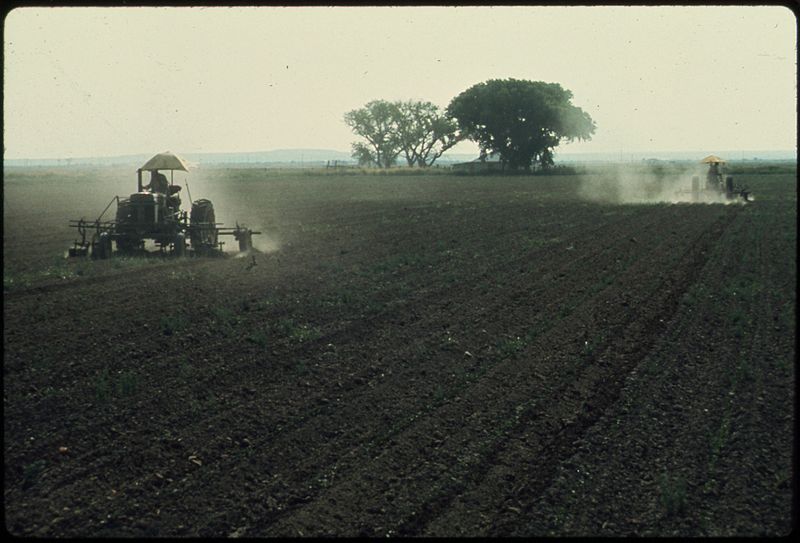
Tractors a Texas field in 1972

Friday, April 1, 2011

Improved crop yield by removing manure solids

Seed Daily: Manure has long been used as a crop fertilizer, but the challenge of finding an efficient use of the nutrients found in manure is ever present. The ratio of nitrogen to phosphorus in manure is low in relation to the nutrient needs of most crops. Therefore, crops tend to be overloaded with manure to meet the nitrogen requirement of agricultural crops, but the excess phosphorus from the process can damage the environment.

In a study funded by agriculture and Agri-Food Canada, scientists at the Pacific Agri-Food Research Centre in Agassiz, British Colombia, with collaborators in Quebec City, Quebec, and Brandon, Manitoba tested the effectiveness of removing solids from dairy manure to improve yield by increasing the nitrogen to phosphorus ratio and reducing the loss of nitrogen by hastening soil infiltration.

Solids were removed from the manure slurry in a passive two stage lagoon system, which resulted in the liquid fraction containing less dry matter and a higher nitrogen to phosphorus ratio than whole manure. The results from the six­-year study indicated that the liquid fraction allowed for a higher crop yield and 63% more nitrogen recovery than whole manure at equal application rates.

These benefits were the most apparent in the mid-season harvests when dry summer weather conditions accelerate nitrogen loss through ammonia volatilization. The slurry's higher nitrogen to phosphorus ratio prevented the soil from becoming overloaded with phosphorus….

A forlorn manure-themed image from Germany's Bundesarchiv, circa 1960

Tuesday, February 15, 2011

World phosphorus use crosses a critical threshold

Science Daily: Recalculating the global use of phosphorous, a fertilizer linchpin of modern agriculture, a team of researchers warns that the world's stocks may soon be in short supply and that overuse in the industrialized world has become a leading cause of the pollution of lakes, rivers and streams.

Writing in the Feb. 14 edition of the journal Environmental Research Letters, Stephen Carpenter of the University of Wisconsin-Madison and Elena Bennett of McGill University report that the human use of phosphorous, primarily in the industrialized world, is causing the widespread eutrophication of fresh surface water. What's more, the minable global stocks of phosphorous are concentrated in just a few countries and are in decline, posing the risk of global shortages within the next 20 years.

"There is a finite amount of phosphorous in the world," says Carpenter, a UW-Madison professor of limnology and one of the world's leading authorities on lakes and streams. "This is a material that's becoming more rare and we need to use it more efficiently."

…"If you have too much phosphorous, you get eutrophication," explains Carpenter of the cycle of excessive plant and algae growth that significantly degrades bodies of fresh water. "Phosphorous stimulates the growth of algae and weeds near shore and some of the algae can contain cyanobacteria, which are toxic. You lose fish. You lose water quality for drinking."

…Complicating the problem, says Carpenter, is the fact that excess phosphorous in the environment is a problem primarily in the industrialized world, mainly Europe, North America and parts of Asia. In other parts of the world, notably Africa and Australia, soils are phosphorous poor, creating a stark imbalance. Ironically, soils in places like North America, where fertilizers with phosphorous are most commonly applied, are already loaded with the element….

Phosphorus table image created for Wikipedia by Schnee on June 24 2003, 23:32 UTC. Licensed under the terms of the GNU FDL. Also under the Creative Commons Attribution-Share Alike 3.0 Unported license

Monday, February 14, 2011

World’s freshwaters contain too much phosphorous

Nadya Anscombe in Environmental Research Web: New policies are needed to decrease the overuse of phosphorous, and allocate the element where it is most needed, according to researchers who have analysed levels in freshwater across the globe. While it's essential for plant growth and agriculture, an excess of phosphorous in water causes eutrophication, which makes water non-potable, leads to blooms of cyanobacteria that are toxic to humans and livestock, depletes oxygen and kills fish.

Stephen Carpenter of the University of Wisconsin, US and Elena Bennett from McGill University, Canada, have found that current conditions exceed all planetary boundaries for phosphorous in freshwater.

In 2009 Rockström et al introduced the concept of planetary boundaries to define a safe operating space for humanity on Earth. They categorized a planetary boundary as a human-determined acceptable level of a key global variable.

"But the phosphorous boundary introduced by Rockström et al was based on oceanic conditions not freshwater," Carpenter told environmentalresearchweb. "The research found that the world was substantially below the oceanic planetary boundary, and this motivated us to look at freshwater. We were not surprised when we found that we are substantially past the boundary for freshwater."…

Cyanobacteria fouling freshwater, shot by Lamiot, Wikimedia Commons, under the Creative Commons Attribution-Share Alike 3.0 Unported

Friday, February 4, 2011

Helping feed the world without polluting its waters

McGill University Newsroom: A growing global population has lead to increasing demands for food. Farmers around the world rely, at least in part on phosphorus-based fertilizers in order to sustain and improve crop yields. But the overuse of phosphorus can lead to freshwater pollution and the development of a host of problems, such as the spread of blue-green algae in lakes and the growth of coastal ‘dead zones’.

A further issue is that phosphorus comes from phosphate rock, a non-renewable resource of which there are limited supplies in such geopolitically charged areas as Western Sahara and China.

Now, for the first time ever, a detailed global map has been produced showing imbalances in the way that phosphorus, an essential plant nutrient, is being used around the world. “Typically, people either worry about what happens when an excess of phosphorus finds its way into the water, or they focus on what happens when we run out of phosphorus,” says Graham MacDonald, a PhD student in the Department of Natural Resource Sciences at McGill University, who led the study. “This is the first study that illuminates the issue on a global scale and suggests that these are not separate problems … that the issue is one of distributing the phosphorus we’ve got.”

The study used detailed agronomic information about how much phosphorus is applied to soils in fertilizers and manures for more than 100 different food, feed, and fibre crops produced around the world in 2000. The results point to large imbalances in phosphorus use, with both the overuse of phosphorus in some parts of the world and phosphorus deficits in others. There were some surprising findings. While it is typically assumed that phosphorus deficits exist in only the poorer countries in sub-Saharan Africa, and phosphorus surpluses dominate in the wealthy nations of Europe and North America, in fact phosphorus levels vary widely within most nations – with surpluses and deficits commonly occurring side-by-side in a single region. Furthermore, countries such as Ukraine, long-known as the Russian empire’s ‘bread basket’, is one area that now suffers from phosphorus deficits, while eastern China and southern Brazil have been identified as phosphorus ‘hotspots’, where surplus phosphorus from the intensive use of fertilizers pose a danger of being lost from farmlands in runoff where it may pollute freshwater supplies.

“Until you can quantify how phosphorus is actually currently being used,” MacDonald says, “it’s difficult for policy-makers to go ahead and make informed decisions at a national or global scale.” Now they will have a tool to help them do so.

The symbol for phosphorous, rendered by Jerome Walker, Wikimedia Commons, under the Creative Commons Attribution-Share Alike 3.0 Unported license

Wednesday, September 29, 2010

Phosphate fertilizer warning for China

Jane Qiu in Nature News: Researchers are warning that inappropriate management of phosphate fertilizer and animal manure in China has resulted in serious water pollution and substantial waste of phosphorus, a non-renewable inorganic chemical. Soils in many parts of the world are deficient in the chemical, which is required for plant growth. In its phosphate form, phosphorus is a vital part of the cell's genetic material, and is also found in adenosine triphosphate (ATP), the main energy carrier in cells.

…Zhang Fusuo, a plant nutritionist at the China Agricultural University in Beijing, says China has 9% of the world's arable land and has to feed 21% of the world's population, yet its soils are not particularly fertile. An unpublished study by Zhang and colleagues, presented at the symposium, traced how the country has steadily boosted its use of phosphate over three decades.

In 1980, Zhang says, close to 80% of cropland in China contained less than 10 milligrams of phosphate available to plants per kilogram of soil — indicating a phosphate deficiency. Since then, the Chinese government has created a series of policies to encourage the production and use of phosphate fertilizer. But with phosphate use increasing at a rate of 5% per year, 85 million tonnes has accumulated in the soil. "The average phosphate content in the soil has nearly tripled and only a quarter of cropland is deficient in this nutrient now," says Zhang. "This has greatly increased crop production."

Such heavy fertilizer use has made China one of the biggest consumers of phosphate fertilizer. Last year, it used 11 million tonnes, or about 35% of global consumption, according to Zhang. With ever-increasing food demand, there is no sign that phosphate use in China will dwindle….

A longji rice terrace in Longsheng county, Guilin, China. Public domain photo by the suspiciously named Anna Frodesiak

Wednesday, March 17, 2010

Scarcity of phosphorus threat to global food production

Science Daily: Phosphorus is just as important to agriculture as water. But a lack of availability and accessibility of phosphorus is an emerging problem that threatens our capacity to feed the global population. Like nitrogen and potassium, it is a nutrient that plants take up from the soil and it is crucial to soil fertility and crop growth.

"Unless something is done, the scarcity of phosphorous will cause problems of a global dimension. As early as 2035 it is calculated that the demand for phosphorus map outpace the supply," says Dana Cordell, who presented her thesis at the Department of Thematic Studies -- Water and Environmental Studies, Linköping University, Sweden on the implications of phosphorus scarcity on global food security.

Phosphorus is extracted from phosphate rock, a non-renewable resource that is used almost exclusively in agriculture. Two thirds of the world's resources are in China, Morocco, and Western Sahara. "The demand for phosphorus has increased and prices soared by 800 percent between 2006 and 2008," says Dana Cordell.

Cordell maintains that the shortage of phosphorus in not simply due to a drop in the availability of phosphate ore. Many of the world's farmers do not have enough purchasing power to be able to afford and use phosphorus-based fertilizer, which means their soil is becoming depleted. What's more, phosphorus use in the food system from mine to field to fork is currently so inefficient that only one fifth of the phosphorus in the rock that is mined actually makes its way into our food.

"There is a lack of effective international governance to secure long-term access to phosphorus for food production," says Dana Cordell, who adds that the way phosphorus resources are handled needs to be improved.

…."If nothing is done, food production runs the risk of a hard landing in the future, including further fertilizer price increases, increasing environmental effects of pollution, energy and resource consumption, smaller harvests, reduced farmer livelihoods and reduced food security," says Dana Cordell…..

Phosphorus sealed in a glass bottle, shot by Dnn87, Wikimedia Commons, under the Creative Commons Attribution 3.0 Unported license