Showing posts with label justice. Show all posts

Thursday, October 23, 2014

UN proposal of debt relief for climate adaptation divides aid experts

Karl Mathieson in Climate Change Hub at the Gurdian (UK): A UN proposal that would see small island states offered debt relief to pay for climate change contains a “fundamentally unjust” blind spot, according to development groups. But advocates see the idea as an innovative way to increase the money available for climate change adaptation in the most vulnerable states.

The UN Development Programme (UNDP) is working on an initiative that would see rich countries write off debt owed to them by Small Island Developing States (Sids) in exchange for the money being spent on climate change adaptation.

But development agencies are concerned the proposal conflates legitimate and illegitimate debt. Tim Gore, Oxfam’s global head of policy for food and climate change says: “They are two separate issues and just merging the two, you could argue, is one way to let developed countries off the hook.”

“It’s definitely an interesting proposal, but I think it’s fundamentally unjust,” says Alex Scrivener, a policy officer for the World Development Movement. “There’s a big difference between the climate debt accrued by rich countries as a result of their emitting CO2 over a long period of time and the often unjust debt which has been accrued by poorer countries,” he says.

Unjust debt, says Scrivener, is often “dictator debt” – money lent by rich countries to poor countries ruled by strongmen, who commonly used it to finance military ventures or vast follies. It is estimated at US$735bn and makes up almost one fifth of the total debt owed by the developing world. But the only Sids with dictator debt is Haiti, says Gail Hurley, a UNDP development finance specialist....

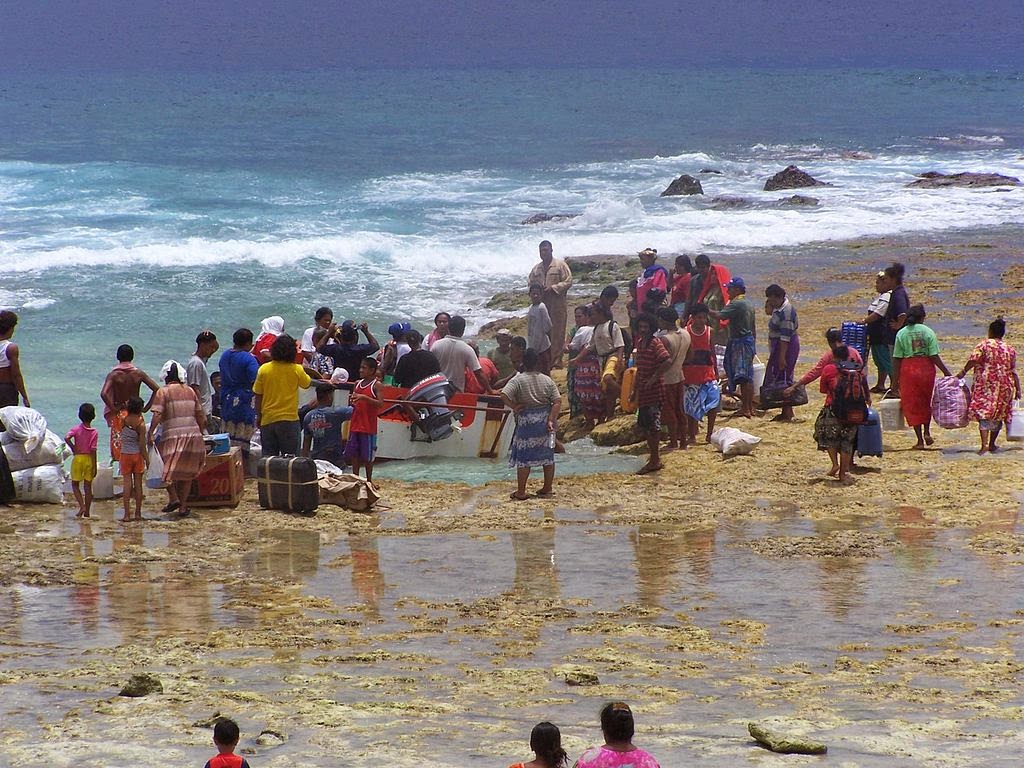
Cargo is offloaded from tenders that transfer passengers & cargo between the inter-island ferries and each of the outer islands of Tuvalu (here on the island of Niutao). A hazardous exercise, fraught with risk for passengers & the crew of the tenders. Shot by CESQLD, public domain

Wednesday, August 27, 2014

UN conference set to bypass climate change refugees

Thalif Deen in IPS: An international conference on small island developing states (SIDS), scheduled to take place in Samoa next week, will bypass a politically sensitive issue: a proposal to create a new category of “environmental refugees” fleeing tiny island nations threatened by rising seas. “It’s not on the final declaration called the outcome document,” a SIDS diplomat told IPS.

The rich countries that neighbour small island states are not in favour of a flood of refugees inundating them, he added. Such a proposal also involves an amendment to the 1951 U.N. Convention on the Status of Refugees, making it even more divisive.

The outcome document, already agreed upon at a U.N. Preparatory Committee meeting last month, will be adopted at the Sep. 1-4 meeting in the Samoan capital of Apia.

Sara Shaw, climate justice and energy coordinator at Friends of the Earth International (FoEI), told IPS, “We believe that climate refugees have a legitimate claim for asylum and should be recognised under the U.N. refugee convention and offered international protection.”

Unfortunately, she said, the very developed nations responsible for the vast majority of the climate-changing gases present in the atmosphere today are those refusing to extend the refugee convention to include climate refugees. “Worse still, they are trying to weaken existing international protection for refugees,” Shaw added....

A NASA image of Aneityum, Vanuatu

Saturday, July 5, 2014

Who is responsible for climate change?

AlphaGalileo via Taylor & Francis: Calculating the cumulative cost of carbon dioxide emissions gives new insights into the question of who is responsible for climate change. ... Jan Kunnas from the University of Stirling and his colleagues from universities in the UK and New Zealand examined how to incorporate the environmental effects of fossil fuel use into the national accounts and measures of sustainability. They suggest using a single global price for carbon dioxide emissions, as there is in the long term no possibility for a single country to isolate itself from the impacts of climate change. Every country will be affected to some degree, say from increases in food prices as climate change has negative impacts on global food production or from climate refugees. Ethically speaking, the use of a global damage cost indicates a belief that we are all in the same lifeboat when it comes to the long-term effects of climate change. Furthermore, the calculated price should decrease as we move back in time to take into account that carbon dioxide is a stock pollutant, and that one unit added to the present large stock is likely to cause more damage than a unit emitted under the lower concentration levels in the past.

...The annual effects of carbon dioxide might be small, but the cumulative effects are not. For Britain the cumulative effects from 1800 to 2000 range from £100 to £1400 billion, and for the
USA from $960 to $13,600 billion (in 2000 prices). In other words at most the cumulative carbon debt exceeds, the annual GDP, which in 2000 were £916 billion in the UK and $9951 billion in the USA.

Calculating the cumulative cost of carbon dioxide emissions provides us an opportunity to finally settle the question of historical responsibility for the damages caused by climate change. The choice of price has a big influence on the accumulated costs, but it does not affect the relative position of different countries. With both a constant price and a declining price the USA has the highest cumulative cost of carbon emissions during the period 1902—2009, contributing 24–27% of the cumulative global cost, followed by the EU with 17–19%. China is nowadays the biggest source of carbon dioxide, but the cumulative costs of its emissions are still long behind with 10–12%.

These calculations support the notion that the main reason for a warming climate is the historical greenhouse-gas emissions of developed countries; 41–47% of the costs are due to the cumulative emissions of carbon dioxide from the USA and the EU alone. On the other hand, the emissions of the big four major contributors account for only 57–59% of the total cumulative costs, leaving over 40% to the rest of the world, supporting the need for a global treaty put forward by developed countries. The starting point for such treaty could be a mutual debt cancellation, developed countries’ carbon debts offsetting developing countries’ conventional monetary debt, leaving the dispute about historical responsibility behind.

Ecuadoran indigenous march to protest water policy

Space Daily via AFP: Scores of indigenous demonstrators marched on Quito Tuesday, to protest against President Rafael Correa's government and losing control of water on their traditional lands.

Lawmakers in Congress last week approved a new law that gives the state exclusive control over all water resources. It spelled a de facto end to indigenous councils that administered water resources on traditional lands.

"We are marching against (government) policies that go against the Ecuadoran people, ... namely approval of the water management law," said Vicenta Minda, an indigenous Saraguro woman who marched from the south for 10 days.

Indigenous groups say this is the government's way of making sure mining interests get what they want; many indigenous communities have opposed mining in some areas where the water they fish and drink was polluted by potentially toxic chemicals used in mining.

"We are the ones who built our communal water systems, so we should be the ones who decide on rights ... Now the state should be in charge? Faced with that we are saying: civil disobedience," added Carlos Perez, who leads Ecuarunari, an association of indigenous groups from the highlands. Ecuador has other indigenous groups in its Amazon lowlands and coast...

A mountain lagoon in Ecuador, shot by Ekem, Wikimedia Commons, under the Creative Commons 3.0 license

Thursday, July 3, 2014

World Bank and UN carbon offset scheme 'complicit' in genocidal land grabs - NGOs

An appalling crime covered by Nafez Ahmed in the Guardian (UK): Between 2000 and 2010, a total of 500 million acres of land in Asia, Africa, Latin America and the Caribbean was acquired or negotiated under deals brokered on behalf of foreign governments or transnational corporations.

...The concentration of ownership of the world's farmland in the hands of powerful investors and corporations is rapidly accelerating, driven by resource scarcity and, thus, rising prices. According to a new report by the US land rights organisation Grain: "The powerful demands of food and energy industries are shifting farmland and water away from direct local food production to the production of commodities for industrial processing."

Less known factors, however, include 'conservation' and 'carbon offsetting.' In west Kenya, as the UK NGO Forest Peoples Programme (FPP) reported, over a thousand homes had been torched by the government's Kenya Forest Service (KFS) to forcibly evict the 15,000 strong Sengwer indigenous people from their ancestral homes in the Embobut forest and the Cherangany Hills.

Since 2007, successive Kenyan governments have threatened Sengwer communities in the Embobut forest with eviction. A deadline for residents to leave the forest expired in early January, prompting the most recent spate of violence. The pretext for the eviction is that the indigenous Sengwer – labelled wrongly as 'squatters' – are responsible for the accelerating degradation of the forest.

...The devastating plight of Kenya's indigenous peoples is symptomatic of the flawed approach to conservation on the part of international agencies.

...A damning new report from the Rights and Resources Initiative (RRI) based in Washington DC thus warns that the UN and World Bank approach to REDD is paving the way for large-scale "carbon grabs" by foreign governments and investors, putting at risk the land rights, livelihoods and lives of indigenous communities....

Mt. Elgon Forest in Kenya, shot by Kristina Just, Wikimedia Commons via Flickr, under the Creative Commons 2.0 license

Sunday, June 29, 2014

Fury over Senegal’s private land buyers

IRIN: ...A liberal land regime in Senegal over the decade has favoured large-scale acquisitions of arable land by both foreign and local investors. Dramatic changes in ownership have coincided with serious food shortages in the sub-region, a global financial crisis and a growing emphasis on the promotion of bio-fuel, with Senegal heavily promoting the planting of the controversial Jatropha tree, the seeds of which are used for the production of fuel for diesel engines.

Between 2000 and 2010, over 657,000 hectares of land, around 17 percent of Senegal’s arable land, was allocated to 17 private firms. Ten of the firms are Senegalese and the rest are foreign, according to the regional pressure group Pan-African Institute for Citizenship, Consumers and Development (CICODEV).

Under the previous administration of Abdoulaye Wade, the government pushed high profile schemes like the Return towards Agriculture plan (REVA) and the Grand Agricultural Drive for Food and Abundance (GOANA), with an emphasis on promoting agri-business and bio-fuels.

“These initiatives have led to a glut of private operators, including religious leaders and senior state officials moving in on land in rural areas,” complains Mariam Sow, coordinator of the Natural Protection Programme of international NGO ENDA.

In a May 2011 report, the Agricultural and Rural Prospective Initiative (IPAR), a sub-regional NGO which aims to provide “strategic analysis” of rural and agricultural issues, highlighted the volume of land deals in northern Senegal. IPAR drew particular attention to the case of Mbane in Saint Louis Region, where it said 232,000 hectares had been distributed to politicians, religious leaders and private operators with strong political connections under the GOANA project. The IPAR report noted that, at the time of writing, much of the land acquired had yet to be exploited....

A farm in Senegal, image by Richard Melo da Silva, public domain

Friday, June 13, 2014

Water in Gaza - what the analysts are saying

IRIN:  A dry winter in the Middle East is being studied particularly closely in Gaza, where the area’s 1.9 million residents already face a number of largely man-made threats to water security. The following round-up of recent publications by think tanks, analysts and human rights organizations highlights the close link between water security and electricity supplies, and the near exhaustion of Gaza’s coastal aquifer.

A power crisis in the Occupied Palestinian Territory (OPT) has reduced the availability of running water in most households, according to a factsheet produced by the UN Office for the Coordination of Humanitarian Affairs (OCHA), with more than 30 percent of homes in Gaza receiving running water for just 6-8 hours every four days.

In March, a petition signed by nearly 13,000 people and organised by the Emergency Water and Sanitation-Hygiene Group (EWASH), a coalition which includes national and international NGOs and UN agencies, was handed to the European Parliament to urge action to end the water crisis in Gaza.

“The scale and severity of the water crisis facing the Gaza Strip is enormous, and unless immediate action is taken, the damage to Gaza’s natural water resources will be irreversible,” says a factsheet produced by the Palestinian Water Authority (PWA).

At least 90 percent of the water supply in Gaza is contaminated with a combination of nitrate (NO3) or chloride (Cl), according to PWA, which says water quantity is also an issue, with average consumption of 90 litres per person per day, below recommended guidelines for minimum health requirements say EWASH....

NASA image of the Gaza Strip from space

Wednesday, June 4, 2014

Sri Lanka offers lessons on how not to manage water

IRIN: Angry paddy farmers blocked major roads in the Minneriya and Girithale areas in Sri Lanka’s North Eastern Polonnaruwa region last month, complaining the government had not released enough water for their rice to grow; they claimed they had lost 50,000 hectares of crops, or 1.75 million kg.

Ananda Edirisuriya, who took part in the protests, accused the Irrigation Department of failing to notify farmers of impending water shortages. “We need to know in advance if there is going to be a drought and how wide the impact is. Right now what we get is that when the drought is at its worst, the officials come and tell us that there is no water,” he told IRIN. “By then it is too late, we have already planted our crops.”

R M P Karunaratane, deputy director of the Polonnaruwa Irrigation Department, admitted weak rainfall was partially to blame, but passed the buck to reservoir releases, claiming the water shortage was caused when no water was released from the main reservoirs that feed the local reservoirs over which his office has control.

“We also don’t know much about impending droughts because we also don’t get detailed forecasts,” Karunaratane added, explaining that the daily bulletins he receives by fax from the central Department of Irrigation and the Meteorological Department often contain insufficient information to accurately inform farmers about water availability.

Edirisuriya said the bureaucratic hurdles are compounded by hotels in the area using large amounts of water. The exasperated farmer added: “If there is a drought, then there needs to be priorities, and agriculture should be the top priority.”...

When building the Victoria Dam in Sri Lanka the Teldeniya city was submerged. This is the sumbmerged old Teldeniya city seen during a drought period the reservior water level abrupty dropped in 2012. Shot by Hasindu2008, Wikimedia Commons, under the Creative Commons Attribution-Share Alike 3.0 Unported license

Wednesday, May 7, 2014

The dirty business of palm oil

Nils Klawitter in Spiegel Interntional: ...Bangku is located at the center of Indonesia's Sumatra island. It's a city full of people that have been pushed off their property and has been a flash point for years in one of the country's bloodiest land conflicts. Palm oil is at the center of the dispute. Almost every second product available in today's supermarkets contains the cheap natural resource, which is often labeled as "vegetable oil," masking its true identity. Palm oil can be found in shampoos, but also in margarine, frozen pizzas, ice cream and lipstick.

There are hundreds of conflicts over land with palm oil companies in Indonesia, but Bungku is considered to be one of the worst. The area's forest, which once provided nourishment to those who lived there, fell victim to the giant palm oil plantations of the firm Asiatic Persada in the mid-1980s. In the following years, the company's bulldozers illegally claimed a further 20,000 hectares (49,000 acres) of rain forest -- an area about half the size of Berlin. Included were areas for which indigenous people's held guaranteed land rights. But they were of little use against the palm oil industry.

On numerous occasions, mercenaries drove out village residents who attempted to return to the "land of our forefathers," as they say. The most recent incident happened only months ago. It's an unequal battle because it essentially pits tribal people against the henchmen of multinational behemoths like Wilmar.

Asia's leading agricultural concern supplies food companies like Anglo-Dutch consumer goods producer Unilever or Swiss multinational Nestlé. And for years Wilmar owned Asiatic Persada.

..."The World Bank also bears some responsibility for the death toll," says Feri Irawan, an environmental activist based in the nearby city of Jambi who has been observing the conflict for years. Irawan says the World Bank long showered Wilmar with loans, in complete disregard for the company's tangle of land conflicts...

A palm oil concession in Riau, Sumatra, shot by Hayden, Wikimedia Commons via Flickr, under the Creative Commons Attribution 2.0 Generic license 

Thursday, May 1, 2014

Adaptation will fail without emissions cuts, funding insufficient - UN climate chief

Laurie Goering at the Thomson Reuters Foundation: The funds available to help poorer countries adapt to the impacts of climate change are “pathetically insufficient”, and adaptation efforts risk failing altogether if countries that produce most of the world’s greenhouse gas emissions don’t agree to “very rapid” cuts, the United Nations’ climate chief warned on Wednesday.

Global emissions, which are still growing, need to peak within the next 10 years, with the world rapidly moving to become “carbon neutral” in the second half of the century, said Christiana Figueres, executive secretary of the U.N. Framework Convention on Climate Change.

The alternative is that “the costs of adaptation will exponentially rise to the point where adaptation is not only extremely difficult but virtually impossible,” she said at the close of a week-long conference in Nepal on financing community-based climate adaptation.

The price of that failure could be a surge in poverty, hunger, migration and extreme weather, which would hit those least equipped to cope hardest, experts said. “It is absolutely urgent we mitigate (climate-changing emissions) rapidly at the same time (as) we invest in adaptation or we are entering a world of much more instability,” warned Atiq Rahman, executive director of the Bangladesh Centre for Advanced Studies.

And it is not just the world’s poorest who will pay the price, as British families affected by flooding this year have discovered, noted Camilla Toulmin, director of the London-based International Institute for Environment and Development (IIED)...

"PÄ…tnów" power plant in Konin, Poland. Shot by Flyz1, Wikimedia Commons, under the Creative Commons Attribution-Share Alike 3.0 Unported, 2.5 Generic, 2.0 Generic and 1.0 Generic license

Thursday, April 17, 2014

Groundbreaking nationwide study finds that people of color live in neighborhoods with more air pollution than whites

A press release from the University of Minnesota: A first-of-its-kind study by researchers at the University of Minnesota found that on average nationally, people of color are exposed to 38 percent higher levels of nitrogen dioxide (NO2) outdoor air pollution compared to white people.

Nitrogen dioxide comes from sources like vehicle exhaust and power plants. Breathing NO2 is linked to asthma symptoms and heart disease. The Environmental Protection Agency has listed it as one of the seven key air pollutants it monitors. The researchers studied NO2 levels in urban areas across the country and compared specific areas within the cities based on populations defined in the U.S. Census as “nonwhite” or “white.”

The health impacts from the difference in levels between whites and nonwhites found in the study are substantial. For example, researchers estimate that if nonwhites breathed the lower NO2 levels experienced by whites, it would prevent 7,000 deaths from heart disease alone among nonwhites each year.

The study entitled “National patterns in environmental injustice and inequality: Outdoor NO2 air pollution in the United States” was published in the April 15 issue of PLOS ONE, a leading peer-reviewed scientific journal.

“We were quite shocked to find such a large disparity between whites and nonwhites related to air pollution,” said Julian Marshall, a civil engineering associate professor in the University of Minnesota’s College of Science and Engineering and co-author of the study. “Our study provides a great baseline to track over time on important issues of environmental injustice and inequality in our country.”...

An aerial view of Harlem and the Harlem River, New York City, shot by Gryffindor, Wikimedia Commons,  under the Creative Commons Attribution-Share Alike 3.0 Unported license

Wednesday, April 16, 2014

Rising activist deaths are a symptom of our global environmental crisis

Oliver Courtney in the Guardian (UK): This week the Intergovernmental Panel on Climate Change (IPCC) confirmed what 99.9% of those who work on environmental issues already knew: we need to change something pretty drastic if we want to avoid a rise in temperature of less than 2C.

...That same message comes through strongly in the research by Global Witness that identifies a significant recent upturn in killings of the very people who are protecting the environment and land rights.

...Huge deals for land, forests and other natural resources continue to be done behind closed doors, without sufficiently considering the social or environmental costs or consulting those who live on the land. When they resist, local communities and indigenous people are branded "anti-development" and bulldozed out of the way, often with the help of the authorities who are meant to protect them.

Ironically, such communities typically practise a better and more sustainable approach to development. Those responsible for their persecution enjoy almost total impunity, while monitoring of threats to this particularly vulnerable group is almost non-existent.

We can trace this problem back to the same forces that lie behind climate change – soaring consumption in the rich world is driving us far beyond the planet's natural boundaries. Things like forests and land are finite, but we are liquidating them faster than ever, generally for the short-term gain of a few vested interests, and at massive cost to the rest of us....

A public domain image of environmental activists, by Lorédan

Monday, April 14, 2014

REDD+ and a green economy are inseparable – but concerns for equity remain

Angela Dewan in Landscapes: The world is transitioning to a green economy, but the many synergies between greater sustainability and the forest-focused REDD+ mechanism are underutilized, according to a recent United Nations report.

Countries with tropical forests have for years been preparing for a full-scale implementation of REDD+, and can offer a wealth of knowledge and lessons learned for the broad shift towards a green economy, according to the report.

“If designed well, REDD+ can thereby contribute to the key elements of a green economy: low-carbon development, social inclusiveness, increased human well-being and respect for natural capital,” says the report, “Building Natural Capital: How REDD+ Can Support a Green Economy” by the UN Environment Program’s International Resource Panel.

The relationship works in both ways — REDD+ is only likely to flourish in a world dedicated to greening the global economy, the report says, as many policies targeted at sustainability could be conducive to REDD+ implementation.

Jeff McNeely, chief author of the report, says that to avoid the Intergovernmental Panel on Climate Change’s dire projections of global warming and its effects on the economy, “the transition to sustainability must be accelerated, not postponed.  REDD+ is one indication of what can be done,” he says...

A small bridge in a tropical forest, shot by Steve Hillibrand, US Fish and Wildlife Service 

Saturday, April 12, 2014

We need an apartheid-style boycott to save the planet

Some inspiration from Desmond Tutu in the Guardian (UK): Twenty-five years ago people could be excused for not knowing much, or doing much, about climate change. Today we have no excuse. No more can it be dismissed as science fiction; we are already feeling the effects.

...Who can stop it? Well, we can, you and I. And it is not just that we can stop it, we have a responsibility to do so. It is a responsibility that begins with God commanding the first human inhabitants of the garden of Eden "to till it and keep it". To keep it; not to abuse it, not to destroy it.

...People of conscience need to break their ties with corporations financing the injustice of climate change. We can, for instance, boycott events, sports teams and media programming sponsored by fossil-fuel energy companies. We can demand that the advertisements of energy companies carry health warnings. We can encourage more of our universities and municipalities and cultural institutions to cut their ties to the fossil-fuel industry. We can organise car-free days and build broader societal awareness. We can ask our religious communities to speak out.

We can actively encourage energy companies to spend more of their resources on the development of sustainable energy products, and we can reward those companies that do so by using their products. We can press our governments to invest in ren
ewable energy and stop subsidising fossil fuels. Where possible, we can install our own solar panels and water heaters.

...It makes no sense to invest in companies that undermine our future. To serve as custodians of creation is not an empty title; it requires that we act, and with all the urgency this dire situation demands.

Desmond Tutu in 2007, shot by Elke Wetzig (Elya), Wikimedia Commons, under the Creative Commons Attribution-Share Alike 3.0 Unported license

Thursday, March 27, 2014

African women push for equality in land and resource rights

Elias Ntungwe Ngalame at the Thomson Reuters Foundation: ....[M]illions of female African farmers ... are disadvantaged by cultural practices and laws that deny them equal access to land. But African women’s rights activists are intensifying their efforts to push governments to speed up land reform processes and establish clear legislation securing women’s rights to own, access and control land and other natural resources.

According to Gregory Muluh, coordinator of the Grassfield Project, a government initiative assisting women farmers in Cameroon’s northwest, the country still has no law that protects land tenure for women.

“Even if people know that refusing women the right to own land is wrong, there is nowhere to complain, and women end up swallowing a bitter pill,” Muluh told Thomson Reuters Foundation during a visit to the Grassfield Project last year. “Instituting a legal provision to safeguard the rights of women to land ownership is imperative if we really want them to contribute fully to development.”

The African Women's Network for Community Management of Forests (REFACOF), an international NGO, believes only reforms that include legal safeguards giving women equal say in decisions made by customary and state authorities on managing land and forest resources will boost gender equality on the continent.

“We know that wherever land rights are being ignored, women are indisputably the most affected. Banding together and raising awareness of these issues is the first step toward ensuring all women’s rights are recognised,” Cécile Ndjebet, president of REFACOF, told Thomson Reuters Foundation....

A farmer at the women’s agricultural cooperative of Walikaly village in Siguiri Prefecture, Guinea. Shot by Laura Lartigue for USAID

Monday, March 24, 2014

Putting climate polluters in the dock

Desmond Brown in IPS: Can Caribbean governments take legal action against other countries that they believe are warming the planet with devastating consequences? A former regional diplomat argues the answer is yes. Ronald Sanders, who is also a senior research fellow at London University, says such legal action would require all Small Island Developing States (SIDS) acting together.

He believes the Hague-based International Court of Justice (ICJ) would be amenable to hearing their arguments, although the court’s requirement that all parties to a dispute agree to its jurisdiction would be a major stumbling block.

“It is most unlikely that the countries that are warming the planet, which incidentally now include India and China, not just the United States, Canada and the European Union…[that] they would agree to jurisdiction,” Sanders told IPS. “The alternative, if countries wanted to press the issue of compensation for the destruction caused by climate change, is that they would have to go to the United Nations General Assembly.”

Sanders said that the Caribbean Community (CARICOM) countries could “as a group put forward a resolution stating the case that they do believe, and there is evidence to support it, that climate change and global warming is having a material effect… on the integrity of their countries.

“We’re seeing coastal areas vanishing and we know that if sea level rise continues large parts of existing islands will disappear and some of them may even be submerged, so the evidence is there.” Sanders pointed to the damaging effects of flooding and landslides in St. Vincent and the Grenadines, St. Lucia, and Dominica as 2013 came to an end...

A mudslide in Nicaragua caused by 1989's Hurricane Mitch, US Geological Survey

Saturday, March 15, 2014

Caribbean to forge united front on elusive climate finance

Peter Richards in IPS: Dr. Ralph Gonsalves, the prime minister of St. Vincent and the Grenadines, says the promises of money by the “biggest polluters in the world” for small island developing states (SIDS) like his to adapt to climate change are a mostly a “mirage”.

But as chair of the 15-member Caribbean Community (CARICOM) grouping, Gonsalves will be playing a lead role in getting the region to coordinate a united front on climate finance.  “We agreed on the establishment of a task force on climate change and small island developing states to provide guidance to Caribbean climate change negotiators, their ministers and political leaders in order to ensure the strategic positioning of the region in the negotiations,” he told IPS following the CARICOM summit that ended here on Tuesday.

Gonsalves said the region is now preparing for two important meetings in September – the U.N. Climate Change Summit and the Third U.N. SIDS International Meeting in Samoa.

Guyanese President Donald Ramotar, who made a presentation at CARICOM’s closed-door summit, told IPS that it was important for the leaders themselves to get involved in the negotiations “and to make our voices heard on this matter, because as you know we have been the least contributors to climate change, but we are among the first to feel the big effects.”

...The task force must now “find areas where CARICOM can agree on”, he said. “This is a critical decision by heads [of state] at a time when efforts are underway through the U.N. to have a global climate change agreement by the end of 2015,” he said...

Mustique International Airport, shot by Acp, Wikimedia Commons,  under the Creative Commons Attribution-Share Alike 3.0 Unported license

Monday, March 10, 2014

Food system that fails poor countries needs urgent reform, says UN expert

Mark Tran in the global development blog at the Guardian (UK): The existing food system has failed and needs urgent reform, according to a UN expert who argues there should be a greater emphasis on local food production and an overhaul of trade policies that have led to overproduction in rich countries while obliging poor countries – which are often dependent on agriculture – to import food.

In his final report , Olivier De Schutter, the UN special rapporteur on the right to food, offers a detailed critique of an industrial system of agriculture that has boosted food production over the past 50 years, yet still leaves 842 million – 12% of the world's population – hungry.

"Measured against the requirement that they should contribute to the realisation of the right to food, the food systems we have inherited from the 20th century have failed," he told the UN human rights council. "Of course, significant progress has been achieved in boosting agricultural production. But this has hardly reduced the number of hungry people."

The right to food is defined as the right of every individual to have physical and economic access at all times to sufficient, adequate and culturally acceptable food that is produced and consumed sustainably, preserving access to food for future generations...

In India, a "metate" is used to process grain, shot by Fotokannan, Wikimedia Commons, under the Creative Commons Attribution-Share Alike 3.0 Unported license 

Friday, February 28, 2014

Island nation takes on the world’s polluters

Jaspreet Kindra in IRIN: A Russian film crew arrived in Palau at the end of 2013 to shoot the reality show ‘Octpob’ on one of the archipelago’s more than 500 islands. The show leaves contestants in isolated locales with limited water and food to test their survival skills. In 2004, the US version of the show, Survivor, was also shot in Palau.

Palauans welcomed the TV crew and its glittering cast of celebrities - it did, after all, bring in much-needed revenue. But the situation presented an uncomfortable irony: while Russian and American contestants have tested their survival abilities in Palau, Russia and the US have adopted strong positions at the UN Framework Convention for Climate Change (UNFCCC) talks, which could threaten Palau’s own chances of surviving as sea levels rise.

The UNFCCC talks aim to come up with a treaty that assigns responsibility for reducing greenhouse gas emissions and for the provision financial and technical support to vulnerable countries, like Palau, that have not contributed to global warming. The talks have met resistance from the developed world and emerging economies like China and India, which say they are not responsible for past emissions and should not be held accountable for emissions in the future.

Time is running out for low-lying islands like Palau. The Asian Development Bank (ADB) said in a recent assessment, “if the world were to stay on the current fossil-fuel intensive growth model” dealing with the impact of changing climate in 14 of the Pacific Ocean islands, including Palau, could cost them 12.7 percent of their collective annual GDP equivalent by 2100....

NOAA image of shark silhouettes near Palau

Saturday, February 15, 2014

Israelis outraged by EU official comparison of Israeli and Palestinian water allocation

Al-Jazeera,com: Comments made by the president of the European Parliament, in which he criticised Israeli settlements and implied that Israelis receive four times more water than Palestinians, has stoked anger in Israel.

The speech, made by German Martin Schulz on Wednesday, prompted the far-right Jewish Home party to storm out of the parliament and the spat made the front pages of Israel's main newspapers. Economy Minister Naftali Bennett warned against Germans criticising his country, in reference to the European country's Nazi past.

...A European Union source who declined to be named said it was hard to find a more pro-Israeli politician in Europe than Schulz, and that he was "shaken" by a controversy that had overshadowed what was meant to be a positive message.

..."How can it be that an Israeli is allowed to use 70 litres of water per day, but a Palestinian only 17?" Schulz asked. The municipal water consumption per capita per day in Israel in 2011 was 250 litres, while among Palestinians in the West Bank ... it was 70 litres.

...The spat prompted several NGOs to publish their own figures on water usage, with Friends of the Earth Middle East citing statistics from 2011 showing the ratio was close to four to one. "The municipal water consumption per capita per day in Israel in 2011 was 250 litres, while among Palestinians in the West Bank, after taking into consideration an average loss of approximately 30 percent of the water - due to theft and lack of infrastructure - it was 70 litres," the group said.

Israeli rights group B'Tselem also said there was "discrimination in water allocation", with Israelis receiving "much more water than Palestinian residents of the West Bank and the Gaza Strip"....

The Gaza Strip viewed from a NASA satellite