Showing posts with label debt. Show all posts

Thursday, October 23, 2014

UN proposal of debt relief for climate adaptation divides aid experts

Karl Mathieson in Climate Change Hub at the Gurdian (UK): A UN proposal that would see small island states offered debt relief to pay for climate change contains a “fundamentally unjust” blind spot, according to development groups. But advocates see the idea as an innovative way to increase the money available for climate change adaptation in the most vulnerable states.

The UN Development Programme (UNDP) is working on an initiative that would see rich countries write off debt owed to them by Small Island Developing States (Sids) in exchange for the money being spent on climate change adaptation.

But development agencies are concerned the proposal conflates legitimate and illegitimate debt. Tim Gore, Oxfam’s global head of policy for food and climate change says: “They are two separate issues and just merging the two, you could argue, is one way to let developed countries off the hook.”

“It’s definitely an interesting proposal, but I think it’s fundamentally unjust,” says Alex Scrivener, a policy officer for the World Development Movement. “There’s a big difference between the climate debt accrued by rich countries as a result of their emitting CO2 over a long period of time and the often unjust debt which has been accrued by poorer countries,” he says.

Unjust debt, says Scrivener, is often “dictator debt” – money lent by rich countries to poor countries ruled by strongmen, who commonly used it to finance military ventures or vast follies. It is estimated at US$735bn and makes up almost one fifth of the total debt owed by the developing world. But the only Sids with dictator debt is Haiti, says Gail Hurley, a UNDP development finance specialist....

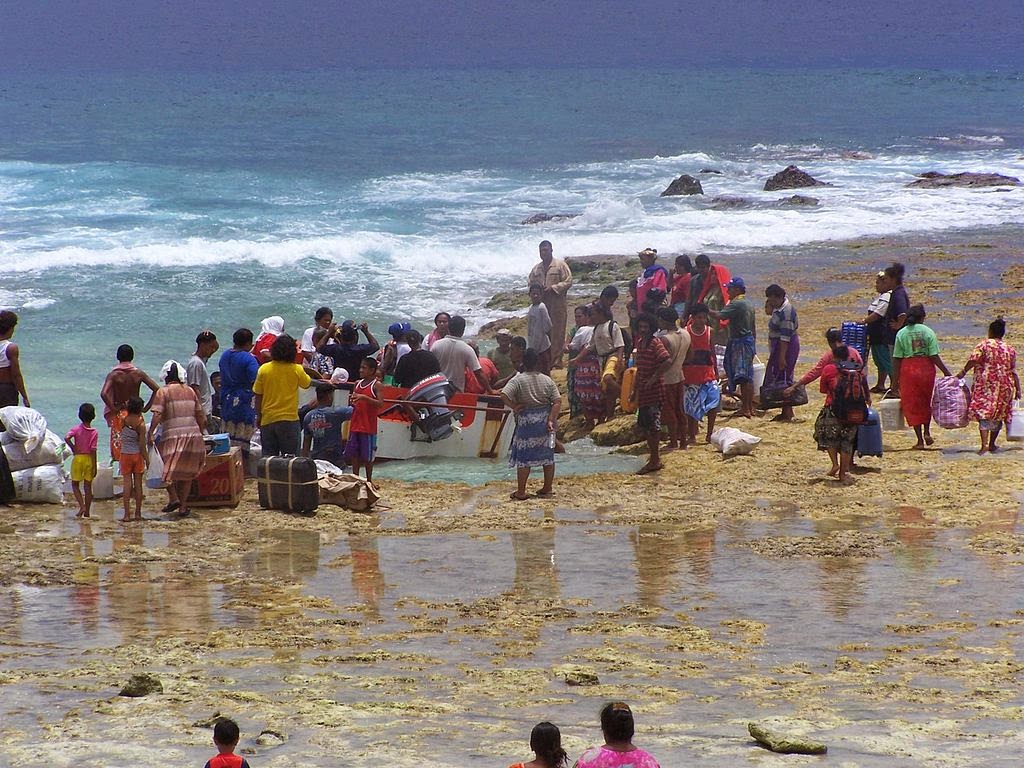
Cargo is offloaded from tenders that transfer passengers & cargo between the inter-island ferries and each of the outer islands of Tuvalu (here on the island of Niutao). A hazardous exercise, fraught with risk for passengers & the crew of the tenders. Shot by CESQLD, public domain

Sunday, September 28, 2014

A new breed of muni bond is financing climate change adaptation

Cassie Owens in Next City: Scott Stringer has his way, New York will soon be the nation’s largest municipal player in the burgeoning green bond market. On Wednesday, Stringer, the city comptroller, proposed a new program for issuing municipal bonds specifically dedicated to financing climate-friendly projects. Announced during UN Climate Week, Stringer’s proposal came a few days after Mayor Bill de Blasio unveiled a plan to cut the city’s greenhouse gas emissions by 80 percent by 2050.

Internationally, interest has grown in green bonds as cities like New York embark on record numbers of big-ticket infrastructure projects aimed at boosting resilience to climate change. In New York alone, the tab on the planned projects will exceed $27 billion over the coming years. In 2014, worldwide green bonds issuance is expected to nearly quadruple last year’s total, and in another Climate Week announcement, several major investment banks such as Zurich, Barclays and Aviva made promises to invest in the bonds and help strengthen the market.

New York isn’t the first city to see opportunity in green bonds. In July, the District of Columbia Water and Sewer Authority issued a $350 million, 100-year certified green bond. The $2.6 billion project will all but rid the city of combined sewer overflows, or treat wastewater from multiple pipes and tunnels that would have otherwise flowed altogether into the city’s rivers. Investors placed orders for about $1.1 billion worth of bonds, with about $100 million coming from those specifically focused on green bonds, the Wall Street Journal reported. George Hawkins, general manager of the water authority, told the Journal that the robust reception from Wall Street was unusual; the green bond “brought more investors to the table” than a regular bond might have.

D.C. Water and Sewer CFO Mark Kim believes that green bonds could be great for other utilities. D.C. Water and Sewer will certainly be issuing more. “Our intent is to finance all remaining capital expenditures for the Clean Rivers Project with a green bond,” Kim says.

Green bonds have been slow to catch on. The World Bank sold the first green bonds in 2008 as part of its efforts to encourage climate change adaptation and mitigation, but the bonds didn’t pick up steam in America until 2013. Experts say total bond issuance is on track to reach $40 billion by year’s end, a pool of money that will in large part go to strengthening infrastructure, including water systems, electrical grids and transportation networks.

What green bonds bring to the table is a not a new order, but rather a new label for reaching investors interested in climate-friendly projects. Matt Fabian, a managing director of Municipal Market Advisors, points out the processes for a muni green bond and any other muni bond are identical....

Driving on the Verrazano Narrows Bridge, shot by Bob Jagendorf, Wikimedia Commons via Flickr, under the Creative Commons 2.0 license

Saturday, December 28, 2013

In the Philippines, a vortex of climate change and debt

Samuel Oakford in IPS: Since Typhoon Yolanda made landfall in the Philippines on Nov. 8, the country has sent holders of its debt close to one billion dollars, surpassing, in less than two months, the 800 million dollars the U.N. has asked of international donors to help rebuild the ravaged central region of the archipelago.

Even as the Philippines goes hat in hand to wealthier countries seeking disaster relief, it continues to diligently pay creditors in those same countries millions of dollars every day – much of it interest on debt that can be traced back to the corrupt regime of Ferdinand Marcos (1965-1986) , Cold War ally to the West.

When Philippine President Benigno Aquino III announced last week the staggering cost of rebuilding from the storm, the price tag – 8.17 billion dollars – and a pair of emergency loans to help meet that goal distressed debt reduction campaigners in the country who have for many years called for a cancellation of illegal debts.

“Every dollar of funding assistance will be used in as efficient and as lasting a manner as possible,” Aquino assured reporters. “The task immediately before us lies in ensuring that the communities that rise again do so stronger, better and more resilient than before.”

Yet every 12 months, the Philippines transfers to lenders nearly the same amount Aquino hopes to raise for reconstruction. And because Filipino law privileges the payment of debt over all other expenses, those installments could end up eating into rebuilding funds.

Even before the storm, education and healthcare spending in the country fell well short of global benchmarks; one in five Filipinos live in poverty and over 15 million are malnourished....


Shanties in Manila, photo by Anton Zelenov, Wikimedia Commons, under the Creative Commons Attribution-Share Alike 3.0 Unported license

Monday, November 4, 2013

Debt for climate adaptation exchanges can work for small island developing states

The Jamaica Observer: Small island developing states (SIDS), among which Jamaica is classified, are suffering from two major problems, one, which in the short term will sink them economically, and the other, which will eventually sink them, or at least large parts of them, physically. The first is debt and the second is climate change. The SIDS are heavily indebted, with most of them having debt/GDP ratios of over 60 per cent and many with over 100 per cent.

...If the SIDS are to survive, they must spend substantial sums of money quickly to take action to protect themselves and delay the impact of the inexorable rise of the sea level.

The problem is that debt repayment demands such a large share of the government's budget and a significant share of foreign exchange that there is hardly any prospect of economic growth. A vicious cycle of impoverishment is entrenched in which debt prevents growth, and the lack of it, in turn, prevents debt repayment. Meanwhile, climate change is having an adverse impact on resources, eg beaches, and economic activity such as tourism.

The obvious solution is foreign assistance from the international development institutions and the developed countries to bail out the SIDS. In these days of a prolonged global economic crisis nobody is giving away aid or granting debt cancellation.

The solution to the problem of the debt-strapped, climate-affected SIDS is debt for adaptation exchanges. There are two types, the first involving commercial or private debt owed to banks and bondholders and the second, bilateral debt owed to governments....

Sunset on the sea at Seven Mile Beach, Negril, Jamaica. Shot by Chaoleonard, Wikimedia Commons, under the Creative Commons Attribution-Share Alike 3.0 Unported, 2.5 Generic, 2.0 Generic and 1.0 Generic license

Tuesday, June 4, 2013

Could climate bonds become a major force in green finance?

Environmental Leader: So-called “green” or “climate” bonds, being issued by a number of financial institutions and state governments as a means of generating funding for sustainable development and clean energy technology, are becoming increasingly popular and could become a major new force in the green investment world, according to the Globe-Net.

The World Bank developed the Green Bond concept in 2007/2008 and simplicity is key to its popularity, according to Globe-Net blog post. The World Bank’s green bonds are triple-A rated and can be traded as easily as other “vanilla” investments, offering investors a high rate of liquidity.

More than $3.3 billion worth of the bonds have been issued by the Word Bank since their creation. Over the past 18 months the  market for these types of investments has doubled, from $5 billion to $9.5 billion, Globe-Net says.

Last month International Finance Corp issued $1 billion of green bonds that will finance climate-friendly projects in the developing world. The bond offering was oversubscribed and was, according to Globe, ”quickly snapped up.” IFC now plans to issue at least $1 billion in green bonds per year, Globe-Net reports.

Last month the European Investment Bank set prices for its first Climate Awareness Bond transaction for 2013 targeted to fixed income investors to support EIB lending for renewable energy and energy efficiency. The state of Massachusetts plans to issue $1.1 billion of binds similar to those issued by the World Bank next month, Globe-Net says.

Such is the growth in interest of such bonds that Globe-Net cites speculation that socially responsible investing could grow from the niche investment technique that it has been for the past few years into a complex array of investments with different risk and reward profiles suited to a much broader set of investors....

Thursday, August 23, 2012

Bangladesh farmers caught in vicious cycle of flood and debt

Syed Zain Al-Mahmood in the "globaldevelopment blog" at the Guardian (UK): ..."People assume that since floods happen almost every year in Bangladesh, flood-affected people have learnt to cope, but it's not that easy," said Abdul Mannan, a senior official at the Ministry of Food and Disaster Management. "The next month will be hard. These people are in real danger of falling into debt."

Flooding is a significant obstacle to the development of Bangladesh, which is home to two of the largest river systems in the world: the Brahmaputra and the Ganges. This year the floods arrived after the harvest of the dry season rice crop – locally known as boro – but the waters hampered planting for the next crop and prevented villagers in some areas from taking their produce to market. Because the flooding leaves communities isolated, income-generating activities are also severely curtailed.

"When you're poor and hungry, losing your home or crops to floods can mean the beginning of the end," said Anisul Islam, director of the Centre for Natural Resources Studies, an NGO with anti-poverty programmes in the region. "The people affected by natural disasters have no insurance policy and no savings to fall back on. They sink deeper into poverty."

Studies carried out after a major flood in 2004 showed that flooded households often fall into a vicious cycle of debt and roughly a fifth of flood-hit families are pushed below the poverty line.

Other studies have confirmed that flood-affected rural communities often deal with the short-term shocks by adopting extreme coping mechanisms – including borrowing money to buy food, reducing expenditure by skipping meals, and selling assets such as cows and goats. Vulnerable families coping with the destruction of their homes, unsafe drinking water and reduced calorie consumption are faced with crippling interest rates – ranging from 21-67% – charged by local loan sharks....

Thursday, September 2, 2010

Flood-ridden Pakistan ineligible for emergency debt relief

Matthew Berger in IPS: A loan deal between the International Monetary Fund (IMF) and flood-stricken Pakistan announced Thursday has drawn the ire of several NGOs that claim the deal represents an "inadequate" and "cynical" response to the disaster that is estimated to have affected the lives of millions.

The news of the loan follows more than a week of talks between Pakistani and IMF officials here, in which Pakistan hoped some of the terms of the 10.66 billion dollar loan granted in 2008 would be loosened in light of the floods which have left a dent in the Pakistani economy that is likely to last long after the floodwaters have receded. Those loan terms set deficit and inflation targets Pakistan has said it will be unable to meet in a post-flood economy. The IMF, for its part, as recently as June has called for Pakistan to take stronger steps to meet those reforms.

Efforts to maintain fiscal discipline, for instance, "proved initially successful, but since June 2009, the authorities have repeatedly exceeded the quarterly budget deficit targets under the program," an IMF statement said in June of this year. It also noted that inflation has been on the rise, reaching 13 percent in March.

But given the magnitude of the damage and suffering caused by the flood since late July, those macroeconomic and fiscal concerns should be irrelevant for the time being, some groups are saying. "Pakistan can not be expected to service debt as it struggles to cope," said Elizabeth Stuart, a senior policy advisor at Oxfam, a group of NGOs from three continents working worldwide to fight poverty.

"Pakistan’s resources must now be directed at recovery from this disaster, and a debt burden can not be allowed to impede recovery," Stuart said, noting a third of Pakistan’s budget revenues are currently spent on loan repayments….

Tuesday, June 1, 2010

Oxfam warns of climate debt with World Bank climate aid

Abigail Kwok in the Inquirer (Philippines): Oxfam International has warned that the $100 billion a year pledged by rich nations to help fight climate change could fail the poorest people if recent moves to deliver climate cash as loans continue. In its report, “The $100 billion Questions,” Oxfam raised concerns saying that “a significant proportion of the first installments of climate cash, to be delivered between 2010 and 2012 will be loans not grants.”

“At a time of economic emergency, when several poor countries are slashing critical health and education budgets to avoid a debt crisis, rich countries are considering saddling them with climate debt for a situation they did not cause and are worst affected by,” said Oxfam’s Senior Policy Advisor Antonio Hill Tuesday.

…In its report, Oxfam lays out suggestions on how rich countries can not only meet their $100 billion a year promise, but also double it by 2020. Some of the suggestions include:

• $100 billion a year from a global Financial Transactions or ‘Robin Hood’ tax on banks;

• $20-$30 billion a year through the creation of emissions trading schemes for international aviation and shipping. This would cap the amount of carbon emissions these industries could produce and then charge them for each unit of carbon used;

• $75 billion a year in fixed contributions from rich countries according to their historic responsibility for carbon emissions and ability to pay. This could be raised through the money from domestic emissions trading (or cap-and-trade) schemes or taken from budgets currently used for subsidizing fossil fuels and carbon-heavy industry;

• $16 billion a year by 2012 from the IMF in the form of low-interest loans for low-carbon development. Using $120 billion of rich country Special Drawing Rights (SDRs) as capital, ‘green bonds’ could be issued, raising $40 billion per year that can be made available as low-cost loans for clean energy investments in developing countries. Of the $40 billion loaned every year, the net transfer (or savings) benefiting developing countries is $16billion….

The 1555 woodcut illustrates the story tale how Starkaðr helped the Norwegian king Helge to fight against nine unjust fighters. From Olaus Magnus' "Historia de gentibus septentrionalibus"

Friday, August 7, 2009

Ecuador wants 'carbon bonds' to save forest

Carbon Positive: While the UN, World Bank and NGOs work away at creating a new international carbon payments mechanism to save the world’s remaining rainforests, Ecuador has been trying a variation on theme – carbon bonds. The bonds would be issued over a government guarantee that oil won’t be extracted from the Yasuni National Park in the Ecuadorian Amazon and its forest and biodiversity preserved.

The project would deliver a total of 407 million tonnes of emissions reduction savings, primarily from the avoided extraction and burning of 850 million barrels of oil under the reserve, and the protection of forest. There would also be significant benefits in biodiversity conservation and protecting the way of life of two indigenous groups living traditionally in the forest.

Working in a similar way to tradable carbon offset credits generated in return for emission reductions, the Ecuadorian government envisages issuing Yasuni Guarantee Certificates linked to the price of offset credits on the European carbon market.

Revenue from bond sales would offset the royalties foregone to oil companies in locking up the reserve permanently. If the oil reserve were to be exploited at some future date, the bonds would be cancelled and the government would be legally bound to return the proceeds, plus interest….

The wooded banks of the River Pindo, in Pastaza province, Ecuador, shot by The lifted lorax, Wikimedia Commons, under the Creative Commons Attribution ShareAlike 3.0 License

Wednesday, April 15, 2009

1,500 farmers commit mass suicide in India

The Independent (UK): Over 1,500 farmers in an Indian state committed suicide after being driven to debt by crop failure, it was reported today. The agricultural state of Chattisgarh was hit by falling water levels.

"The water level has gone down below 250 feet here. It used to be at 40 feet a few years ago," Shatrughan Sahu, a villager in one of the districts, told Down To Earth magazine "Most of the farmers here are indebted and only God can save the ones who do not have a bore well." Mr Sahu lives in a district that recorded 206 farmer suicides last year. Police records for the district add that many deaths occur due to debt and economic distress.

…Bharatendu Prakash, from the Organic Farming Association of India, told the Press Association: "Farmers' suicides are increasing due to a vicious circle created by money lenders. They lure farmers to take money but when the crops fail, they are left with no option other than death." Mr Prakash added that the government ought to take up the cause of the poor farmers just as they fight for a strong economy. "Development should be for all. The government blames us for being against development. Forest area is depleting and dams are constructed without proper planning.

Mahuwa trees in Chattisgarh state, India, shot by Nvvchar, Wikimedia Commons, under the Creative Commons Attribution ShareAlike 3.0 License

Wednesday, October 8, 2008

From Sri Lanka, a proposal to trade debt against carbon credits

A striking idea from Sri Lanka, reported on by IPS: Little Sri Lanka wants developing countries to be able to trade their debts against the environment destruction and climate change attributed to the developed nations. Piloting the idea is Sri Lanka's environmental minister Champaka Ranawaka, a maverick politician who may be taking on more than he can chew by trying to rally undeveloped nations around the concept of ‘environmental debt’ owed by the richer countries.

"We have a right to live; a right to develop, but that is being blocked by richer nations," the minister, a qualified engineer, told IPS in an interview. Ranawaka and his aides want to take the idea of environmental debt to the main forums of the world and convince the richer nations to exchange their debt claims from borrower-countries against environmental damage caused.

"Our foreign debt is 1.35 billion US dollars but our environmental cost is much higher because richer countries have polluted our environment and we are told to forget development," he said. "Forget GSP Plus or other trade concessions -- we should be able to trade off our environmental burden against loans and trade benefits. The U.S. has already exploited our resources and retarded our development. Now they must pay for it." Currently the only form of payback to developing countries for carbon emissions by richer countries is the carbon trading mechanism developed under the United Nation’s Kyoto protocol. Carbon trading is a market-based mechanism for helping mitigate the increase of CO2 in the atmosphere. Carbon trading markets bring buyers and sellers of carbon credits together with standardised rules of trade. A handful of Sri Lankan companies are already involved in this exercise.

Environmentalists tend to agree with Ranawaka's rational views on the environment, but believe it would be a huge uphill task to convince the international community to accede to such a proposal. "He may be irrational in his views on the ethnic conflict but he is well read and intelligent on the environment and on many other issues," one environmentalist said…..

Flag of Sri Lanka