Showing posts with label coal. Show all posts

Sunday, July 12, 2015

Coal giant exploited Ebola crisis for corporate gain, say health experts

Suzanne Goldenberg in the Guardian (UK): Public health experts involved in the response to the Ebola crisis have condemned what they described as a ludicrous, insulting and opportunistic attempt to exploit the disease for corporate gain by the world’s largest privately-held coal company.

As part of a PR offensive to rebrand coal as a “21st-century fuel” that can help solve global poverty, it has emerged that at the height of Ebola’s impact in Africa, Peabody Energy promoted its product as an answer to Africa’s devastating public health crisis.

Greg Boyce, the chief executive of Peabody, a US-based multinational with mining interests around the world, included a slide on Ebola and energy in a presentation to a coal industry conference in September last year. The slide suggested that more energy would have spurred the distribution of a hypothetical Ebola vaccine – citing as supporting evidence a University of Pennsylvania infectious disease expert.

The World Health Organisation believes nearly 27,000 people contracted Ebola in an outbreak of the virus in West Africa last year, and more th
an 11,000 died – although the international agency believes that is probably an underestimate.

Public health experts who were involved in fighting the spread of Ebola were outraged at Peabody’s suggestion that expanding energy access with coal generation could have hindered the spread of Ebola and helped with the distribution of a vaccine – especially as there is no approved vaccine against the disease....

Coal stockpile at the Peabody Coal's Kayenta mine, Peabody Coal photo, Wikimedia Commons, under the Creative Commons Attribution 3.0 Unported license

Saturday, July 4, 2015

New coal plants 'most urgent' threat to the planet, warns OECD head

Fiona Harvey in the Guardian (UK): Governments must rethink plans for new coal-fired power plants around the world, as these are now the “most urgent” threat to the future of the planet, the head of the OECD has warned. In unusually strong terms for the organisation – best known as a club of the world’s richest countries – its secretary general Angel Gurria, told governments to think “twice, or three, or four times” before allowing new coal-fired plants to go ahead.

“They will still be emitting years from now,” he warned. As a result, many could turn into “stranded assets”, having to be mothballed decades before their economic lifetime had expired. “We are on a collision course with nature,” he warned.

New research, published by the OECD on Thursday, has found that, on current trends, coal-fired power generation will result in more than 500bn tonnes of carbon dioxide released into the atmosphere between now and 2050. That is the equivalent of about half of the “carbon budget” – the amount of greenhouse gas that we can safely pour into the atmosphere – for this half-century, if we are to stay within the 2C limit that is widely agreed as the threshold for dangerous climate change.

Gurria said that financing from rich countries to provide access to renewable energy in developing nations as an alternative to coal should
form a key part of the discussions in the run-up to the crunch UN climate talks in Paris in December. Governments are hoping to agree a new deal on greenhouse gas emissions involving all countries, to take effect from 2020 when current commitments expire, and with absolute cuts in emissions from the rich nations and curbs on the growth of future emissions from the poor....

A Drax coal-fired power station in the UK, shot by Paul Glazzard, Wikimedia Commons via Geograph UK, under the Creative Commons Attribution-Share Alike 2.0 Generic license

Wednesday, December 10, 2014

Black Mesa mines: Native Americans demand return of their ancestors' bones

Leslie Macmillan in the Guardian (UK): In 1967 the Peabody coal company came to the Navajo and Hopi reservations in northern Arizona and Utah to excavate a strip mine – but the land it leased from the tribes was on an ancient tribal burial ground. So, as required by law, it hired archeologists and for the next 17 years a dig known as the Black Mesa archeological project – the largest in North American history – unearthed more than one million artefacts, including the remains of 200 Native Americans.

Now the bones and artefacts are at the centre of a debate between tribes people who say ancestral remains and archeological ruins have been desecrated, and a coal company and government officials who are planning a new dig.

Native American groups and the Sierra Club are suing the US government to protect ancient Indian burial sites as one of the world’s biggest coal companies, Peabody, seeks a lifetime mining permit for the land it leases from the tribes. “I am incensed that my ancestors were dug up, ground up and send off to universities to be studied,” said Vernon Masayesva, a plaintiff and former Hopi tribal chairman.

Peabody says it has taken good care of the artefacts and bones. The collection is curated “with the express wishes of both tribes” and “in compliance with federal law,” said Beth Sutton, a company spokesperson.

But a report by the Army Corps of Engineers, which surveyed the collection early last decade at the University of Illinois, where it is housed, found the curation to be “substandard in every respect”. Rodents and spiders “were a problem”, according to the report, which notes that facilities had been broken into and artefacts were missing.

What’s more, Alan Downer, a former historical preservation officer for the Navajo Nation, said the tribe had never authorised any remains to be loaned to a professor, Debra L Martin, who teaches at the University of Nevada at Las Vegas. He said he was “shocked to find out” about eight years ago, that she had had the bones since 1980...

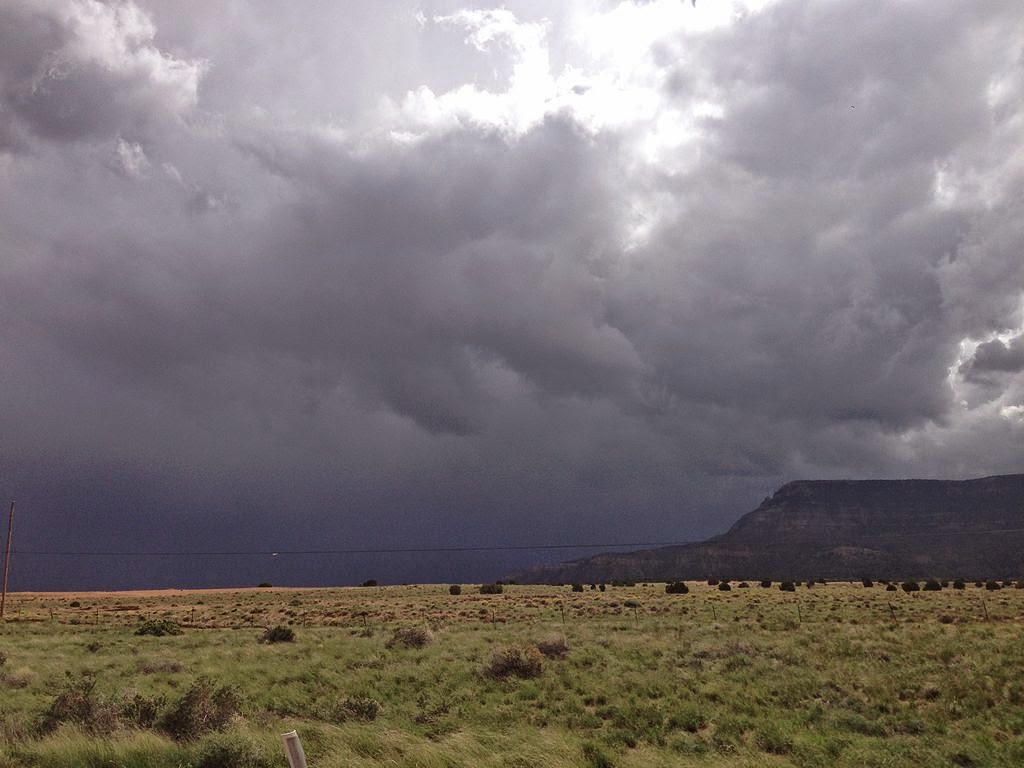
A thunderstom of Black Mesa, near Kayenda, Arizona. Shot by Famartin, Wikimedia Commns, under the Creative Commons Attribution-Share Alike 3.0 Unported license

Saturday, October 11, 2014

Satellite data shows surprising methane hotspot in US southwest

The Guardian (UK) via AP: A surprising hotspot of the potent global warming gas methane hovers over part of the southwestern US, according to satellite data and is likely to be leakage from pumping methane out of coal mines. The result hints that the US Environmental Protection Agency (EPA) and other agencies considerably underestimate leaks of methane, which is also called natural gas.

The higher level of methane is not a local safety or a health issue for residents, but is a factor in overall global warming. While methane isn’t the most plentiful heat-trapping gas, scientists worry about its increasing amounts and have had difficulties tracking emissions.

A satellite image shows the hotspot of atmospheric methane concentrations as a bright red blip over the Four Corners area of New Mexico, Colorado, Arizona and Utah in continental US. The image used data from 2003 to 2009.

Within that hotspot, a European satellite found atmospheric methane concentrations equivalent to emissions of about £1.3m a year. That’s about 80% more than the EPA figured. Other ground-based studies have calculated that EPA estimates were off by 50%. The methane concentration in the hotspot was more than triple the amount previously estimated by European scientists.

The amount of methane in the Four Corners, an area covering about 2,500 square miles would trap more heat in the atmosphere than all the carbon dioxide produced yearly in Sweden. That’s because methane is 86 times more potent for trapping heat in the sh
ort-term than carbon dioxide.

...“It’s the largest signal we can see from the satellite,” said study lead author Eric Kort, a University of Michigan atmospheric scientist. “It’s hard to hide from space.” There could be some areas elsewhere in the country where more methane is emitted if it is dispersed by wind, Kort said. Kort said the methane likely comes from leaks as workers extract natural gas from coal beds, and not from hydraulic fracturing, called fracking, because the data were collected before fracking really caught on....

Image of hotspot from NASA

Tuesday, June 17, 2014

Coal consumption highest since 1970

Energy Daily via UPI: As world leaders try to generate momentum for an international agreement on and solution to climate change, large amounts of coal continue to be produced and burned. In fact, coal consumption now accounts for more than 30 percent of the world's energy market -- its highest share in 44 years.

According to a recently released report, the "BP Statistical Review of World Energy 2014," coal consumption grew three percent in 2013 -- more than any other energy source. That's a dip from coal's ten year average; consumption of the fuel has grown nearly 4 percent per year over the last decade.

It's bad news for those who had hoped alternative and renewable energy sources would cut into the dominance of dirtier, more traditional sources like coal. Although renewables continue to grow, especially wind and solar, they can't keep up with cheaper and more popular competitors like coal.

Americans -- who sit on the largest coal reserves in the world -- are using less coal, thanks to the abundance of cheaper shale gas. But the U.S. is still producing and exporting the fuel to Europe and Asia in huge amounts, chiefly China and India....

Stoking coal in the Royal Navy during World War II

Tuesday, June 3, 2014

EPA seeks 30% cut in power plant carbon emissions by 2030

Wendy Koch in USA Today: Taking a historic step to fight climate change, the Obama administration proposed a plan Monday that aims to slash carbon dioxide emissions from existing power plants 30% by 2030 and could accelerate the nation's shift away from coal.

The Environmental Protection Agency plan, which is President Obama's largest climate effort so far, could help the United States prod other countries like China to pledge similar emissions cuts as part of a new international treaty that's slate for negotiation next year in Paris.

The controversial 645-page plan, expected to trigger legal challenges, sets different reduction targets for each state and gives them flexibility in how to achieve them. Yet it aims for a 30% national reduction of heat-trapping CO² emissions, from 2005 levels, by 2030 -- an amount that the EPA says is equal to annual emissions from powering more than half of U.S. homes.

... Some states that rely heavily on coal-fired power plants will have lower emission targets by 2030 than others that do not. For example, West Virginia must cut 19%,compared to its 2012 emissions, while Ohio must cut 28%, Kentucky 18%
and Wyoming, 19%. In contrast, New York has a 44% target although it can get credit for steps it's already taken to lower emissions.

Thwarted by Congress' inability to pass a bill to lower carbon emissions, Obama is pushing his own approach. Last June, he asked the EPA to use its authority under the Clean Air Act to limit power plant emissions, which account for the largest share — nearly 40% — of total U.S. emissions. Coal-fired facilities could be hardest hit, because they emit more carbon than other power plants.

The rule will not take effect for at least two more years. Obama has asked the EPA to finalize it in June 2015 and initially wanted each state to submit its plan by June 2016. The EPA proposal gives states until 2017 or, if they make joint efforts with other states, 2018....

The coal-fired Avon Lake power plant on Lake Erie, shot by Ben Stephenson, Wikimedia Commons via Flickr, under the Creative Commons 2.0 license 

Saturday, May 24, 2014

Australian environmentalists welcome bank wariness on reef port

PhysOrg: Environmentalists on Saturday welcomed Deutsche Bank's reluctance to invest in a major port expansion near Australia's Great Barrier Reef, saying it reflected global concern about the project. Australia gave the green light to the major coal port expansion for India's Adani Group at Abbot Point on the Great Barrier Reef coast last year subject to strict environmental conditions.

But conservationists slammed the approval, warning it would hasten the natural wonder's demise given it is under pressure from climate change, land-based pollution and crown-of-thorn starfish outbreaks. At its annual general meeting in Europe on Friday, Deutsche Bank said its policy for dealing with activities in or near World Heritage Sites ruled it out of investing in Abbot Point.

"Deutsche Bank does not support activities when the government and UNESCO do not agree that the planned activities do not place the exceptional universal value of the site at risk," the bank said. "As we have seen, there is currently no consensus between UNESCO and the Australian government regarding the expansion of Abbot Point in the vicinity of the Great Barrier Reef. Our policy requires such a consensus at the least. We therefore would not consider applications for the financing of an expansion any further."

UNESCO has stated concerns about coastal development proposed in the region including port and coal operations, with the body expected to discuss the issue at a meeting in June.

The Australian Marine Conservation Society, which is campaigning against the port expansion, welcomed Deutsche Bank's stance, which it said showed global concern about plans to "industrialise the coastline of the Great Barrier Reef"...

Helicopter view of the Great Barrier Reef, shot by Nickj, Wikimedia Commons, licenseed under Creative Commons 3.0 

Saturday, March 22, 2014

Invisible cities and flammable rivers: China’s pollution problem

Ilaria Bertini in Blue & Green Tomorrow: Disregard for pollution law from China, the world’s largest greenhouse gas emitter, is having destructive effects on the country’s rivers and land – not to mention its citizens and its long-term prosperity.

China relies heavily on coal-fired power plants to provide energy to its cities and businesses. This, combined with heavy traffic, has led to alarming levels of air pollution in major Chinese cities, including Beijing, Shijiazhuang, Xingtai, Harbin and Shanghai.

...In January, Beijing smog levels were reported to be 25 times higher than the limit considered safe by authorities, in a crisis that continued well into February. Officials say thousands of people die prematurely every year in the country because of the poor quality air. Industrial pollution is so high that it is spreading to nearby Tokyo and Seoul.

Pollution is poisoning the land, making it unsuitable for agriculture, and it’s also contaminating waterways. Earlier this month, a river in the city of Wenzhou was literally set on fire by a discarded cigarette – as years of industrial spillage had made it flammable.

Some businesses are fleeing the country as a result. A survey by the American Chamber of Commerce in Beijing said many firms are finding it difficult to send top executives to work in China because of the pollution issues....

Smog in Harbin, shot by Fredrik Rubensson, Wikimedia Commons via Flickr, under the Creative Commons Attribution-Share Alike 2.0 Generic license 

Monday, January 27, 2014

Beijing's mayor urges "all-out effort" to curb air pollution

Sui-Lee Wee in Reuters: Beijing's mayor pledged on Thursday to cut coal use by 2.6 million tonnes and set aside 15 billion yuan ($2.4 billion) to improve air quality this year as part of the city's "all-out effort" to tackle air pollution, state news agency Xinhua said.

The announcement by Wang Anshun came as the capital was blanketed in its worst smog in months. An index measuring PM2.5 particles, especially bad for health, reached 500 in much of the capital in the early hours.

The U.S. Environmental Protection Agency considers a level above 300 hazardous. Coal-burning boilers inside Beijing's fifth ring road - covering the built-up area of the city - will be eliminated and measures taken against coal burning in the capital's periphery, Xinhua quoted Wang as saying.

The city also aims to ban all heavily polluting vehicles this year, cut new car registrations and promote new energy vehicles, Wang said....

Heavy smog in Tianamen Square, shot by McKay Savage, Wikimedia Commons via Flickr,  under the Creative Commons Attribution 2.0 Generic license 

Tuesday, December 10, 2013

US supreme court to rule on EPA's powers to enforce air pollution limits

Suzanne Goldenberg in the Guardian (UK): Barack Obama's authority to compel power plants in the US midwest to reduce the smog and soot that blow across to north-eastern states will be put to the test on Tuesday in the first of three major challenges to environmental regulations.

The supreme court will hear arguments about whether the Environmental Protection Agency (EPA) can set limits on air pollution that, while originating in one state, directly affect the air quality in other states.

It is the first of two cases this session that will help define the limits of the EPA's authority to deal with air pollution and climate change. Early next year, the court will hear a challenge to the EPA's plans to limit greenhouse gas emissions from power plants.

Elsewhere on Tuesday, the federal appeals court will hear a case seeking to overturn EPA limits on mercury and other emissions from coal-fired power plants. The case was brought by the coal company, Peabody Energy Corp, the United Mineworkers of America, Texas and other states.

In Tuesday's supreme court proceedings, judges will review whether the EPA had the authority to allocate responsibility for air pollution to the different states. The DC circuit court struck down the regulation in August 2012, following a challenge filed by 15 states....

James Earle Fraser's statue The Authority of Law, which sits on the west side of the United States Supreme Court building, on the south side of the main entrance stairs. Shot by Matt H. Wade, Wikimedia Commons, under the Creative Commons Attribution-Share Alike 3.0 Unported license

Friday, September 27, 2013

First ship through the Arctic carried coal

John McGarrity and Henning Gloystein in Reuters: A large sea freighter completed a voyage through the hazardous Arctic Northwest Passage for the first time on Friday as global warming opens routes that mariners have wanted for centuries.

The 75,000 deadweight-ton Nordic Orion, built in 2011, left the Canadian Pacific port of Vancouver in early September with a cargo of coking coal and is scheduled to arrive in the Finnish port of Pori on October 7, according to AIS shipping data.

"The Northwest Passage is more than 1,000 nautical miles shorter than the traditional shipping route through the Panama Canal and will save time, fuel and reduce carbon dioxide emissions, but even more importantly increase the amount of cargo per transit 25 percent," said Nordic Bulk Carriers, the Danish owner of the ship...

A coal loading depot in Inverkeithing, shot by Richard Webb, Wikimedia Commons via Geograph UK, under the Creative Commons Attribution-Share Alike 2.0 Generic license 

Monday, June 17, 2013

Leave coal in ground, Australian scientists urge governmen

Ben Cubby in the Sydney Morning Herald: Most of Australia's coal reserves will have to be left unburned if the world is to avoid catastrophic global warming, according to a major new report from the federal government's Climate Commission. The report puts the key science advisory body on a collision course with some of the nation's biggest export industries, and marks the first time a government agency has endorsed calls for fossil fuel industries to be phased out because of their contribution to climate change.

Its findings mean that most of Australia's known coal, oil and gas reserves – many of which are already subject to minerals production licences held by companies such as BHP Billiton and Rio Tinto – must somehow be left alone if the world is to avoid dangerous climate change.

The Climate Commission acknowledged its conclusions were "sobering" and that the potential for economic disruption could be serious, but said there was no alternative if the world was to avoid dangerous climate change.

"How people react to this is up to the policymakers and governments, as well as investors," said Professor Lesley Hughes, co-author o
f the report The Critical Decade 2013 – Climate change science, risks and responses, to be released on Monday.

"It isn't our job to reconcile the politics of this with the science," she said. "We are simply presenting the facts as best we know them. Just because the facts may be unpalatable to some people doesn't make them any less important."...

Trains and overburden dredge on the former 900mm gauge railway in the open cut coal mine at Yallourn, Victoria, Australia. Taken in 1948 or thereabouts. Scanned from Gill, Herman (1949) Three Decades: The story of the State Electricity Commission of Victoria from its inception to December 1948, Hutchinson & Co

Wednesday, June 12, 2013

European coal pollution causes 22,300 premature deaths a year, study shows

John Vidal in the Guardian (UK): Air pollution from Europe's 300 largest coal power stations causes 22,300 premature deaths a year and costs companies and governments billions of pounds in disease treatment and lost working days, says a major study of the health impacts of burning coal to generate electricity.

The research, from Stuttgart University's Institute for energy economics and commissioned by Greenpeace International, suggests that a further 2,700 people can be expected to die prematurely each year if a new generation of 50 planned coal plants are built in Europe. "The coal-fired power plants in Europe cause a considerable amount of health impacts," the researchers concluded.

Analysis of the emissions shows that air pollution from coal plants is now linked to more deaths than road traffic accidents in Poland, Romania, Bulgaria and the Czech Republic. In Germany and the UK, coal-fired power stations are associated with nearly as many deaths as road accidents. Polish coal power plants were estimated to cause more than 5,000 premature deaths in 2010.

The cumulative impact of pollution on health is "shocking", says an accompanying Greenpeace report. A total of 240,000 years of life were said to be lost in Europe in 2010 with 480,000 work days a year and 22,600 "life years" lost in Britain, the fifth most coal-polluted country. Drax, Britain's largest coal-powered station, was said to be responsible for 4,450 life years lost, and Longannet in Scotland 4,210....

The picture is of Queen Elizabeth and King George Dock in the background and the storage area for cheap imported Eastern European coal in the foreground. All but the bottom left hand side of this area is within the specified square (TA1528). The area of the coal heap is huge - about 16 hectares (39 acres). The picture was taken (from memory) at about 1200 feet. Shot by Andy Beecroft, Wikimedia Commons via Geograph UK, under the Creative Commons Attribution-Share Alike 2.0 Generic license

Wednesday, April 24, 2013

Rivers act as “horizontal cooling towers,” study finds

University of New Hampshire Media Relations: Running two computer models in tandem, scientists from the University of New Hampshire have detailed for the first time how thermoelectric power plants interact with climate, hydrology, and aquatic ecosystems throughout the northeastern U.S. and show how rivers serve as “horizontal cooling towers” that provide an important ecosystem service to the regional electricity sector — but at a cost to the environment.

The analysis, done in collaboration with colleagues from the City College of New York (CCNY) and published online in the current journal Environmental Research Letters, highlights the interactions among electricity production, cooling technologies, hydrologic conditions, aquatic impacts and ecosystem services, and can be used to assess the full costs and tradeoffs of electricity production at regional scales and under changing climate conditions.

...Thermoelectric power plants boil water to create steam that in turn drives turbines to produce electricity. They provide 90 percent of the electricity consumed nationwide and an even a greater percentage in the Northeast — a region with a high density of power plants.

Cooling the waste heat generated during the process requires that prodigious volumes of water be withdrawn and makes the thermoelectric sector the largest user of freshwater in the U.S. — withdrawing more than the entire, combined agricultural sector. Water withdrawals are either evaporated in cooling towers or returned to the river at elevated temperatures. Rivers can help mitigate these added heat loads through the ecosystem services of conveyance, dilution, and attenuation  — essentially acting as horizontal cooling towers as water flows downstream.

Says Stewart, a research scientist in the EOS Earth Systems Research Center, “Our modeling shows that, of the waste heat produced during the production of electricity, roughly half is directed to vertical, evaporative cooling towers while the other half is transferred to rivers.” The study also shows that, of the waste heat transferred to rivers, only slightly more than 11 percent wafts into the atmosphere with the rest delivered to coastal waters and the ocean. ...

Tricastin Nuclear Power Center in the Rhone wine region of Coteaux du Tricastin. Shot by jean-louis Zimmermann, Wikimedia Commons via Flickr, under the Creative Commons Attribution 2.0 Generic license

Monday, March 25, 2013

China’s electricity industry faces severe water shortages

Todd Woody in Quartz: For those keeping track of China’s looming environmental apocalypse, here’s another thing to worry about: The nation’s coal-fired power plants face severe water shortages that could disrupt their operations—and the economy—in the years ahead.

Coal supplies nearly 80% of China’s electricity and has fueled the country’s economic boom. But thermal power plants need water to generate steam and cool their operations. Yet 85% of  China’s generating capacity is located in “water-stressed” regions, according to a report released today by market research firm Bloomberg New Energy Finance. And 60% of China’s electricity is produced in northern China, which has just 20% of the country’s freshwater supplies. The map above shows how China’s coal-fired generating capacity is concentrated in regions where water is scarce.

It gets worse for China’s big five state-owned utilities. Two of them, Huaneng and Datang, have 84% of their generating capacity tied up in areas that are moderately to severely water stressed. Even the utility with the least exposure to water shortages, Guodian, faces water-related risks to 65% of its assets, according to Bloomberg.

Bloomberg estimates that Chinese utilities will consume 124 billion cubic meters of water annually by 2030, up from 102 billion cubic meters in 2010.

“The era of water abundance in China is over, and competition for resource access between business, agriculture, and urban centers is starting to bite,” said Maxime Serrano Bardisa, one of the report’s authors, in a statement….

China's Three Gorges Dam seen from space, via NASA in 2011

Saturday, March 9, 2013

Large rise in CO2 emissions sounds climate change alarm

John Vidal in the Guardian (UK): The chances of the world holding temperature rises to 2C – the level of global warming considered "safe" by scientists – appear to be fading fast with US scientists reporting the second-greatest annual rise in CO2 emissions in 2012.

Carbon dioxide levels measured at at Mauna Loa observatory in Hawaii jumped by 2.67 parts per million (ppm) in 2012 to 395ppm, said Pieter Tans, who leads the greenhouse gas measurement team for the US National Oceanic and Atmospheric Administration (NOAA). The record was an increase of 2.93ppm in 1998.

The jump comes as a study published in Science on Thursday looking at global surface temperatures for the past 1,500 years warned that "recent warming is unprecedented", prompting UN climate chief, Christiana Figueres, to say that "staggering global temps show urgent need to act. Rapid climate change must be countered with accelerated action."

Tans told the Associated Press the major factor was an increase in fossil fuel use. "It's just a testament to human influence being dominant", he said. "The prospects of keeping climate change below that [two-degree goal] are fading away."...

An old Mauna Loa emissions chart

Tuesday, August 14, 2012

China's coal expansion may spark water crisis

Reuters: China's plan to rapidly expand large coal mines and power plants in its arid northern and western provinces threatens to drain precious water supply and could trigger a severe water crisis, a report by environmental activists Greenpeace said on Tuesday.

China intends to boost coal production in provinces including Inner Mongolia, Shanxi, Shaanxi and Ningxia, with output in those areas expected to reach 2.2 billion tons, or 56 percent of the country's forecast production of 3.9 billion tons, by 2015.

As part of the country's major overhaul of its power generation strategy, Beijing also plans to build 16 large coal-fired power stations in those provinces by 2015. Total installed capacity for the plants is expected to exceed 600 gigawatts. Coal mining and coal-fired power generation are extremely water-intensive projects.

Water demand created by this energy strategy, along with the development of coal-related industries in these area, will consume at least 9.98 billion cubic meters of water by 2015 - equivalent to one sixth of the annual total water volume of China's largest Yellow River, Greenpeace said in a report on Tuesday....

Photo of a coal-fired power plant in Shuozhou, Shanxi, China, shot by Kleineolive, Wikimedia Commons, under the Creative Commons Attribution 3.0 Unported license 

Friday, May 25, 2012

Carbon dioxide emissions reach record high

Neela Banerjee in the Los Angeles Times: Emissions of heat-trapping carbon dioxide reached an all-time high last year, further reducing the chances that the world could avoid a dangerous rise in global average temperature by 2020, according to the International Energy Agency, the energy analysis group for the world’s most industrialized states.

Global emissions of carbon-dioxide, or CO2, from fossil-fuel combustion hit a record high of 31.6 gigatonnes  in 2011, according to the IEA’s preliminary estimates, an increase of 1 Gt, or 3.2% from 2010. The burning of coal accounted for 45% of total energy-related CO2 emissions in 2011, followed by oil (35%) and natural gas (20%).

According to the vast majority of climatologists, the rapid rise of carbon dioxide in the atmosphere because of industrialization over the last 150 years has led to an increase in global average temperature by about 1 degree Celsius.

Scientists and the IEA contend that countries need to keep the global average temperature from rising by more than 2 degrees Celsius (3.6 degrees Fahrenheit) in order to avoid profound damage to life on Earth, from water and food scarcity to rising sea levels to greater incidence and severity of disease.

Last year’s jump in carbon emissions sets the world even more firmly on the path to hurtle past a two-degree Celsius increase. “The new data provide further evidence that the door to a 2C trajectory is about to close,” said IEA Chief Economist Fatih Birol...

Wednesday, January 18, 2012

More valuable than gold

Dominic Feain in the Coffs Coast Advocate (Australia): A new warning calling for greater research into Australia's groundwater has been welcomed by locals concerned about the burgeoning coal seam gas industry on the Northern Rivers.

The statement, released yesterday by the National Centre for Groundwater Research and Training, describes Australia's underground water reserves as a "buried treasure" potentially more valuable to our future gross national product than gold, oil, wheat or coal. It states groundwater will become increasingly critical as the population grows and temperatures rise.

Environmental scientist Boudicca Cerese, from community group Kyogle Against Gas, said her primary concern had always been the lack of information and she believed the warning vindicated the call for a moratorium on the industry until "adequate regional hydro-geological studies" have been undertaken. "The critical thing it says is that the key to ground water management is knowledge - and I believe we have insufficient knowledge to be going ahead with any coal seam gas exploration," she said.

The centre's director, Professor Craig Simmons, says that ground-water makes up 97% of the world's fresh water, but he expected dependence upon it to grow as the pressure from population growth, climate change, mining, coal seam gas and agriculture intensified.

"In a future where rainfall cannot be relied on, groundwater represents Australia's national water security for the future," Prof Simmons said. "Where our national security is concerned, we should spare no effort to assure it....

Water bore and dam on a property in the Townsville district of Queensland, Australia, ca. 1902

Saturday, November 12, 2011

Americans using more fossil fuels

Anne M. Stark at Lawrence Livermore National Laboratory: American energy use went back up in 2010 compared to 2009, when consumption was at a 12-year low. The United States used more fossil fuels in 2010 than in 2009, while renewable electricity remained approximately constant, with an increase in wind power offset by a modest decline in hydroelectricity. There also was a significant increase in biomass consumption, according to the most recent energy flow charts released by the Lawrence Livermore National Laboratory.

Wind power jumped from .70 quadrillion BTU, or quads, in 2009 to .92 quads in 2010. (A BTU or British Thermal Unit is a unit of measurement for energy and is equivalent to about 1.055 kilojoules). Most of that energy is tied directly to electricity generation and thus helps decrease the use of coal for electricity production. Biomass energy consumption rose from 3.88 quads to 4.29 quads. That increase was driven by ethanol use as a transportation fuel and a feedstock for industrial production. (The apparent decline in geothermal energy use is due to an accounting change by the Energy Information Administration.)

"We are still seeing the capacity additions from a wind energy boom come online," said. A.J. Simon, an LLNL energy systems analyst who develops the flow charts using data provided by the Department of Energy's Energy Information Administration. "And renewable fuel mandates are driving the consumption of ethanol by cars and trucks."

...The majority of energy use in 2010 was used for electricity generation (39.49 quads), followed by transportation, industrial, residential and commercial consumption. "This is just a snapshot of how the energy system was used," Simon said. "Although it doesn't appear to change much from year-to-year, even small shifts can have big consequences for certain sectors of our economy."

As in previous years, coal was the major player in producing electricity, with nuclear and natural gas coming in second and third, respectively. But natural gas consumption by the electric sector grew 0.5 quads this year, driven by consistently low natural gas prices. Over the past six years, gas use in the electric sector has increased 25 percent....

Chart of estimate US energy use in 2010 from the Lawrence Livermore National Laboratory