Showing posts with label Europe. Show all posts

Sunday, June 21, 2015

Risk of major sea level rise in Northern Europe

A press release from Niels Bohr Institute: Global warming leads to the ice sheets on land melting and flowing into the sea, which consequently rises. New calculations by researchers from the Niels Bohr Institute show that the sea level in Northern Europe may rise more than previously thought. There is a significant risk that the seas around Scandinavia, England, the Netherlands and northern Germany will rise by up to about 1½ meters in this century. The results are published in a special issue of the scientific journal Climate Research.

Sea level rise is a significant threat to the world’s coastal areas, but the threat is not the same everywhere on Earth – it depends on many regional factors. “Even though the oceans are rising, they do not rise evenly across the globe. This is partly due to regional changes in the gravitational field and land uplift,” explains Aslak Grinsted, associate professor at the Centre for Ice and Climate at the Niels Bohr Institute, University of Copenhagen.

He explains that gravity over the surface of the land and sea varies due to differences in the subsurface and surroundings – the greater the mass, the greater the gravity. The enormous ice sheet on Greenland attracts the sea, which consequently becomes higher around Greenland. When the ice sheet melts and flows out to sea as water, this attraction is reduced and even though more water has entered the sea, the sea level around Greenland would fall.

...Another very important effect for Northern Europe is that during the ice age we had a thick ice sheet that weighted down the land. When the weight disappears, then the land rises and even though it has been more than 10,000 years since the ice disappeared, the land is still rising. The calculations show that in the Gulf of Bothnia the land is still rising faster than the expected sea level rise....

...“Based on the UN climate panel’s report on sea level rise, supplemented with an expert elicitation about the melting of the ice sheets, for example,how fast the ice on Greenland and Antarctica will melt while considering the regional changes in the gravitational field and land uplift, we have calculated how much the sea will rise in Northern Europe,” explains Aslak Grinsted.

,,,The calculations show that there is a real risk that what have been regarded as high scenarios in the Netherlands and England will be surpassed....

Lemvig on the Danish coast, shot by Anigif, Wikimedia Commons, under the Creative Commons Attribution 3.0 Unported license

Friday, January 9, 2015

Europe’s olive trees threatened by spread of deadly bacteria

Arthur Neslen in the Guardian (UK): First it was Europe’s ash trees under threat from disease. Now it’s the continent’s olives in the firing line. A killer pathogen that has established itself in southern Italy is now “very likely” to spread, posing a major risk to European olive trees, according to an assessment by the European Food Safety Authority (Efsa).

Xylella fastidiosa, also known as olive leaf scorch, has taken hold in the Apulia region at the southernmost tip of Italy, where several thousand hectares of olive plantations are now affected. The bacterium kills infected plants by preventing water movement in trees, causing leaves to turn yellow and brown before falling off, their branches following soon after.

Its “establishment and spread in the EU is very likely,” the scientists’ report says. “The consequences are considered to be major because yield losses and other damage would be high and require costly control measures.”

The disease’s impact comes on top of a particularly bad year for Spanish and Italian olive growers in 2014 due to pests and the weather, with harvests in Italy down 40-50%. Spain and Italy account for 70% of Europe’s olive output, leading to warnings that olive oil prices will rise. “The outbreak in Apulia is very severe,” said Giuseppe Stancanelli, one of the report’s advisors. “The bacteria is deadly and many plants in Lecce province are dying because of it.”

Xylella is an exotic pathogen common in the Americas and the Middle East, which is thought to have been brought to Europe by infected insects carried with plant commodities, or travelling as stowaways....

An olive tree, shot by Anna Anichkova, Wikimedia Commons, under the Creative Commons Attribution-Share Alike 3.0 Unported license

Tuesday, January 6, 2015

European temperature records smashed amid 2014 heat wave

The Japan Times via AFP: The year 2014 broke a series of heat records in France, Britain, Germany and Belgium, weather agencies reported Monday. In France, “2014 was the hottest year since 1900,” the Meteo-France weather agency said in a statement.

The country’s average annual temperature in 2014 was 1.2 degr
ees Celsius (2.2 degrees Fahrenheit) higher than normal, defined by the long-term average for 1981-2010. The year 2014 dethroned 2011 as the previous warmest year, which was an average 1.1 higher than the benchmark.

Meteo-France also pointed to records in Germany and Belgium, saying in both countries the average annual temperature in 2014 was 1.4 higher than normal. In Britain, provisional data showed 2014 was the country’s warmest year since 1910, according to the Met Office.

The mean temperature in 2014 was 9.9, 1.1 degrees above the 1981-2010 average or 0.2 degrees higher than the previous record of 2006, it said. Eight of Britain’s top 10 warmest years have happened since 2002.

Fifteen of the hottest years in France since the start of the 20th century have been in the last 25 years, Meteo-France said. “In Paris, the thermometer went below 0 C only on two days, compared to the usual 25-odd days of subzero temperatures per year,” it added....

Plate 8, Turgot map of Paris, from 1739

Wednesday, December 10, 2014

Chances of extreme heat waves in Europe up tenfold

Diane Depra in Tech Times: The Met Office released a study in 2004 about the extreme heatwave that hit Europe the previous year, finding that the event is now more than twice likely to happen because of the influence of humans on climate. The National Weather Service updated the 2004 study by exploring how hot weather chances in Mediterranean and Central Europe have changed over the course of a decade.

Published in the journal Nature Climate Change, the new study focused on summers from 2003 to 2012. Comparing the period covered by the first study (the 1990s) and the focus of the new study, researchers found that summers have become warmer by 0.81 ºC or 33.4 ºF in Mediterranean and Central Europe, increasing the likelihood of summer and extreme heatwaves happening in the regions affected.

Summer heatwaves are defined as having temperatures of 1.6 ºC or 33.9 ºF over the long-term average set between 1961 and 1990, while extreme heatwaves are 2.3 ºC or 36.1 ºF above the said average.

According to Dr. Nikos Christidis, the study's lead author, extremely hot summers that were once expected to happen twice in a century during the early 2000s are highly likely to occur more frequently now. How frequently? Expect extremely hot summers about twice every 10 years.

"Moreover, the chances of heatwaves as extreme as seen in 2003 have increased from about 1-in-1000 to about 1-in100 years and are projected to occur once every other year by the 2030s-2040s under continuing greenhouse gas emissions," Dr. Christidis added...

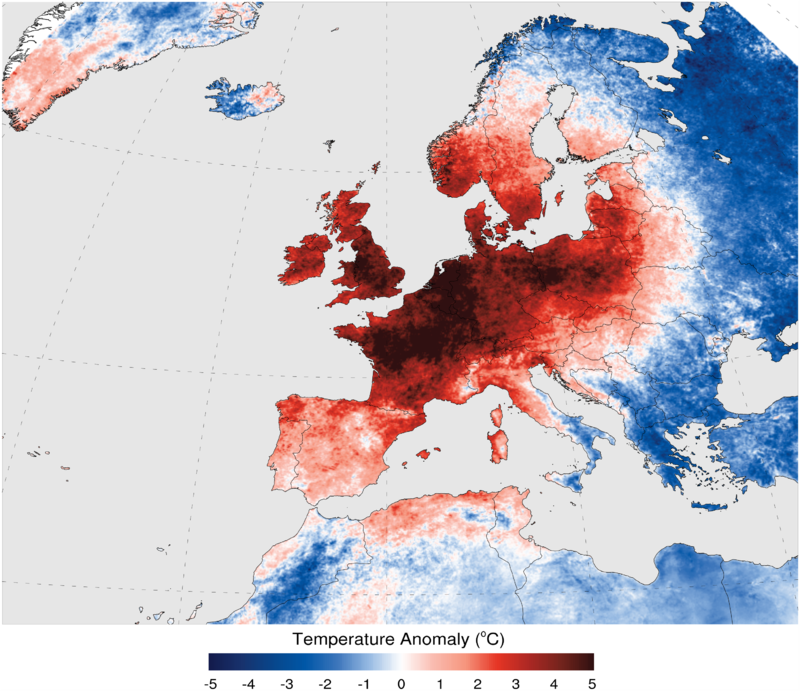
Giorgiogp2 - created this rendering of the 2006 European heat wave, using NASA's Modis Terra data, Wikimedia Commons, under the Creative Commons Attribution-Share Alike 3.0 Unported license

Wednesday, November 5, 2014

Study reveals startling decline in European birds

Terra Daily via SPX: Bird populations across Europe have experienced sharp declines over the past 30 years, with the majority of losses from the most common species, say the University of Exeter, the RSPB and the Pan-European Common Bird Monitoring Scheme (PECBMS) in a new study. However numbers of some less common birds have risen.

The study, published in the journal Ecology Letters, reveals a decrease of 421 million individual birds over 30 years. Around 90 percent of these losses were from the 36 most common and widespread species, including house sparrows, skylarks, grey partridges and starlings, highlighting the need for greater efforts to halt the continent-wide declines of our most familiar countryside birds.

Richard Inger from the University of Exeter said: "It is very worrying that the most common species of bird are declining rapidly because it is this group of birds that people benefit from the most."

"It is becoming increasingly clear that interaction with the natural world and wildlife is central to human wellbeing and significant loss of common birds could be quite detrimental to human society."

Birds provide multiple benefits to society. They help to control agricultural pests, are important dispersers of seeds, and scavenging species play a key role in the removal of carcasses from the environment. In addition, for many people birds are the primary way in which they interact with wildlife, through listening to bird song, enjoying the sight of birds in their local environment, feeding garden birds and through the hobby of bird watching....

A bird at the Nymphenberg Palace in Munich, shot by Tiia Monto, Wikimedia Commons, under the Creative Commons Attribution-Share Alike 4.0 International license

Friday, August 29, 2014

Faster, more accurate flood warnings through EU research

A press release from the European Commission: Timely flood alerts and real-time monitoring of flood emergencies can save lives and prevent damage to property, infrastructure and the environment. Imprints, WeSenseIt and UrbanFlood are just three examples of EU-funded projects that have developed unique forecasting and alert systems to warn communities of impending floods.

Flood management and prevention is at the heart of the Imprints project which has developed an early warning platform to cut responses to flash floods down to about two hours, and even less – potentially giving people more time to get out of harm’s way. The platform is based on better rainfall predictions, using meteorological models and weather radar networks. The software is able to predict water flows on the ground and provide a full early warning system for flash floods, the amount of debris they might carry and any potential damage to local infrastructure.

Water services and hydro-meteorological operations in Spain, Switzerland and France are using these project’s innovations to refine their own real-time forecasting systems. Furthermore, flash flood indicators, developed within this project, are used now in the operational European Flood Awareness System.

Meanwhile, WeSenseIt, a project which ends in September 2016, makes good use of the power of human observation as an essential part of an early warning system. People contribute by taking measurements using new apps currently being developed by the project, and sending information and images by mobile phone. The new technologies and approaches are being tested in Italy, the Netherlands and the UK.

“We have developed mobile apps so that flood wardens in the UK can walk along river banks, and take tagged pictures if they think there is something of concern,” says project coordinator Fabio Ciravegna from the University of Sheffield. In Italy, an evaluation involving some 500 volunteers simulating a flood in the city of Vicenza was completed at the end of March 2014....

A 2005 flood in Thun, Switzerland, uploaded by Zumbo, Wikimedia Commons, under the Creative Commons 3.0 license

Tuesday, August 5, 2014

Climate 'key driver' in European forest disturbances

Mark Kinver in BBC News: Europe's forests have experienced increased disturbances throughout the 20th Century from wind, bark beetles and wildfires, a study has shown. A team of European-based scientists identified climatic changes as a "key driver behind this increase".

However, they added, how the expected continuation of climate change would affect Europe's forests in the future remained unresolved. The findings have been published online by the journal Nature Climate Change.

The researchers wrote: "Natural disturbances, that is, large pulses of tree mortality from agents such as wildfire, insect outbreaks or strong winds, are integral drivers of forest dynamics and contribute to the diversity and adaptive capacity of ecosystems."

But co-author Rupert Seidl from the University of Natural Resources and Life Sciences in Vienna observed: "These disturbances have intensified considerably in recent decades, which increasingly challenges the sustainable management of forest ecosystems."

The authors said the frequency and severity of large wildfires had increased around the globe over the past decade. They added: "In addition, recent bark beetle outbreaks, for example, in North America and Central Europe, have reached unprecedented levels."...

A Black Forest landscape, painted by Hans Thoma in 1886

Saturday, May 24, 2014

Stanford research shows importance of European farmers adapting to climate change

Laura Seaman at Stanford News: A new Stanford study finds that due to an average 3.5 degrees Fahrenheit of warming expected by 2040, yields of wheat and barley across Europe will drop more than 20 percent.  New Stanford research reveals that farmers in Europe will see crop yields affected as global temperatures rise, but that adaptation can help slow the decline for some crops.

For corn, the anticipated loss is roughly 10 percent, the research shows. Farmers of these crops have already seen yield growth slow down since 1980 as temperatures have risen, though other policy and economic factors have also played a role.

"The results clearly showed that modest amounts of climate change can have a big impact on yields of several crops in Europe," said Stanford doctoral student Frances Moore, who conducted the research with David Lobell, an associate professor of environmental Earth system science.

..."By adaptation, we mean a range of options based on existing technologies, such as switching varieties of a crop, installing irrigation or growing a different crop, one better suited to warmer temperatures," said Lobell, the associate director of the Center on Food Security and the Environment at Stanford. "These things have been talked about for a long time, but the novelty of this study was using past data to quantify the actual potential of adaptation to reduce climate change impacts. We find that in some cases adaptation could substantially reduce impacts, but in other cases the potential may be very limited with current technologies."

According to the analysis, corn has the highest adaptation potential. Moore and Lobell predict that corn farmers can reduce yield losses by as much as 87 percent through long-term adaptation. ...

A cornfield near Straelen, Germany, shot by flamenc, Wikimedia Commons,  under the Creative Commons Attribution-Share Alike 3.0 Unported license 

Monday, April 7, 2014

Swedish researchers map the risks of new virus epidemic in Europe

A press release from the University of Umea (Sweden): The risk of dengue fever beginning to spread in Europe is imminent. According to researchers from Umeå University, this is no longer just an issue for the scientific community but also for politicians and policy makers, who need to be prepared and develop preventive measures.

With a changing climate and rising temperatures in Europe, the incidence of the Aedes aegypti mosquito has also increased. The mosquito is the main vector of dengue that can cause haemorrhagic fever. Although no outbreak of the disease has not yet occurred in Europe, researchers at the Epidemiology and Global Health unit at Umeå University claim that there is now good living conditions for the mosquito in Europe and that it is therefore only a matter of time before we see an epidemic here. The Aedes albopictus mosquito has already established itself in large parts of Europe. Even though it is not as competent a vector as Aedes aegypti, several domestic cases of the disease have been observed in countries such as France and Croatia.

“The last outbreak of dengue in Portuguese Madeira when several thousand became ill, shows that it is no longer a theoretical possibility that the disease can take hold in Europe. It is a reality that can strike at any time,” says Raman Preet, researcher and scientific project manager of the Dengue Tools project at the Department of Epidemiology and Global Health, Umeå University.  “When the disease shows up in Europe it has probably accompanied travellers in areas in the world where the disease is established. Then it will be spread with the help of the Aedes mosquito”.

The risk for Swedish travellers to be infected by dengue is highest when going to Sri Lanka and Bangladesh, while most cases in Sweden stems from trips to Thailand....

Turner's "Fifth Plague of Egypt"

Saturday, March 8, 2014

Researchers map European climate change

EurekAlert via the Institute of Physics: The majority of Europe will experience higher warming than the global average if surface temperatures rise to 2 °C above pre-industrial levels, according to a new study published today. Under such a scenario, temperatures greater than the 2 °C global average will be experienced in Northern and Eastern Europe in winter and Southern Europe in summer; however, North-Western Europe—specifically the UK—will experience a lower relative warming.

The study, which has been published today, 7 March, in IOP Publishing's journal Environmental Research Letters, also shows that in the summer, daily maximum temperatures could increase by 3𔃂 °C over South-Eastern Europe and the Iberian Peninsula and rise well above 40 °C in regions that already experience some of the highest temperatures in Europe, such as Spain, Portugal and France. Such higher temperatures will increase evaporation and drought.

In the winter, the maximum daily temperatures could increase by more than 6 °C across Scandinavia and Russia. Lead author of the research Robert Vautard, from Laboratoire des Sciences du Climat et de l'Environnement (CEA/CNRS/UVSQ), said: "The 2 °C warming target has mainly been decided among nations as a limit not to exceed in order to avoid possibly dangerous climate change. However, the consequences of such a warming, at the scale of a continent like Europe, have not yet been quantified.

"We find that, even for such an ambitious target as 2 °C, changes in European climate are significant and will lead to significant impacts."

The study also shows that there will be a robust increase in precipitation over Central and Northern Europe in the winter and Northern Europe in the summer, and that most of the continent will experience an increase in instances of extreme precipitation, increasing the flood risks which are already having significant economic consequences. Southern Europe is an exception, and will experience a general decline in mean precipitation....

The clock tower in Piazza San Marco, in Venice, shot by G.dallorto, Wikimedia Commons, under the Creative Commons Attribution-Share Alike 2.5 Italy license 

Sunday, March 2, 2014

Flood damage cost to rise fivefold across Europe

Damian Carrington in the Guardian (UK): The huge cost of flood damage is set to soar fivefold across Europe in coming decades, according to the first comprehensive analysis of risk across the continent. The cost of homes, belongings, businesses and infrastructure wrecked by the wettest winter in England for 250 years has been at least £1bn and over the last decade the average annual loss across the European Union has been €4.5bn. But increasingly intense downpours driven by climate change, as well as population growth and urbanisation, will see that rise to €23bn a year by 2050, the study found.

The growing prosperity of citizens is also a factor, according to Brenden Jongman, a researcher at the VU University Amsterdam, who led the new work. “People increasingly have more expensive stuff – like expensive televisions and other gadgets – than they had 50 years ago,” he said.

The costs of damage could be curbed by better flood protection and insurance schemes, but faces political obstacles, according to Jongman. “For rare events [like England’s wettest winter on record] the chances of it happening within the term of one government is low, so the incentive for politicians to invest in flood protection is quite low,” he said. “The cost is upfront but the benefits are over decades.”

The UK’s coalition government cut annual flood defence spending sharply after entering office in 2010 and the Guardian revealed earlier in February that projects in flood-stricken areas from the Somerset Levels to the Thames valley were not built as a result.

The new research, published in the journal Nature Climate Change, found that improving flood defences across the EU to resist once-a-century flooding would save €7bn a year by 2050 but cost just €1.75bn. In the UK, most flood defences save £8 for every £1 spent....

A 2013 flood in Passau, on the Danube, shot by Stefan Penninger, Wikimedia Commons via Flickr,  under the Creative Commons Attribution-Share Alike 2.0 Generic license 

Friday, February 7, 2014

Are invasive plants a problem in Europe? Controversial views among invasion biologists

Seed Daily via SPX: Some introduced (i.e. non-native) plants become abundant, threaten species richness and the well-functioning of ecosystems, the economy, or health (plant invasion). Environmental policies that attempt to restrict the expansion of non-native species are based on a consensus among scientific experts that invasions are a serious environmental problem. An example of a problematic non-native species in many parts of the world is Fallopia japonica, the Japanese knotweed that negatively affects river ecosystems.

A consensus among experts on the severity of plant invasions seems evident in many scientific and outreach publications. However, instead of consensus, a new study by an interdisciplinary research team at ETH Zurich (Switzerland) of psychologists and plant biologists found a wide range of different opinions among scientific experts about how to describe invasive plant species, and how severe their effects on the environment are. The study is published in the latest issue of the open access journal NeoBiota.

The researchers conducted 26 face-to-face interviews with a representative sample of German-speaking scientists working on plant invasions, or more generally on environmental change, in Europe. The interviews revealed that individual understandings of scientific concepts, uncertainties, and value-based attitudes towards invasive plants and their management diverged widely among these experts.

"Particularly, ambiguous definitions of the terms non-native and invasive (two key notions in invasion science) are a strong source of misunderstandings among scientists," said lead author Franziska Humair, a doctoral student at ETH Zurich. Some of the study participants used a biological definition to discriminate native from non-native species ("species from a different biogeographic region"), while others referred to culture ("species not familiar to local people")....

Japanese knotweed, shot by H. Zell, Wikimedia Commons, under the Creative Commons Attribution-Share Alike 3.0 Unported license

Monday, December 16, 2013

Nitrogen deposition poses a threat to the diversity of Europe's forest vegetation

A press release from the Finnish Environment Institute: Unless nitrogen emissions are curbed, the diversity of plant communities in Europe's forests will decrease. Atmospheric nitrogen deposition has already changed the number and richness of forest floor vegetation species in European forests over the last 20–30 years. In particular, the coverage of plant species adapted to nutrient-poor conditions has reduced. However, levels of nitrogen deposition in Finnish forests remain small compared to Southern and Central Europe.

These results will be presented as part of international research published in the journal Global Change Biology. Researchers from the Finnish Environment Institute and the Finnish Forest Research Institute (Metla) participated in this research, which concludes that unless nitrogen emissions are curbed, the diversity of plant communities in Europe's forests will decrease. The work involved the examination of long-term changes in vascular plant communities within a 1 300 monitoring grid covering 28 forested areas in various parts of Europe.

The number and richness of forest floor vegetation species in European forests have changed over the last 20 to 30 years, due to wet and dry deposition of atmospheric nitrogen. In particular, low-nutrient or acidic habitats are sensitive to long-term nitrogen deposition. Among such habitats, coverage of species such as heather and may lily has been reduced in many areas, in which nitrogen deposition has exceeded a certain threshold value i.e. the critical nitrogen load.

The largest changes in vegetation have occur red in Southern and Central European forests. Although deposition has not yet markedly affected species numbers within plant communities, most new species spreading into forests during the monitoring period have been types that favour nitrogen.

...Although nitrogen deposition remains small in Northern Europe, even a slight rise in long-term deposition could change the competitive relationship of vascular plants by promoting the dissemination and growth of nitrogen-favouring species....

Species found in nutrient-poor habitats, such as heather, lingonberry, crowberry and lichens in particular are sensitive to nitrogen deposition. Photo Hannu Nousiainen, Metla.

Tuesday, December 3, 2013

European cities slow to adapt to climate change

Laura Dattaro in the Weather Channel: A new study shows that many European cities have no plans in place to help slow climate change or acclimate to its effects. Those that are working toward a climate change fix are, in general, working to slow its pace.

Plans to deal with climate change fall into two categories: mitigation, which addresses the causes of climate change directly (like reducing greenhouse gas emissions), or adaptation, which focuses on strategies to cope with new weather patterns (like building flood barriers to protect cities in the face of rising sea levels).

The new study, led by Diana Reckien of Columbia University’s Center for Research on Environmental Decisions, found that of the 200 European cities examined, 130 — or 65 percent — have at least a mitigation plan, while the remaining 35 percent had neither a mitigation nor an adaptation plan. The team also identified 25 percent of the cities as “climate leaders” for having both types of plans, plus specific targets for reducing greenhouse gas emissions.

“It looks like that for the regular city, the path of development is you adopt a mitigation plan, you start with an adaptation plan and then you get into putting those plans into practice,” Reckien said. “It’s true that there is a lack of adaptation and adaptation engagement.”

The United Kingdom had the highest percentage of climate-leading cities, including London, Manchester and Liverpool, followed by Germany, Finland and France....

In Augsburg, Germany, the Komödie (theatre) Photographed by Andreas Praefcke, February 2003, Wikimedia Commons, under the Creative Commons Attribution 3.0 Unported license

Friday, November 8, 2013

AIR estimates insured losses from last week’s European windstorm Christian at between EUR 1.5 billion and EUR 2.3 billion

AIR Worldwide: Catastrophe modeling firm AIR Worldwide estimates that insured losses from Windstorm Christian (known as St. Jude in the UK) will range between EUR 1.5 billion and EUR 2.3 billion, with the majority of insured losses occurring in Denmark and Germany. Significant insured losses also occurred in the Netherlands, France, UK, and Sweden.

“Windstorm Christian smashed into southern Britain on Monday, October 28, knocking down trees, flooding lowlands, and disrupting travel over land, sea, and air,” said Gerhard Zuba, senior principal scientist at AIR Worldwide. “Gusts of 160 km/h (100 mph) were reported on the Isle of Wight in southern England, and waves greater than 7.5 meters (25 feet) were reported elsewhere along the coast.”

According to AIR, after striking the UK, the storm moved north and east, hitting France, the Netherlands, northern Germany, Denmark, Sweden, and Russia with similar force, and across the Baltic Sea to Latvia and Estonia, where the storm weakened. The Ile d’Ouessant, Finistere, France, reported a gust of 133 km/h (83 mph); the Netherlands gusts of 90 to 130 km/h (56 to 81 mph) along the Ijsselmeer coast; and southern Denmark the strongest wind recorded in the country’s history—a gust of 194.4 km/h (120.8 mph). By Tuesday morning, Windstorm Christian had dissipated considerably as it moved to Sweden's east coast and out toward the Baltic Sea, although hurricane-force gusts of over 115 km/h were measured on the Baltic islands of Oland and Gotland.

Dr. Zuba noted, “October is usually a quiet month for windstorms in Europe. Nevertheless, the overall atmospheric conditions were favorable for storms to impact the UK and northern Europe. The damage from storms during this time of year can be more severe than storms that develop later because many trees still have leaves on their branches, making branches more likely to break off and become airborne missiles, and also making trees more likely to topple. Further, Christian, powered by the temperature gradient between cold polar air and warm subtropical air, strengthened as it traveled over the UK, France, Belgium, the Netherlands, and Germany.”...

Damage from the windstorm, October 28, 2013, shot by Richard Symonds,  under the Creative Commons Attribution 3.0 Unported license
Monday, November 4, 2013

Why is Europe failing to take the energy-water connection seriously?

Brooke Barton in the "Water hub" at the Guardian (UK): Concerns are intensifying in the US about the troubling interdependence of the economy's water and energy needs. In particular, the vast quantities of water (about 40% of national water withdrawals) needed for cooling US power plants are making headlines, and proposals to build thirsty new generation plants in drought-stricken states like Texas are under heavy scrutiny. Hydropower is also under strain from climate change, as more and more "one in a hundred years" droughts are reducing rivers to a trickle and power generation to a near standstill.

But in the EU, this growing collision between energy and water resources has been strikingly absent from public discussion, let alone from the EU energy agenda.

That's not to say scientists aren't trying to put it there. I recently had the pleasure of seeing John Matthews, director of freshwater and climate change at Conservation International, wake up an otherwise sleepy crowd of Commission staff and MEPs in Brussels with this powerful image of Las Vegas' dwindling Lake Mead and America's most iconic – and soon to be stranded – hydro-power asset, the Hoover Dam. The southwest US is painfully close to losing an important energy source for 1.3 million people living in Arizona, Nevada and California.

...Still, I wasn't sure if European legislators and investors in Brussels would relate to these challenges 5,000 miles away. Judging from the chorus of gasps to Matthew's slides, the point was driven home.

And it's not just scientists and NGOs prodding the regulators on these trends. European utilities such as Enel are also voicing concern. Enel is a multinational heavyweight in the power sector, with generation and distribution activities in 40 countries. Of the company's 98GW of installed capacity, a whopping 31% comes from hydropower. The company is also under strict carbon emissions targets in the EU, and a stable, low-carbon hydropower portfolio is critical to meeting them. For Enel, the water-energy collision is much more than an interesting catchphrase....

Statue is named "Winged Figures of the Republic," by Oskar J. W. Hansen, it's located on the Nevada side of Hoover Dam. Shot by Raquel Baranow, Wikimedia Commons, under the Creative Commons Attribution-Share Alike 3.0 Unported license

Saturday, November 2, 2013

Melting Arctic sea ice could increase summer rainfall in northwest Europe

A press release from the University of Exeter: A new study offers an explanation for the extraordinary run of wet summers experienced by Britain and northwest Europe between 2007 and 2012. The study found that loss of Arctic sea ice shifts the jet stream further south than normal resulting in increased rain during the summer in northwest Europe.

Dr James Screen from Mathematics at the University of Exeter used a computer model to investigate how the dramatic retreat of Arctic sea ice influences the European summer climate. He found that the pattern of rainfall predicted by the model closely resembles the rainfall pattern of recent summers. The study is published in the journal Environmental Research Letters.

Dr Screen said: “The results of the computer model suggest that melting Arctic sea ice causes a change in the position of the jet stream and this could help to explain the recent wet summers we have seen. “The study suggests that loss of sea ice not only has an effect on the environment and wildlife of the Arctic region but has far reaching consequences for people living in Europe and beyond.”

Jet streams are currents of strong winds high in the atmosphere – around the height at which aeroplanes fly. These winds steer weather systems and their rain. Normally in summer the jet stream lies between Scotland and Iceland and weather systems pass north of Britain. When the jet stream shifts south in summer, it brings unseasonable wet weather to Britain and northwest Europe causing havoc for tourism and farming.

The model suggests that while summer rainfall increases in northwest Europe, Mediterranean regions will receive less rain. The effects are not limited to Europe - weather systems as far as North America could also be influenced....

Arctic ice, shot by Patrick Kelley, Wikimedia Commons via Flickr, under the Creative Commons Attribution 2.0 Generic license

Tuesday, October 29, 2013

Storm batters Europe

CNN: The cleanup operation continued Tuesday, a day after a major Atlantic storm pummeled England, France, Belgium, Germany, the Netherlands and Denmark, killing at least 13 people. Hurricane-force winds early Monday caused major disruption to travel and power supplies.

In Britain, 61,000 homes remained without electricity Tuesday, after power was restored to 100,000 properties overnight, said Tim Field, a spokesman for the Energy Networks Association, which represents British and Irish power operators.

 4 killed, thousands lose power in storm CNN reporter in 80mph UK storm Major storm hits the UK Overall, 605,000 properties have been reconnected, he told CNN. Energy companies said they were working to restore power as quickly as possible.

Rail services were largely running again across southern England on Tuesday, a day after fallen trees caused chaos as they blocked rail lines and roads. London's Heathrow Airport, where the number of flights was reduced Monday because of the severe weather, said operations were returning to normal Tuesday.

At least two storm-related deaths were confirmed Monday in England, and a third person was missing after being swept out to sea...

Tuesday, October 15, 2013

Europe needs local and regional strategies for climate change

Neil Swannick in the Guardian (UK): ...The European commission launched a strategy in April about adaptation to climate change, which was reviewed by the committee of the regions last week in Brussels. This European Union consultative body comprises 353 elected local and regional authority representatives from the 28 member states. Local and regional authorities are well aware that they are in the front line as first responders to extreme weather events in their communities, such as the deadly floods in central Europe when the Elbe and Danube burst their banks.

Local government, as well as having to cope with the "new norm" of more frequent extreme weather events and the slow-onset effects of climate change such as increase in temperatures and rising sea level, will need to put in place the adaptation work necessary to avoid their regions becoming unattractive to investors or uninsurable because of climate risk.

Many areas of local government responsibility such as spatial planning, buildings, waste and transport, will need to be changed and emergency planning and adaptation brought together. But while local and regional authorities will have to be key players in developing climate resilience, the EU adaptation strategy focuses its attention on national adaptation strategies, which few member states appear to be addressing as a priority.

The Committee of the Regions argues that a multi-level governance approach, which recognises a role for member state governments and local and regional authorities, will be necessary to make our world ready for the changing climate environment. It points out that encouraging societies and economies to become more resilient to climate change, while at the same time lessening their contribution to the problem through reducing greenhouse gas emissions, is a crucial aspect of strengthening Europe's competitiveness and quality of life over the coming decades....

Wednesday, October 2, 2013

IPCC: Europe has been warming faster than the global average

The Guardian (UK) via the Carbon Brief: Europe has been warming faster than the global average over the last 30 years, the UN's new climate report reveals. This week, the Intergovernmental Panel on Climate Change (IPCC) released part one of its scientific report in full.

Among some of the most significant findings from a summary of the report released a few days ago are that humans are responsible for at least half of the warming experienced in recent decades. The report also predicts higher sea levels and further warming worldwide if greenhouse gas emissions continue. The full report also looks at how climate change could pan out differently across the many regions of the world. There will be much more on this when the IPCC releases the second part of its climate report in March 2014. But the first part provides some valuable insights about how climate change affects Europe.

Since 1979, the land in Europe has been warming faster than the global average of 0.27 degrees Celsius (°C) per decade - but some parts have been warming faster than others. In northern Europe - the region encompassing countries such as the UK and Sweden - temperatures have risen by 0.48°C per decade. In the central Europe region, where countries like France and Germany sit, temperatures have risen 0.44°C per decade. Temperatures in southern Europe and the Mediterranean have risen a little slower, at around 0.34°C per decade.

In addition to the warming trend, it's also very likely - which means scientists are 90 per cent certain - that Europe has experienced a greater number of warm days and nights since 1950s, according to the report. Since the 1950s, it's also likely that the number of heatwaves in Europe has risen....