Showing posts with label insects. Show all posts

Wednesday, March 4, 2015

Munching bugs thwart eager trees, reducing the carbon sink

University of Wisconsin-Madison News: In a high carbon dioxide world, the trees would come out ahead. Except for the munching bugs. A new study published today [Monday, March 2, 2015] in Nature Plants shows that hungry, plant-eating insects may limit the ability of forests to take up elevated levels of carbon dioxide in the atmosphere, reducing their capacity to slow human-driven climate change.

The finding is significant because climate change models typically fail to consider changes in the activities of insects in the ecosystem, says Richard Lindroth, a professor of ecology at the University of Wisconsin-Madison and the leader of the study. The research suggests it’s time to add insects to the models.

Carbon dioxide typically makes plants grow faster and makes them more efficient in how they use nutrients. But the amount of damage caused by leaf-munching bugs in the study nearly doubled under high carbon dioxide conditions, leading to an estimated 70g of carbon-sequestering biomass lost per meter squared per year.

“This is the first time, at this scale, that insects have been shown to compromise the ability of forests to take up carbon dioxide,” Lindroth says.

In addition, as feeding increased, more nutrients moved from the canopy to the forest floor in the form of insect fecal material and chewed-on leaf scraps, mixing into the soil and likely altering the nutrient profile of the forest....

Photo of a tent caterpillar by Mary A. Jamieson/UW-Madison Department of Entomology

Tuesday, September 2, 2014

Madagascar's capital city plagued by locust swarm

Eric Zerkel at the Weather Channel: Clouds of millions of locusts blacked out portions of the sky in Madagascar's capital city of Antananarivo, the scene a part of an ongoing plague that's threatening the food supply of more than 13 million people.

The plague started back in April of 2012, ABC News reports, and was largely limited to the rural, agricultural areas of the island nation. But on Thursday the locusts arrived in hordes in Antananarivo, a city of more than 700,000 people, attracted by unseasonably warm temperatures amplified by the city's urban setting. “It reminds us of the 10 plagues of Egypt,”  Ronald Miller, a missionary working in Madagascar with his family, told ABC.

..."Locust infestations, if untreated, could wipe out food crops and livestock grazing lands -- and with it a family’s ability to provide for itself," the Washington Post reports.

Previous swarms of that magnitude prompted the Madagascar government to declare a state of disaster across the country. So since 2013, the government along with the United Nations Food and Agriculture Organization (FAO), have been spraying insecticides across large swaths of the country to combat locust outbreaks.

Those measures are part of a three year, $41 million plan to reduce the locust population to protect the livelihoods of millions of people living in Madagascar. So far the plan appears to be working, even though the images coming out of Antananarivo might seem to suggest otherwise...

A 1944 image of locusts in the Sahara

Sunday, August 31, 2014

Museum specimens, modern cities show how an insect pest will respond to climate change

A press release from North Carolina State University: Researchers from North Carolina State University have found that century-old museum specimens hold clues to how global climate change will affect a common insect pest that can weaken and kill trees – and the news is not good. “Recent studies found that scale insect populations increase on oak and maple trees in warmer urban areas, which raises the possibility that these pests may also increase with global warming,” says Dr. Elsa Youngsteadt, a research associate at NC State and lead author of a paper on the work.

“More scale insects would be a problem, since scales can weaken or kill the trees they live on,” Youngsteadt says. “But cities are unique, so we wanted to know whether warming causes scale insect population explosions in rural forests, the way it does in cities.”

To address that question, Youngsteadt examined more than 300 museum specimens of red maple branches collected between 1895 and 2011 in rural areas of North Carolina, South Carolina and Georgia. By evaluating the scale insect remains attached to each specimen, Youngsteadt estimated scale population density and compared it to the average August temperature for the year and place where the specimen was collected. Youngsteadt then compared the findings from the historical specimens with more recent data from urban Raleigh, North Carolina.

“Scale insect density in rural areas was not as high as it was in the city, but there was a common pattern,” Youngsteadt says. “Scale insects were most likely to be present on specimens collected during warm historical time periods, and scales were most abundant when temperatures were similar to modern, urban Raleigh.”

Given the shared urban and historical pattern, the researchers also predicted that scale insects would be more abundant in rural forests today than in the past, as a result of recent climate warming. To test this prediction, Youngsteadt went to 20 sites where historical specimens were collected from 1970 to 1997 and sampled their modern scale insect populations.

“Sure enough, scale abundance had increased at 16 of the 20 sites,” Youngsteadt says. “Overall, we found a total of about five times more scale insects in 2013 than on the historical specimens from the same locations. The urban and historical data are so well-aligned that we can view scale insect populations in cities as a preview of what to expect elsewhere,” Youngsteadt adds. “It also suggests that we should begin looking at cities for clues to how other insect species will respond to higher global temperatures.”...

A red maple museum sample of evaluated as part of the study. Image credit: North Carolina State University Herbarium. 

Wednesday, June 25, 2014

Liberians flee caterpillar invasion

Jennifer Lazuta in Voice of America News: Thousands of people have fled their homes in northern Liberia following an invasion of caterpillars - which have overtaken houses and schools, destroyed crops and contaminated water sources. The United Nations Food and Agriculture Organization (FAO) says these attacks are becoming more frequent in Liberia and the government needs to put in place an early warning system to stop the invasions from reaching such catastrophic levels.

Residents of at least 25 villages and towns in the forested areas of Lofa and Gbarpolu counties have been fleeing en masse since early June to escape the trail of excrement that the caterpillars leave behind. “We are afraid. You see here, the caterpillars are all over and there is nowhere to sleep. I am leaving with my children to a different community," explained Mary Tolbert who lives in Gbarpolu County.

Jeremiah Toe, a nurse in one of the affected villages, says the caterpillars pose a serious public health problem. “The situation is alarming. We have informed the Ministry of Health," he said. "As you can see, the caterpillars are taking over the homes of residents. They have polluted the creeks…Even our clinic has been attacked by the caterpillars.”

Residents and local authorities say the caterpillars have also taken over classrooms, forcing many schools in the area to shut down. Fresh water sources have become so contaminated with caterpillar feces that they are no longer safe to drink from.  Farmers say some of their crops have been destroyed.

This is not the first time caterpillars have attacked the region.  A 2009 invasion caused the government to declare a state of emergency. Smaller invasions were seen in 2011 and 2012....

Achaea catocaloides, the alleged culprit. SIR GEORGE F. HAMPSON, BART. - CATALOGUE OF THE NOCTUIDAE IN THE COLLECTION OF THE BRITISH MUSEUM

Monday, June 9, 2014

Termites, fungi play more important role in decomposition than temperature

Science Daily: Climate change models could have a thing or two to learn from termites and fungi, according to a new study released this week. For a long time scientists have believed that temperature is the dominant factor in determining the rate of wood decomposition worldwide. Decomposition matters because the speed at which woody material are broken down strongly influences the retention of carbon in forest ecosystems and can help to offset the loss of carbon to the atmosphere from other sources. That makes the decomposition rate a key factor in detecting potential changes to the climate.

But scientists from Yale, the University of Central Florida and SUNY Buffalo State found that fungi and termites, which help break down wood, may play a more significant role in the rate of decomposition than temperature alone. The group's findings appear in this week's edition of the journal Nature Climate Change.

"The big surprise of this work was the realization that the impact of organisms surpassed climate as a control of decomposition across spatial scales," said Joshua King, a biologist at UCF and co-author of the paper. "Understanding the ecology and biology of fungi and termites is a key to understanding how the rate of decomposition will vary from place to place."

So how did scientists originally come up with temperature as the main factor in decomposition? It has to do with data and math. Scientists most often construct a model based on the average decomposition rates of sites that are in close proximity to each other. In this case, it appears that each local number matter because they reflect the activity of fungi and termites. The team suggests that scientists need to embrace the variability found across data collected from many different sites instead of averaging it all together to create better models with more accurate predictions.

The team reached this conclusion after running a 13-month experiment. They distributed 160 blocks of pine tree wood across five sub-regions of temperate forest in the eastern U.S. -- from Connecticut to northern Florida -- and then monitored the decay that occurred....

Logs eaten by termites, shot by Lady alys, Wikimedia Commons, under the Creative Commons Attribution-Share Alike 3.0 Unported license

Saturday, February 22, 2014

Extreme weather decides distribution of insects

Christina Troelsen and Johannes Overgaard in a press release from the University of Aarhus (Denmark): As climate change is progressing, the temperature of our planet increases. This is particularly important for the large group of animals that are cold-blooded (ectothermic), including insects. Their body temperature is ultimately determined by the ambient temperature, and the same therefore applies to the speed and efficiency of their vital biological processes.

But is it changes in average temperature or frequency of extreme temperature conditions that have the greatest impact on species distribution? This was the questions that a group of Danish and Australian researchers decided to examine in a number of insect species. ... The results demonstrate that it is especially the extreme temperature events that define the distribution of both tropical and temperate species. Thus climate change affects ectotermic animals primarily because more periods of extreme weather are expected in the future.

The researchers examined 10 fruit fly species of the genus Drosophila adapted to tropical and temperate regions of Australia. First they examined the temperatures for which the species can sustain growth and reproduction, and then they found the boundaries of tolerance for hot and cold temperatures. “This is the first time ever where we have been able to compare the effects of extremes and changes in average conditions in a rigorous manner across a group of species”, mentions Ary Hoffmann.

 Based on this knowledge and knowledge of the present distribution of the 10 species they then examined if distribution was correlated to the temperatures required for growth and reproduction or rather limited by their tolerance to extreme temperature conditions. "The answer was unambiguous: it is the species' tolerance to very cold or hot days that define their present distribution," says Johannes Overgaard.

It is therefore the extreme weather events, such as heat waves or extremely cold conditions, which costs the insects their life, not an increase in average temperature. With this information in hand, the researchers could then model how distributions are expected to change if climate change continues for the next 100 years....

A fruit fly, shot by Sanja565658, Wikimedia Commons, under the Creative Commons Attribution-Share Alike 3.0 Unported license

Saturday, October 12, 2013

Massive spruce beetle outbreak in Colorado tied to drought

University of Colorado at Boulder: A new University of Colorado Boulder study indicates drought high in the northern Colorado mountains is the primary trigger of a massive spruce beetle outbreak that is tied to long-term changes in sea-surface temperatures from the Northern Atlantic Ocean, a trend that is expected to continue for decades.

The new study is important because it shows that drought is a better predictor of spruce beetle outbreaks in northern Colorado than temperature alone, said lead study author Sarah Hart, a CU-Boulder doctoral student in geography. Drought conditions appear to decrease host tree defenses against spruce beetles, which attack the inner layers of bark, feeding and breeding in the phloem, a soft inner bark tissue, which impedes tree growth and eventually kills vast swaths of forest.

Spruce beetles, like their close relatives, mountain pine beetles, are attacking large areas of coniferous forests across the West. While the mountain pine beetle outbreak in the Southern Rocky Mountains is the best known and appears to be the worst in the historical record, the lesser known spruce beetle infestation has the potential to be equally or even more devastating in Colorado, said Hart, lead author on the new study.

 “It was interesting that drought was a better predictor for spruce beetle outbreaks than temperature,” said Hart of the geography department.  “The study suggests that spruce beetle outbreaks occur when warm and dry conditions cause stress in the host trees.”

...The new study also puts to rest false claims that fire suppression in the West is the trigger for spruce beetle outbreaks, said Veblen.

...The strongest climate correlation to spruce beetle outbreaks was above average annual values for the Atlantic Multi-decadal Oscillation, or AMO, a long-term phenomenon that changes sea-surface temperatures in the North Atlantic. Believed to shift from cool to warm phases roughly every 60 years, positive AMO conditions are linked to warmer and drier conditions over much of North America, including the West....

Wolf Creek Pass ski area in Colorado, shot by Doc Searls, Wikimedia Commons via Flickr, under the Creative Commons Attribution-Share Alike 2.0 Generic license

Monday, July 29, 2013

Common chemicals harm honey bees' health

University of Maryland Right Now: Commercial honey bees used to pollinate crops are exposed to a wide variety of agricultural chemicals, including common fungicides which impair the bees’ ability to fight off a potentially lethal parasite, according to a new study by researchers at the University of Maryland and the U.S. Department of Agriculture.

The study, published July 24 in the online journal PLOS ONE, is the first analysis of real-world conditions encountered by honey bees as their hives pollinate a wide range of crops, from apples to watermelons.

The researchers collected pollen from honey bee hives in fields from Delaware to Maine. They analyzed the samples to find out which flowering plants were the bees’ main pollen sources and what agricultural chemicals were commingled with the pollen. The researchers fed the pesticide-laden pollen samples to healthy bees, which were then tested for their ability to resist infection with Nosema ceranae – a parasite of adult honey bees that has been linked to a lethal phenomenon known as colony collapse disorder.

On average, the pollen samples contained 9 different agricultural chemicals, including fungicides, insecticides, herbicides and miticides. Sublethal levels of multiple agricultural chemicals were present in every sample, with one sample containing 21 different pesticides. Pesticides found most frequently in the bees’ pollen were the fungicide chlorothalonil, used on apples and other crops, and the insecticide fluvalinate, used by beekeepers to control Varroa mites, common honey bee pests.

In the study’s most surprising result, bees that were fed the collected pollen samples containing chlorothonatil were nearly three times more likely to be infected by Nosema than bees that were not exposed to these chemicals, said Jeff Pettis, research leader of the USDA’s Bee Research Laboratory and the study’s lead author. The miticides used to control Varroa mites also harmed the bees’ ability to withstand parasitic infection...

Honey bee photo by Lip Kee, Wikimedia Commons via Flickr, under the Creative Commons Attribution-Share Alike 2.0 Generic license

Monday, April 22, 2013

Research finds invasive kudzu bugs may pose greater threat than previously thought

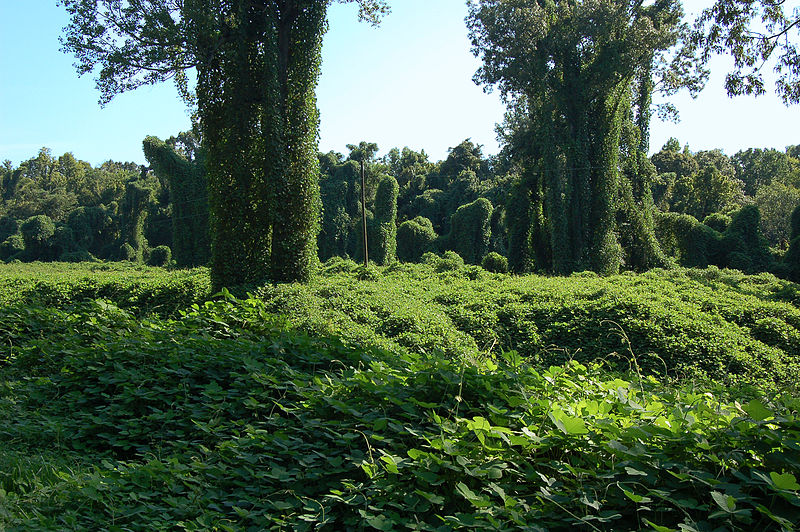
Seed Daily via SPX: The invasive kudzu bug has the potential to be a major agricultural pest, causing significant damage to economically important soybean crops. Conventional wisdom has held that the insect pests will be limited to areas in the southern United States, but new research from North Carolina State University shows that they may be able to expand into other parts of the country.

Kudzu bugs (Megacopta cribraria) are native to Asia, and were first detected in the U.S. in Georgia in 2009. They have since expanded their territory as far north as Virginia. The bugs have an interesting life cycle, which has been thought to be a limiting factor on far they can spread.

Eggs laid in the spring hatch into a first generation, which we'll call "Generation A." The immature bugs of Generation A normally feed on kudzu plants until they reach adulthood, when they have been known to move into commercial soybean fields.

These mature adults lay eggs that hatch into Generation B during the summer months. Generation B kudzu bugs can feed on soybean crops during both their immature and adult life stages, causing significant crop damage. ..

A field of kudzu. Maybe there are some bugs in there. Shot by Galen Parks Smith (Gsmith), Wikimedia Commons, under the Creative Commons Attribution-Share Alike 3.0 Unported license

Thursday, April 18, 2013

Lyme disease prevalence increased in US, tied to climate change

Healio: The incidence of Lyme disease increased about 80% in the United States from 1993 to 2007, according to new data published in CMAJ Open. Although the prevalence of Lyme disease varied from state to state, its increase has been linked to climate change.

 “Our findings are consistent with the hypothesis that increases in Lyme disease incidence in recent decades are attributable at least in part of the effects of climate change, with increasing rates of change observed at more northerly latitudes, and declines in disease incidence in the southernmost states,” the researchers wrote.

David N. Fisman, MD, MPH, of the University of Toronto Dalla Lana School of Public Health, and colleagues estimated the incidence rate ratios (IRRs) for Lyme disease for the 1993-2007 period on a state-by-state and year-by-year basis. Additional analyses were conducted to examine the heterogeneity of the disease between states and to identify state-level characteristics associated with its increasing prevalence....

Borrelia drawing (Borrelia burgdorferi) ; Borrelia is a genus of bacteria of the spirochete phylum. It causes borreliosis, a zoonotic, vector-borne disease transmitted primarily by ticks and some by lice, depending on the species. There are 36 known species of Borrelia. Drawn by Lamiot, Wikimedia Commons, under the Creative Commons Attribution-Share Alike 3.0 Unported license

Wednesday, April 10, 2013

Satellite imagery helps fight locust plagues in North Africa

Space Daily via SPX: DMC International Imaging (DMCii) is helping The Algerian Space Agency (ASAL) to predict the spread of locust plagues across North Africa as part of a pro-active approach to tackle the destructive phenomenon using satellite imagery.

Every year, North Africa is subjected to locust plagues that threaten to decimate crops and endanger countries' food security. The satellite imagery is used to assess vegetation conditions, which helps to predict the locations of locust breeding grounds. The imagery, from the UK-DMC2 satellite, is used in conjunction with weather data to help create locust forecasts and focus the application of pesticides to prevent the spread of swarms.

Last year, in a six-month summer campaign to fight the spread of locusts, DMCii acquired monthly images of regions in Southern Algeria, Northern Mali and Northern Niger for ASAL. Now, imagery is being acquired before the summer season starts, to predict as well as monitor the threat of locusts...

Monday, March 11, 2013

Temperature changes effect growth of dengue mosquito

Phys.org: A significant field discovery analyzing how natural temperature fluctuations affect the growth rate of the dengue mosquito could lead to crucial control-and-prevention strategies, according to newly published research from Thomas Scott's Mosquito Research Laboratory and the Center for Vectorborne Diseases (CVEC), University of California, Davis.

The research, published March 8 in the PLOS ONE journal, shows that that "temperature effects on larval development time, larval survival and adult reproduction depend on the combination of mean temperature and magnitude of fluctuations," said lead author Lauren Carrington, a former postdoctoral fellow in the Scott lab and CVEC.

The scientists investigated how realistic fluctuations in temperature during the day influence the life-history traits and population dynamics of the dengue mosquito, Aedes aegypti. "The effect of temperature on insect biology is well understood under constant temperature conditions, but less so under more natural, fluctuation conditions," said Carrington, who completed her three-year postdoctoral fellowship last December at UC Davis but continues research projects with the Scott lab. She is now based at the Nossal Institute for Global Health, University of Melbourne, Australia.

The research, "Effects of Fluctuating Daily Temperatures at Critical Thermal Extremes on Aedes aegypti Life-History Traits," is expected to lead to greater accuracy of applications for mosquito surveillance and disease prevention. "An improved understanding of mosquito responses to natural temperature variation," Carrington said, "will enhance the effectiveness of vector control strategies, thereby reducing transmission of mosquito-borne diseases, such as dengue fever." By using constant temperatures, scientists can under- or -over estimate values, she said....

The aedes aegypti mosquito, carrier of dengue fever--image from the CDC

Wednesday, March 6, 2013

Loss of wild insects hurts crops around the world

Seed Daily via SPX: Researchers studying data from 600 fields in 20 countries have found that managed honey bees are not as successful at pollinating crops as wild insects, primarily wild bees, suggesting the continuing loss of wild insects in many agricultural landscapes has negative consequences for crop harvests.

The study, which prompts an urgent call to maintain and manage pollinator diversity for long-term agricultural production, is published today in the prestigious journal Science.

The 50 international researchers, including Lawrence Harder, professor in the Department of Biological Sciences in the Faculty of Science at the University of Calgary, analysed data from 41 crop systems around the world including fruits, seeds, nuts, and coffee to examine the consequences of having abundant wild pollinators for crop pollination.

"Our study demonstrates that production of many fruit and seed crops that make diets interesting, such as tomatoes, coffee and watermelon, is limited because their flowers are not adequately pollinated," says Harder. "We also show that adding more honey bees often does not fix this problem, but that increased service by wild insects would help."

Flowers of most crops need to receive pollen before making seeds and fruits, a process that is enhanced by insects that visit flowers. These pollinators, including bees, flies, butterflies and beetles, usually live in natural or semi-natural habitats, such as the edges of forests, hedgerows or grasslands. As these habitats are lost, primarily owing to conversion to agriculture, the abundance and diversity of pollinators decline and crops receive fewer visits from wild insects....

"Broad-bottom drones storming the hive - wasps, hornets & bumble bees, joining in the attack", by James Gillray (died 1815), published by Hannah Humphrey (floruit 1778). This set of images was gathered by Dcoetzee from the National Portrait Gallery, London website using a special tool. All images in this batch have been confirmed as author died before 1939 according to the official death date listed by the NPG.

Thursday, February 21, 2013

Advance promises to expand biological control of crop pests

Seed Daily via SPX: A new discovery promises to allow expanded use of a mainstay biological pest control method, which avoids the health, environmental and pest-resistance concerns of traditional insecticides, scientists are reporting. The advance toward broadening applicability of the so-called sterile insect technique (SIT) appears in the journal ACS Synthetic Biology.

Luke Alphey and colleagues explain that the Lepidoptera, a large family of insects with a caterpillar stage, cause widespread damage worldwide to cotton; apples, pears and other fruits; and vegetable crops like broccoli, Brussels sprouts and cabbage.

Farmers usually battle these pests with traditional insects, with little use of SIT, despite its many advantages. SIT involves mass release of radiation-sterilized insects, which mate but produce no offspring, thus reducing the population of pests.

Alphey's team focused on eliminating major drawbacks that discourage wider use of SIT: They include difficulty in producing male-only sterile insects without the use of radiation, which reduces their ability to compete with wild males for mates. The scientists describe development of a synthetic genetic system that produces vigorous adult males with lethal information encoded in their sex-determination genes....

From 1894, Otto Staudinger, [1894]Hochlandine Lepidoptera Dt. Ent. Z. Iris 7 (1) : 43-100, plate 2. A wide variety of Lepidoptera

Wednesday, January 16, 2013

Pine beetle outbreak buffers watersheds from nitrate pollution

University of Colorado-Boulder News: A research team involving several scientists from the University of Colorado Boulder has found an unexpected silver lining in the devastating pine beetle outbreaks ravaging the West: Such events do not harm water quality in adjacent streams as scientists had previously believed.

According to CU-Boulder team member Professor William Lewis, the new study shows that smaller trees and other vegetation that survive pine beetle invasions along waterways increase their uptake of nitrate, a common disturbance-related pollutant. While logging or damaging storms can drive stream nitrate concentrations up by 400 percent for multiple years, the team found no significant increase in the nitrate concentrations following extensive pine beetle tree mortality in a number of Colorado study areas.

“We found that the beetles do not disturb watersheds in the same way as logging and severe storms,” said Lewis, interim director of CU’s Cooperative Institute for Research in Environmental Sciences. “They leave behind smaller trees and other understory vegetation, which compensate for the loss of larger pine trees by taking up additional nitrate from the system. Beetle-kill conditions are a good benchmark for the protection of sub-canopy vegetation to preserve water quality during forest management activities.”

....“The U.S. Forest Service and other agencies have established harvesting practices that greatly mitigate damage to forests caused by logging, and they deserve credit for that,” said Lewis. “But this study shows just how important the survival of smaller trees and understory vegetation can be to stream water quality.”

In waterways adjacent to healthy pine forests, concentrations of nitrate is generally far lower than in rivers on the plains in the West like the South Platte, said Lewis. Nitrate pollution is caused by agricultural runoff from populated areas and by permitted discharges of treated effluent from water treatment facilities....

Fog at the treeline in Rocky Mountain State Park, shot by Michael Gäbler, Wikimedia Commons, under the Creative Commons Attribution 3.0 Unported license

Wednesday, January 2, 2013

As climate warms, bark beetles march on high-elevation forests

Terry Devitt in the University of Wisconsin-Madison News: Trees and the insects that eat them wage constant war. Insects burrow and munch; trees deploy lethal and disruptive defenses in the form of chemicals. But in a warming world, where temperatures and seasonal change are in flux, the tide of battle may be shifting in some insects’ favor, according to a new study.

In a report published today (Dec. 31, 2012) in the Proceedings of the National Academy of Sciences, a team of scientists from the University of Wisconsin-Madison reports a rising threat to the whitebark pine forests of the northern Rocky Mountains as native mountain pine beetles climb ever higher, attacking trees that have not evolved strong defenses to stop them.

The whitebark pine forests of the western United States and Canada are the forest ecosystems that occur at the highest elevation that sustains trees. It is critical habitat for iconic species such as the grizzly bear and plays an important role in governing the hydrology of the mountain west by shading snow and regulating the flow of meltwater.

“Warming temperatures have allowed tree-killing beetles to thrive in areas that were historically too cold for them most years,” explains Ken Raffa, a UW-Madison professor of entomology and a senior author of the new report. “The tree species at these high elevations never evolved strong defenses.”

A warming world has not only made it easier for the mountain pine beetle to invade new and defenseless ecosystems, but also to better withstand winter weather that is milder and erupt in large outbreaks capable of killing entire stands of trees, no matter their composition....

A stand of aspens, with pines in the background, in the Rio Grande National Forest in southern Colorado, U.S. Department of Agriculture

Wednesday, September 26, 2012

Butterflies act as wildlife indicators, warning us of ecosystem changes

Faye Dobson in Environment News Network via the Ecologist: Although butterflies may seem like an attractive addition to your flower garden they are a more important insect than most people realize. Acting as a vital wildlife indicator, butterflies can tell us almost everything we need to know about the health of an ecosystem. But from the Meadow Brown to the Swallowtail, British native butterfly species are slowly disappearing.

According to a report by the Dorset-based charity Butterfly Conservation, 72 per cent of butterfly and moth species have declined in the last ten years, and 54 per cent have decreased in the UK. Even the abundance of common garden butterflies, such as the Red Admiral, has dropped by 24 per cent.

Butterflies react extremely quickly to even minor changes in the environment, making them both a good indicator of biodiversity and providing an early warning system for other reductions in wildlife. As a result, they are now the best-monitored group of insects in the world.

A decline in butterflies would also have a knock-on effect on other British species, in particular birds such as blue tits, jays and sparrows.

Stephen Dickie, head keeper explains: "Birds plan their whole breeding season around when caterpillars will be most abundant. If the butterfly and caterpillar numbers are depleted then there's not going to be a lot of food for developing chicks."

Plants will also be affected. Butterflies are a major pollinator of both wild and cultivated plants. Without them and other important pollinating insects flying around, there will be a significant decline in viable seed produced.....

Plate XVI from Europas bekannteste Schmetterlinge. Beschreibung der wichtigsten Arten und Anleitung zur Kenntnis und zum Sammeln der Schmetterlinge und Raupen (ca. 1895), F. Nemos, Oestergaard Verlag, Berlin, 18 chromolithographische Tafeln, 160 pp. By Dr. F. Nemos. Public domain

Sunday, September 23, 2012

Biodiversity hopes dropping like (fruit) flies

John Elder in the Sydney Morning Herald: In a world first, Melbourne researchers have shown that many species of fruit fly won't survive even a modest increase in temperature. Many are close to or beyond their safety margin - and very few have the genetic ability to adapt to climate change.

Professor Ary Hoffmann, of Melbourne University's department of genetics, says: ''We were hoping to see potential for adaptation and that didn't happen. Which is bad news. And not just for fruit flies.''

The research - published this week in Proceedings of the National Academy of Sciences, by researchers from Monash University, the University of Melbourne and Danish collaborators - is part of an ongoing project to identify signatures of extinction risk, at the genetic level. This will indicate what life forms will be the first-stage losers in a climate of greater extremes - heat, cold and dryness.

Much climate research has focused on the delicacy of tropical environments, such as rainforests. ''What this paper shows, worryingly, is that it's very difficult for species that have evolved in more moderate mid-latitude environments to jump into a more extreme environment.''

Dr Vanessa Kellerman, of Monash University's molecular ecology research group, said the scientists looked at the heat resistance of 100 different species of fruit flies. ''This involved putting them in a water bath and slowly ramping up the water temperature over a three- or four-hour period until they started literally falling over.''

It was found that only a few species could withstand high temperatures, and that these species were all closely related - and had evolved in a more extreme climate....

A fruit fly shot by michael, Wikimedia Commons via Flickr, under the Creative Commons Attribution 2.0 Generic license

Sunday, August 19, 2012

Earthworms soak up heavy metal

EurekAlert: Earthworms could be used to extract toxic heavy metals, including cadmium and lead, from solid waste from domestic refuse collection and waste from vegetable and flower markets, according to researchers writing in the International Journal of Environment and Waste Management.

Swati Pattnaik and M. Vikram Reddy of the Department of Ecology and Environmental Sciences, at Pondicherry University, in Puducherry, India, explain how three species of earthworm, Eudrilus eugeniae, Eisenia fetida and Perionyx excavates can be used to assist in the composting of urban waste and to extract heavy metals, cadmium, copper, lead, manganese, zinc, prior to subsequent processing.

With rapid increases in urban populations particularly in the developing world, there is a growing problem of how to manage organic waste and to find alternatives to landfill disposal particularly for domestic food waste and that from vegetable markets. According to the research team, it is an unfortunate fact of life that much of this waste is currently dumped on the outskirts of many towns and cities and is causing serious pollution, disease risk and general ecological harm. It also represents a considerable wasted resource, whereas the organic matter might be exploited usefully in growing food crops.

The process of vermicomposting in this way allows such waste materials to be remediated and the compost used subsequently for use in growing human food without the risk of accumulating heavy metals in crops. The team says that up to about three-quarters of the various heavy metals can be removed by the worms from solid waste. The E. eugeniae species was the most effective worm at remediating solid waste and producing rich compost. The team's tests on vermicomposting reveal that the heavy metal content of such waste can be reduced to levels significantly below the permissible safe limits....

A worm in salt marsh

Friday, August 3, 2012

Invasive insects cause staggering impact on a native Guam tree

EurekAlert: The beautiful, endemic and endangered cycad, Cycas micronesica was once a dominant forest tree on the island of Guam, but recent plant mortality predicts extirpation from Guam habitats by 2019. This dire prediction by scientists at the Western Pacific Tropical Research Center (WPTRC), University of Guam is validated by the research of Thomas E. Marler and John H. Lawrence, which has concluded that Cycas micronesica is the only native host for the invasive scale insect Aulacaspis yasumatsui. "The potential cascading ecosystem responses are yet to be completely understood," says WPTRC research scientist Marler.

The armored scale insect A. yasumatsui attacks several cycad genera, but only members of the Cycas genus are killed by the pest. Around twenty years ago the insect was unintentionally introduced to an area in southern Florida known for the production and exportation of Cycas revoluta. The scale was documented in Hawaii in 1998 and in Guam in 2003, and by 2005 it was found in native limestone forest habitat close to the initial outbreak site.

"We looked for native habitats that would be representative of the general cycad populations where we could study population-level response to the devastating scale pest. Our data showed the number of months for juvenile plants to reach 100% mortality was dependent on size and other demographic features," says Marler.

Just like the human body, plants exposed to constant stresses eventually become weakened and unable to withstand additional stresses that by themselves would not be fatal. After the scale invasion, mature C. micronesica trees began to succumb to other pressures. These other factors contributing to the plant mortality include two other invasive insects that enjoy eating cycad salads for dinner: the cycad blue butterfly (Chilades pandava) and a tiny moth (Erechthias sp.).

"During the time frame of our study, cycad scale has been found in Rota in 2007 and in Palau in 2008," says Marler. "The spread of A. yasumatsui in the region underscores the importance of empirical studies to inform conservation efforts on Guam and the rest of Micronesia."

Semicircle of Cycad (Cycadales) leaves looking up trunk. Palm House, Kew Gardens. Shot by Ian Alexander, Wikimedia Commons, under the Creative Commons Attribution-Share Alike 3.0 Unported license