Showing posts with label farm. Show all posts

Sunday, February 15, 2015

Adaptation in Philippine farming

Oliver T. Baccay at the Philippines Information Agency:  ...As a region which plays a key role in the balance of agricultural productivity, Cagayan Valley cannot afford to decrease production these days as it will have an effect on the entire country’s economy. But the threat disguised as Climate Change looms and may affect production, farmer-leaders told agriculture officials recently.      

Just how resilient and adapted to natural calamities as an effect of climate change are the region’s preferred crops would be a lingering question.

The region is within the typhoon belt, prone to different disasters that cause devastations to farmer’s productivity. Without these calamities, farmers’ produce would be enough to feed the nation  or even a surplus production for export.

With these challenges, the workers of the Department of Agriculture (DA) Region 2 as well as other agriculturists continue to stretch their research muscles to address these challenges not only to ensure production, but also to develop disaster-resilient crops. These efforts, Hector Tabbun, information officer, said include the researches for drought and water resistant corn, palay, legumes and root crop varieties.

 ...DA also constructed several Small Water Impounding Projects (SWIPS) in different areas to harvest sufficient water during the rainy season to be utilized during the dry season. The farmers are also continuously taught how to harvest rainwater from the small type water reservoir as a climate change adaptation measure....

Not in Cagayan, but a rice field in the Nagacadan Rice terraces, shot by Schubert Ciencia Shubert Ciencia, Wikimedia Commons via Flickr, under the Creative Commons Attribution 2.0 Generic license

Sunday, November 16, 2014

Farmers and scientists divided over climate change

A press release from Purdue University: Crop producers and scientists hold deeply different views on climate change and its possible causes, a study by Purdue and Iowa State universities shows. Associate professor of natural resource social science Linda Prokopy and fellow researchers surveyed 6,795 people in the agricultural sector in 2011-2012 to determine their beliefs about climate change and whether variation in the climate is triggered by human activities, natural causes or an equal combination of both.

More than 90 percent of the scientists and climatologists surveyed said they believed climate change was occurring, with more than 50 percent attributing climate change primarily to human activities. In contrast, 66 percent of corn producers surveyed said they believed climate change was occurring, with 8 percent pinpointing human activities as the main cause. A quarter of producers said they believed climate change was caused mostly by natural shifts in the environment, and 31 percent said there was not enough evidence to determine whether climate change was happening or not.

The survey results highlight the division between scientists and farmers over climate change and the challenges in communicating climate data and trends in non-polarizing ways, Prokopy said. "Whenever climate change gets introduced, the conversation tends to turn political," she said. "Scientists and climatologists are saying climate change is happening, and agricultural commodity groups and farmers are saying they don't believe that. Our research suggests that this disparity in beliefs may cause agricultural stakeholders to respond to climate information very differently."

...Focusing on the causes of climate change, however, is likely to polarize the agricultural community and lead to inaction, said study co-author Lois Wright Morton, professor of sociology at Iowa State University. To foster productive dialogue, she said, scientists and climatologists need to "start from the farmer's perspective."...

A 1935 image of a truck garden in Oregon, from the OSU Collections, Wikimedia Commons via Flickr Commons, under the Creative Commons 2.0 license

Sunday, April 13, 2014

Unity is strength in the marketing of smallholder farm produce

Seed Daily via SPX: Smallholder farmers often face the challenge of accessing markets and selling their produce at competitive prices because they produce in small quantities that may not be commercially viable. The farmers are now being advised to adopt market interventions such as 'collective action' where they can come together as a group to pool their harvests and sell it in bulk.

A study conducted by the World Agroforesty Centre (ICRAF) in Cameroon has shown that effective implementation of collective action improves market access for smallholder producers of agroforestry products and reduces transaction costs leading to improved income and food security.

The study, published in the journal Current Opinions on Environmental Sustainability, says smallholder farmers, who are mostly in rural areas, often do not have access to information regarding prices in urban areas, furthermore, most production systems in Africa are done on a small scale and, hence, farmers acting individually are not able to participate in new markets such as supermarkets where larger quantities and standardization of products are often required.

ICRAF scientist and marketing specialist Dr. Amos Gyau and co-authors synthesize some of the lessons learned over two decades of implementing collective action, and cite studies that show how collective action in marketing agroforestry products has enabled farmers to access information and sell in markets which would otherwise be out of reach.

"Farmers are able to obtain the necessary information, meet quality standards and operate on a larger scale when they pool financial and labor resources together"...

A 1905 painting by Witold Wojtkiewicz, "Tillage"

Monday, December 23, 2013

NOAA: Coastal ocean aquaculture can be environmentally sustainable

A press release from NOAA: Specific types of fish farming can be accomplished with minimal or no harm to the coastal ocean environment as long as proper planning and safeguards are in place, according to a new report from researchers at NOAA’s National Ocean Service.

The study, led by scientists at National Ocean Service’s National Centers for Coastal Ocean Science (NCCOS), evaluated the environmental effects of finfish aquaculture, including interactions with water quality, benthic habitats, and marine life across various farming practices and habitat types.

“We did this study because of concerns that putting marine finfish farms in the coastal ocean could have adverse effects on the environment,” said Dr. James Morris, NCCOS ecologist. “We found that, in cases where farms are appropriately sited and responsibly managed, impacts to the environment are minimal to non-existent.”

“This report provides coastal and farm managers with a global perspective on a range of potential environmental effects and their relative intensity,” said Dr. Michael Rubino, director of NOAA Fisheries Office of Aquaculture. “It is a tool that can be used when evaluating proposed or operational farming sites and gives them a factual basis to make decisions.”

In the report, scientists said that continued development of regional best-management practices and standardized protocols for environmental monitoring are key needs for aquaculture managers. As aquaculture development increases in the coastal ocean, the ability to forecast immediate or long-term environmental concerns will provide confidence to coastal managers and the public.

“This report contributes to the growing body of evidence supporting marine aquaculture as a sustainable source of safe, healthy and local seafood that supports jobs in coastal communities,” said Sam Rauch, acting assistant NOAA administrator for NOAA Fisheries...

Net pen aquaculture in deep coastal waters, photo by NOAA

Tuesday, November 12, 2013

Climate change impacts on small scale farmers

This Day Live: Climate change is exacting a heavy price on worldwide agricultural production and smallholder farmers in developing countries are one of the most vulnerable groups, since the ecosystems they depend upon to grow food are at risk, and many lack the adaptive capacities to cope with more extreme weather events, the International Fund for Agricultural Development IFAD has said.

The international agriculture organisation also noted that smallholder farmers were most in need of an ambitious deal on mitigating and adapting to climate change at the 19th session of the United Nations Framework Convention on Climate Change (UNFCCC).

According to IFAD, such a deal would attempt to stabilise average temperature increases at no more than 2° C above pre-industrial levels and commit additional finance for climate-change mitigation and adaptation in developing countries. The climate negotiations, also known as COP19, are taking place November 11-22 in Warsaw, Poland.

New scientific evidence from the from the Fifth Assessment Report of the Intergovernmental Panel on Climate Change shows that by the end of this century, smallholder farmers are likely to be threatened with: An increase in intensity and duration of heat waves and drought in dryland regions, putting more strain on agricultural productivity and water security, and an increase in the frequency and intensity of heavy rainfall over many land areas.

Others include increases in more severe storms and global tropical cyclone activity, mostly in the North Pacific, but also in the North Atlantic and South Indian Basins; sea level rise between 26 and 82 centimetres, causing salinity intrusion and threatening agricultural lands and fresh water supplies in coastal regions....

USAID photo of a poultry farm in Ethiopia

Tuesday, September 17, 2013

Carbon farming schemes should consider multiple cobenefits

Seed Daily via SPX: Carbon markets and related international schemes that allow payments to landholders for planting trees, sometimes called carbon farming, are intended to support sequestration of carbon from the atmosphere.

But they will have harmful effects, such as degrading ecosystems and causing food supply problems, if other benefits and disbenefits from revegetating agricultural landscapes are not also taken into account in land-use decisions, according to an article published in the October issue of BioScience.

Brenda B. Lin of the Australian Commonwealth Scientific and Industrial Research Organization and her colleagues assessed a variety of ways that people have attempted carbon farming. Simple maximization of profit can lead landholders accessing carbon markets to create monoculture plantations, which do not support biodiversity and provide few environmental benefits to local inhabitants.

But alternatives such as planting strips of trees on farms, agroforestry-integrating trees into cropping systems-and revegetation of marginal or crop land can sequester carbon while also yielding a broad spectrum of environmental benefits. These benefits may include, for example, reduced pollution outflow and erosion, and better wind protection, pest control, and pollination....

A christmas tree farm, public domain

Friday, August 30, 2013

Brazil Amazon town takes a stand against deforestation

Terra Daily via AFP: When farmer Luiz Martins Neto first moved to Sao Felix do Xingu a quarter of a century ago, the area had virgin forest, gold and a reservation for the local indigenous people. "They used to say it was the best place to live," he said.

But like many others, he created his first fazenda -- coffee plantation -- with slash and burn techniques, helping to destroy his pristine surroundings. "In those days, the more you cleared the forest, the better your life was and the more land you acquired," the 54-year-old said. This was long the prevailing view in Brazil's vast Amazon region, particularly during the 1964-85 military dictatorship.

But, decades later, the town in the northern state of Para is turning its back on the destructive ways of the past and trying to save what it has left.

Today, Neto's farm is part of a model agribusiness project that makes use of deforested land and does not encroach on the remaining forest. "One learns how to do things right," he said, flashing a proud smile under his straw hat.

A new forestry law took effect last October, limiting the use of land for farming and mandating that up to 80 percent of privately-owned acreage in the Amazon rainforest remains intact. More than 60 percent of Brazil's 8.5 million square kilometers (3.3 million square miles) is covered in forest, but two-thirds of it is either privately owned or its ownership is undefined....

Seen from space, fires along the Xingu River, via NASA

Saturday, June 1, 2013

Financing climate adaptation for smallholder farmers is critical

EnergyBangla: Ahead of the United Nations climate change meeting in Germany, Kanayo F. Nwanze, President of the International Fund for Agricultural Development (IFAD) stresses the climate resilience needs of 500 million smallholder farms.

 With World Environment Day approaching next week, key negotiations within the UN’s climate change talks are to take place in Bonn. IFAD wants to see greater recognition of the climate impacts smallholder farmers have to face and more assistance to meet that challenge.

 “One group of people are really important in all this, but are almost invisible in global discussions on climate change - these are smallholder farmers,” says IFAD President Kanayo Nwanze. “Smallholders are on the front line of climate impacts, so require urgent action to increase their resilience to the climate crisis.”

 Smallholder farmers may not be attending the climate negotiations in Bonn, but they are aware of the impact of climate change on their lives: more droughts, floods, hurricanes, extreme heat and sea level rise. Small farmers and their families across many developing countries are the hardest hit with little capacity to adapt.

“What smallholders need is recognition in global dialogues on climate change of the role they can and must play in the solution,” says Elwyn Grainger-Jones, Director of IFAD’s Environment and Climate Division. “Add to that a major effort at country level to unlock smallholder farmer potential to adapt to the climate crisis while helping them transition from subsistence to profitable and sustainable entrepreneurs.  IFAD will play its part in supporting this effort.”...

Plowing with oxen in Zambia, shot by Amanita Phalloides, Wikimedia Commons, under the Creative Commons Attribution-Share Alike 3.0 Unported license 

Tuesday, May 7, 2013

Nepal farmers' adaptation to climate change

Dr. Narahari p. Ghimire in the Himalayan Times: Nepali farmers have perceived climate change and have experienced the changes in climatic pattern since many years. A study was conducted in Gulmi district on farmer’s perceptions, witnesses and experiences on effects of climate change on agriculture and adaptations by farmers. While studying the farmers’ perception and pattern of climate change, it was found that temperature is increasing at a lower rate. Big change has not been noticed in total monsoon precipitation. Erratic rainfall is continuing and winter rain is decreasing. The proper timing and amount of rainfall is very important in agriculture as it has great impact on yields. Erratic rainfall is also increasing incidences of drought as well as floods.

Problems of soil fertility and irrigation management have also increased and farmers have even lost some local rice varieties which were unable to adjust to the changing environment. Similarly, an erratic rainfall and increasing temperatures have promoted the incidence of insect pests and diseases directly affecting the growth and development of crops resulting in reduced production. The farmers’ past experience tells that untimely and decreasing rainfall was the biggest threat to rice growers. Only 5-10 per cent financially well-off farmers have irrigation facility to raise nursery, prepare the field and transplant paddy while others have to wait for the monsoon rain.

Water has been the major limitation in this area, so that, adaptation to vegetable farming is almost impossible. Most of the farmers have slowly shifted to hybrid, less water-requiring and early-maturing varieties. To adjust with the climatic extremity of drought and late rainfall, most of farmers have changed cropping calendar, pattern and planting method. They have made adjustments in agricultural practices such as varietal changes, changes in cropping calendar, pattern, planting method, application of pesticide and chemical fertilizers and resource conservation technologies such as zero tillage and surface seeding are adopted by farmers in both low and upland areas...

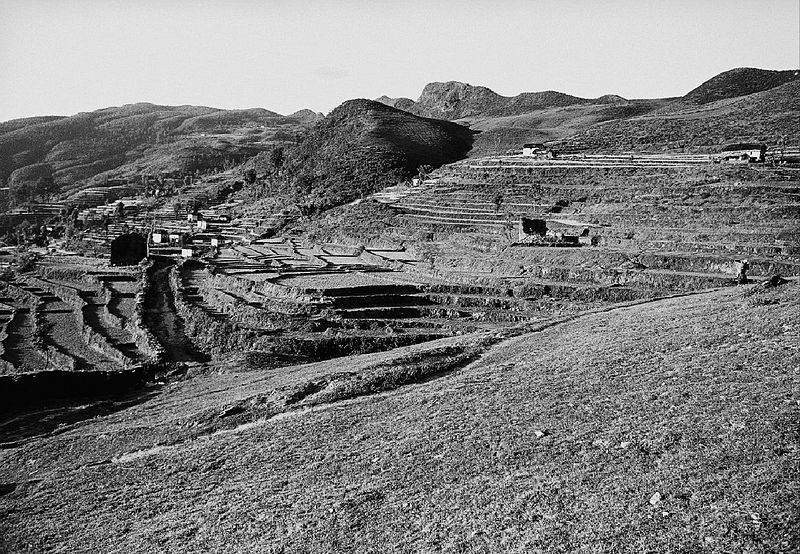
Tutemani with its single farm settlements is a cultural landscape typical for eastern Nepal. Despite the barren landscape, rice, wheat and maize is grown. The surrounding hills used to be covered in trees. Photo: Fritz Berger, Etter Studio. Wikimedia Commons via Flickr, under the Creative Commons Attribution 2.0 Generic license

Thursday, February 21, 2013

Malawi's bountiful harvests and healthier children

Michigan State University News: Through research led by Michigan State University, crop yields have increased dramatically. The children of Ekwendi, Malawi, also have gained weight and are taller. These improvements bring smiles to Sieglinde Snapp, MSU ecologist, and other researchers who have worked in Malawi for many years.

Snapp, a crop and soil scientist at MSU’s Kellogg Biological Station, shared the secrets of the initiative’s success at the annual meeting of the American Association for the Advancement of Science Feb. 14-18 in Boston.

One of the focal points of her research has been improvements in crop diversity and soil health, which have increased yields. Snapp has worked with local scientists, hospital staff and extension workers to rotate cereal grains with bushy legumes, which sparks soil improvement without relying solely on fertilizers.

Crop model simulations, long-term field trials and on-farm experimentation highlight which combinations of legumes, cereals and soil management are best at using resources efficiently. Rotating corn with pigeonpea mixtures (a shrubby legume) keeps the soil from being stripped of nutrients, such as nitrogen, while increasing nutrient-rich grain productivity.

“Participatory action research combined with access to new seeds of bushy food legumes has helped spread a mantle of green across the countryside and help achieve greater food security,” Snapp said. “There have been notable gains in dietary diversity and increased child health in hundreds of farm communities of Northern Malawi – a truly sustainable project.”

Malawi farmers, many of whom are women, also play a critical role in the program’s success. They have embraced the initiative and constantly look to improve their efforts through testing of crop rotations, nutrient-enriched legumes, drought-tolerant crops and staple cereals. Working together, the entire team will help cope with a changing world, Snapp added....

Sorghum in Malawi, shot by Swathi Sridharan, Wikimedia Commons via Flickr, under the Creative Commons Attribution-Share Alike 2.0 Generic license

Saturday, February 16, 2013

Modern food supply technology 'key to affordable food'

Joel D. Adriano in SciDev.net: The modernisation of farm-to-market supply chains is important for increasing farmers' income, alleviating poverty, cutting food waste and improving the affordability of food staples, according to the authors of a book. The Quiet Revolution in Staple Food Value Chains: Enter the Dragon, the Elephant, and the Tiger is a joint project by the Asian Development Bank (ADB) and the International Food Policy Research Institute (IFPRI) that was launched last month.

The book examines the movement of rice and potatoes from the farm to the consumer — known as the 'value chain' — in three Asian countries: Bangladesh, China and India. Rice and potato are food staples in Asia.

Thomas Reardon, a professor in the Department of Agricultural, Food and Resource Economics at Michigan State University, United States, and one of the book's authors, says that the study also has lessons for South-East Asian and Pacific island states.

He says that all three countries have found ways to modernise the value chains of these staple crops. He adds that the changes had been introduced at the grassroots and brought about mainly by mobile phones, the use of improved crop varieties and technological changes related to rice milling and potato storage.

Reardon says the rapid rise of modern cold storage facilities for potatoes, which enable them to be supplied out of season, had led to more stable prices and higher incomes for farmers.... 

Monday, February 11, 2013

Climate change promises tough future for US farmers

Alex Kirby in Responding to Climate Change:  Climate change may force American farmers to alter where they grow crops and to spend millions of dollars more tackling weeds, pests and diseases, a report says. It urges them to consider this as a risk they may have to manage.

The report, by the US Agriculture Department, says American farmers have managed to adapt to environmental changes for nearly 150 years. But the accelerating pace and intensity of global warming in the next few decades might soon overwhelm it.

“We’re going to end up in a situation where we have a multitude of things happening that are going to negatively impact crop production,” said Jerry Hatfield, a plant physiologist with USDA’s Agricultural Research Service and lead author of the study. “In fact, we saw this in 2012 with the drought.”

The National Oceanic and Atmospheric Administration (NOAA) says 2012 was the hottest year in the US since record-keeping began in 1895, overtaking the previous record by 1°F (-17.2°C). The country suffered its worst drought in over 50 years.

The report’s authors say US cropland agriculture will resist climate change fairly well during the next 25 years. Farmers will be able to minimize the impact of warming by changing their timetables and using crop varieties more resilient to drought, disease and heat. More use of irrigation and moving production to regions with a more clement temperature will also help.

But by mid-century adaptation becomes more difficult and expensive as crops and livestock need to become ever more adaptable, something which will leave their productivity increasingly unpredictable. Temperature increases and more extreme swings in precipitation could cause yields of major crops to fall....

A wheat field on the Palouse, in Idaho, US Department of Agriculture

Tuesday, January 15, 2013

Climate change will force Australian farmers to adapt

Sarah Clarke in ABC News: Australia's farmers will need to adapt to cope with a potentially hotter and drier continent as the effects of climate change take hold, scientists say. As the UN's chief science body meets in Hobart today to update the latest climate modelling, the CSIRO says forecasts show Australia will have to cope with less rainfall, longer dry periods and crops struggling to grow in changing conditions.

CSIRO climate applications scientist Steve Crimp says the nation's agricultural sector will likely feel the heat of a hotter climate. "Certainly across most of southern Australia, the projections of the future are for warmer and drier conditions, so when we experience warm and dry conditions, growing those crops, canola, wheat, barley etc will be more challenging in the future," he said.

A CSIRO report warns climate change will threaten Australia's farming productivity and says grazing livestock, particularly cattle, will be stressed as a result and less likely to breed. Central Australia is predicted to experience the greatest warming.

Modelling shows irrigated cropping may also be challenged, especially in the south east where water is drawn from upstream in the Murray-Darling Basin. The CSIRO forecasts all cropping could be hit by less rainfall....

Drought in the Wheatlands, Western Australia, shot by Phillip Capper, Wikimedia Commons via Flickr, under the Creative Commons Attribution 2.0 Generic license

Tuesday, December 18, 2012

Farmers need to grow climate smart

Busani Bafana in IPS: Farmers cannot wait much longer for negotiators to reach an agreement on including a work programme on agriculture in the United Nations Framework Convention on Climate Change. And until one is approved, “it will continue to be difficult for farmers to produce the food needed, and at the same time reduce greenhouse gas emissions.”

This is according to Anette Friis from the Danish Food and Agriculture Council and spokesperson for Farming First, a global coalition calling on world leaders to increase agricultural output in a sustainable and socially responsible manner.

“Countries failed to get an agreement on agriculture at this year’s (Conference of the Parties) COP18 in Doha, which means that discussions will not move to the next level and a work programme on agriculture is not foreseen for the near future,” Friis told IPS. A work programme is a blueprint for action.

Friis said that agricultural organisations needed to pressure leaders to ensure that a future COP deal would include agriculture. She said that discussions on including an agricultural work programme would continue at the next COP in Bonn in June 2013. But this, Friis said, would be without further submissions from parties, which could have informed and moved the process forward.

Farming First is one of 18 leading agricultural organisations that have called for a work programme on agriculture under the Subsidiary Body for Scientific and Technological Advice (SBSTA), an advisory body established under the UNFCCC....

No-till farming in Switzerland, outside Bern, shot by Volker Prasuhn, Wikimedia Commons, under the Creative Commons Attribution-Share Alike 3.0 Unported license

Thursday, December 13, 2012

Typhoon reduces Philippine farmers to beggars

Seed Daily via AFP: The secluded valley that sheltered Jerry Blanco's banana crop from communist and Muslim rebellions offered no refuge from Typhoon Bopha, which left him destitute in seconds.

Last week's terrifying storm has left more than 1,600 people dead or missing in the southern Philippines, and all but wiped out the banana plantations that are one of the desperately poor country's few export earners.

"First the strong wind came, then a sheet of rain. Our roof rattled, the house creaked and then the wall was blown away," Blanco, a 39-year-old plantation worker, told AFP in the southern Philippines.

"I looked out across the field, and all the (banana stalks) were felled. Our harvest was gone. The first thought in my mind was, we've just lost our future," the father of four said....

Wednesday, June 13, 2012

Rio+20 a chance to engage smallholder farms in sustainable agriculture

Mark Tran in the globaldevelopment blog at the Guardian (UK): The draft outcome document of the Rio+20 summit mentions smallholder farmers – many of them women – in growing acknowledgment of their importance in terms of food security, with the continued threat of famine in the Sahel, and environmental sustainability, as farming accounts for at least 14% of global greenhouse emissions.

That smallholder farmers are on the agenda is gratifying for Kanayo Nwanze, president of the International Fund for Agricultural Development (Ifad), one of the three UN food agencies based in Rome. The Nigerian national, who has worked for 30 years in poverty reduction through agriculture, rural development and research, will be championing the cause of smallholder farmers in Rio next week.

Nwanze said smallholder farmers have gained tremendous importance in the past five years, beginning with the L'Aquila initiative in 2009, in which the G8 industrialised countries pledged to invest $22bn in agriculture in the developing world to boost food security.

"It has been fascinating to see the importance given to small farmers now compared with 20 years ago, when they were considered not sustainable because of their slash and burn techniques," Nwanze said in a telephone interview from Rome. "Now they are considered among the most sustainable private-sector enterprises in terms of family inputs and their relation to the land. Smallholder farmers were specifically mentioned by President Obama at Camp David last month [in the G8 food security initiative]."...

Friday, June 8, 2012

Mexican farmers use traditional knowledge to deal with climate change

Emilio Godoy in IPS: Small farmers in Mexico, who receive little institutional support, are drawing on their traditional knowledge to deal with and adapt to climate change, experts say. "Campesinos (peasants) have a strong tradition of expanding their territory, which makes them quite flexible" in dealing with new conditions, Fernando Briones, a researcher at the public Centre for Research and Higher Studies in Social Anthropology (CIESAS), told IPS.  "But their traditional knowledge doesn’t always work. Adaptation is not a lineal process," he said.

The academic carried out the study "Saberes y prácticas climáticas de los pueblos indígenas de México: los choles" (Climate wisdom and practices of the Chole indigenous people of Mexico), focusing on an indigenous community in the city of Tila in the southern state of Chiapas, one of the country’s poorest states.

He studied the farming practices and expertise of the Chole people, one of 62 native groups who make up between 12 and 30 percent of the country’s 112 million people (the smaller, official, estimate is based on the number of people who speak an indigenous language).

Describing some of the traditional practices, Briones said Mexico’s campesinos stagger the planting of their maize, beans, coffee and other crops. Some is done before the rainy season starts in June, a much larger part is based on the traditional calendar, and the remainder is done once the dry season has started. Another practice is to plant at different altitudes...

A pasture in Chiapas, shot by AlejandroLinaresGarcia, Wikimedia Commons, under the Creative Commons Attribution-Share Alike 3.0 Unported license

Tuesday, May 29, 2012

Tree planting helps Pakistani farmers weather floods

Saleem Shaikh and Sughra Tunio in AlertNet: Abdul Qadir Shah, a cotton farmer in Pakistan’s southern Sindh province, has been able to spring back from the destructive floods of the past two years thanks to his decision to plant mango, date and neem trees on his 14-acre plot.

When floodwaters hit Khairpur Mir’s district, some 400 miles (644 km) northeast of Karachi, in 2010 and then again in 2011, Qadir Shah suffered financial losses of 4 million rupees ($44,000) as his cotton crop was ruined. “But income from mango and date palm trees, which I had planted some four years earlier in my cotton field and on the edges of nearby irrigation waterways, provided enough money to let me repair damaged water channels, buy cotton seed, farm tools and pesticides, and other inputs for cultivating my farmland again this year,” he explained.

...Following the devastating floods, Qadir Shah realised that cultivating trees alongside crops can be of great help when natural disasters wipe out harvests. Now he is spreading the word. “I have persuaded other farmers, who have been unable as yet to emerge from the economic damages from the ravaging floods, to plant trees beside their crops to survive losses from crop failures in the future,” he told AlertNet, pointing to new seven-month-old trees now growing on agricultural land in the area.

As well as providing crucial income, Qadir Shah’s 90 mango trees, 20 date palms and 25 neem trees – whose oil is used in health products - have curbed soil erosion, reduced water evaporation and strengthened the unlined channels that supply irrigation water to his fields from the Khairpur West canal, which is fed by the Sukkur Barrage....

A panorama in Khairpur, shot by Mnazirawan, Wikimedia Commons, under the Creative Commons Attribution-Share Alike 3.0 Unported license

Monday, April 30, 2012

Climate change biggest threat to Zimbabwe farming

Jeffrey Gogo in AllAfrica.com via the Herald (Zimbabwe): Collecting memories from Zimbabwe's 32-year history, the reforms on land ownership stand prominent, apart from political freedom. The reforms represented a major shift in the balance of economic power within the agriculture sector, after Government transferred millions of hectares of fertile arable land to over 300 000 marginalised indigenous peasants from a few thousand white farmers.

For the new farmers -- both large-scale commercial and small-scale farmers not to mention their subsistence counterparts -- their biggest mandate is to provide food for the nation and for export.

But since the start of the fast track land reforms over 10 years ago, that goal is yet to be met.

During this period, Zimbabwe has been forced to import, on average, 50 percent of its annual grain requirements to cover local deficits. The reasons for poor food and agricultural production in a land-reformed Zimbabwe are numerous, key among them lack of funding, inputs shortage and lack of adequate agriculture skills as well as laziness.

However, the biggest challenge to farming and food security in the country today is not funding, it is not skills shortage but climate change and global warming. Changing climatic and weather systems pose a serious threat to agriculture, as they have disrupted rains, caused droughts and resulted in higher average temperatures.

They attack the very core of activities that make the farmers who they are, empowered individuals, whom without their overflowing agriculture produce, are just like every other individual -- disempowered and powerless needing aid....

Shona farms in Zimbabwe, shot by Ulamm, Wikimedia Commons, public domain

Monday, January 23, 2012

Efforts to control Mississippi River result in flooded farmland and permanent damage

Terra Daily via SPX: When the water in the Mississippi River rose to 58 feet with a forecast of 60 feet or higher in May 2011, the emergency plan to naturally or intentionally breach the levees, established over 80 years prior, was put in motion. The flood of 1937 did top the frontline levee and water passed into and through the New Madrid Floodway, but being floodfree since then caused area landowners to oppose the plan being put into action.

..."The initial additional force and depth of floodwater caused more damage to buildings and more deep land scouring than was predicted. The strong current and sweep of water through the Birds Point, Missouri, breach created deep gullies in 133,000 acres of Missouri farmland, displaced tons of soil, and damaged irrigation equipment, farms, and homes."

Olson has followed the drama of the deliberate flooding closely and believes it will create long-lasting, if not permanent, agricultural damage to hundreds of acres of land. The rushing water gouged large deep gullies on parcels of land adjacent to the blown levees and on some distant fields. The land was also covered with a thick sand deposit and in some areas adjacent to where new crater lakes were formed.

"Reclamation efforts by the Corps of Engineers included patching the frontline and fuse plugs levees with the sand, and topsoil was trucked in," Olson said. "...Proper drainage in the area has been restored, but the unanticipated fields with large and deep gullies located five miles from the levee breaches will not be repaired very easily." Olson believes that even if the fields of gullies are reclaimed, the soils are likely to have lower productivity.

"The resulting land surface will have less soil aggregation, less organic carbon, and be more sloping, making it difficult to farm the land," he said. "Some of this lost cropland could be restored as wetlands and wildlife habitat adjacent to the patched levees."...

Water flows from the Missouri River over levee L-550, located north of Highway 136 in Atchison County, Mo., June 19. The local sponsor reported overtopping of the levee to the U.S. Army Corps of Engineers the morning of June 19. The levee is in the Federal Program (PL 84-99) and is operated and maintained by a non-federal sponsor. It was constructed by the Corps in the late 1940s. (U.S. Army Corps of Engineers photo by Carlos J. Lazo)