Showing posts with label books. Show all posts

Saturday, January 21, 2012

The next Carbon Based annual is here!

Now available! Another annual book drawn from this very blog! I've incorporated the lessons I've learned from last year's annual and made this one much more focused.

Climate change adaptation teems with large events and subtle forces. Every day, the news brings more stories of climate-related floods, droughts, forest fires, sea level rise, extreme weather, disasters, ecological stress, and infectious diseases. The field also spans new developments in computer modeling, agriculture, water and land use, paleoclimate, scientific research, insurance, and finance. Climate instability takes a dramatic toll on indigenous peoples and developing countries, but it also warps the psychological and social quality of our lives, and in my blogging I don't neglect these subjects, either.

For this year's annual review, I've focused on stories about climate risks, since I view risk as the one way of unifying the thronging variety of climate change adaptation. It's a central topic because one effect of global warming is worsening probabilities, something that is notoriously difficult to detect. It's a natural filter for me because risk has been the subject of many of the articles I've written during 2011. Maybe it's my bias showing, but I think risk as a topic is only going to grow in importance as the risks shift and take new forms.

Saturday, October 18, 2008

Climate change’s most deadly threat: drought

A book review from the Christian Science Monitor: ...In recent years, a flood of books about global warming has been written for the lay audience. Among the most noteworthy: Tim Flannery’s “The Weather Makers”; Elizabeth Kolbert’s “Notes From A Catastrophe”; Eugene Linden’s “The Winds of Change”; and Ross Gelbspan’s “The Heat Is On.”

Each scopes out its own piece of the climate puzzle, from tundra to tropics and atmosphere to ocean, using plain narratives to explain a phenomenon that, when left to scientific lexicon, can seem too complicated to grasp. Fagan, author of the bestselling “The Little Ice Age,” makes an original contribution in “The Great Warming” by summoning attention to what he calls “the silent elephant in the room”: drought.

As polar icecaps melt and glaciers disappear, thus causing seas to rise, low-lying coastal areas may indeed be inundated, creating millions of environmental refugees. But it is the inland agricultural breadbasket regions that feed the world that stand to suffer the greatest upheaval if reliable precipitation patterns vanish.

Such a scenario is not speculative, Fagan insists; it’s based upon not only sophisticated computer models, but also the precedent of what’s already happened during episodes of climate change half a millennium ago – in the Arctic, Europe, China, the Southern Hemisphere, and in America’s own backyard. By taking readers back to the Medieval Warm Period and Little Ice Age, Fagan argues that history “shows how drought can destabilize a society and lead to its collapse.”

….“Droughts are expensive in human terms and also carry a high economic price,” he writes. “The notorious Dust Bowl droughts of the 1934-40 over the Great Plains scarred an entire generation. Three and a half million people fled the land.” Imagine the Dust Bowl lasting centuries with no end in sight.

Now imagine the superproduce fields of California’s Central Valley and the fast-growing Southwest, with desert cities like Phoenix, Tucson, Las Vegas, El Paso, and greater Los Angeles-San Diego confronting depleted aquifers and dry aqueducts....

Saturday, March 22, 2008

Brian Fagan's "The Great Warming" tells of elites sleepwalking to disaster

Several reviews have appeared of Brian Fagan's The Great Warming: Climate Change and the Rise and Fall of Civilizations. Andrew Nikiforuk's discussion in the Globe and Mail (Toronto) struck me as the best: ...In a book that reads like climate déjà vu, well-known University of California anthropologist Brian Fagan shows that the Medieval Warm Period humbled political elites and demolished their well-engineered empires with equanimity.

Fagan says we're now entering another era of extreme aridity, and that the challenges of adapting to water shortages and crop failures won't be easy. Although elites can ignore the climate, Fagan says, the climate won't ignore them. It never has....

Fagan, a veteran chronicler of how climate can undo a society's best-laid plans, cements his lucid and often surprising observations on this climate event with much scientific data collected from ice cores and tree rings. He admits that there is still much debate about what caused the great warming, and nobody really knows how hot it actually got. But no one doubts that the dramatic event turned a grape-like bunch of civilizations into raisins....

In his final chapter, Fagan explains why climate history matters, and it's not inspiring reading. Britain's esteemed Hadley Centre for Climate Change recently documented a 25-per-cent increase in global drought since the 1990s. Right now, about 3 per cent of the planet is drying up. Global warming will soon place a third of the Earth in extreme drought and force another half of the world's land mass to taste "moderate drought." Such abiding dryness will "challenge even small cities, to say nothing of thirsty metropolises like Los Angeles, Phoenix and Tucson." Even Las Vegas could lose a craps game or two.

But history in a virtual age remains an impoverished teacher, much like truth speaking. The good news, Fagan says, is that highly nomadic communities with diverse food supplies often read the weather signs and move. The bad news is that elites try to super-manage their way out of droughts, with disastrous results for ordinary people....

Saturday, March 8, 2008

Report: EU must urgently address security threats stemming from climate change

AP: Climate change is happening now and the European Union must lose no time in addressing the impact it will have on Western Europe, its neighbors and allies, says a report prepared for next week's meeting of the 27 EU leaders. The report – a copy of which was obtained by The Associated Press – calls climate change a “threat multiplier” that will worsen tensions and instability between nations as they face loss of arable land, water shortages, diminishing food and fish stocks, more frequent flooding, prolonged droughts and scarcer energy resources.

The report to the EU leaders says climate change will trigger not only humanitarian crises but also political and economic instability, border disputes, ethnic tensions and “environmentally induced” migration of millions of people from Africa and the Middle East to Europe. It urges the EU to put climate change high on the international agenda. The EU leaders hold their spring summit in Brussels on March 13 and 14.

…The report was drafted by Javier Solana, the EU's foreign and security affairs chief. EU officials said the study was prompted by Russia's interruption of gas deliveries to Western Europe in January, 2006, in a dispute with Ukraine. “It has been estimated a business-as-usual scenario in dealing with climate change could cost the world economy up to 20 percent,” of its annual economic output, whereas “effective concerted action” would limit that to only 1 percent, the report argues.

The report says polluters and “emerging economies must be induced to commit to an ambitious (UN) climate agreement” – a dig at the United States and rising giants such as China, India and Brazil.

The EU must also boost global warming research, step up civil protection, study the impact of global warming on different regions of the world and increase international cooperation on climate change. The report said the EU was well suited to engage others in combatting climate change because of its multilateral approach to global politics and experience in conflict prevention and management.

Flag of Europe, Wikimedia Commons

Friday, February 22, 2008

New book by Lester Brown: Plan B 3.0

Veteran environmental activist and writer Lester Brown has a new book out: Plan B 3.0: Mobilizing to Save Civilization. The latest iteration in his "Plan B" series, Brown's book teeters on my ever-growing stack, but those who've been reading him over the years know that he's exceedingly reliable and action-oriented. As the President of the Earth Policy Institute, Brown has also made the book free online and is offering numbers crunchers a chance to examine the background data in detail. A model of transparency and openness!

An expert on the limitations on the Western model of oblivious economic expansion, Brown shows that this method won’t work for the developing world. He shows the true cost of gasoline, further tramples on the undead zombie that is corn ethanol, and anatomizes the triple crisis simmering in food, oil and water. The ecology of cities comes in for some very well-informed discussion, putting the urban world in its natural context in a revealing way.

While he dwells on the dangers of mega-fires, infrastructure failure of all kinds, as well as deforestation and desertification, he also has a bursting quiver of great policy suggestions and long-range approaches. Ever since he founded the Worldwatch Institute in 1984, Brown has been a bubbling fountain of ideas.

Thursday, February 21, 2008

Yearbook 2008 from the UN Environment Programme

For the past five years, the United Nations Environment Programme has published a "Yearbook," and the latest one is out. The table of contents looks interesting, with a number of topics that focus on adaptation: biodiversity, environmental governance, and emerging challenges such as Arctic climate feedbacks, methane from thawing permafrost, methane from hydrates, and significant changes in nature.

The website declares: The UNEP Year Book 2008 highlights the increasing complexity and interconnections of climate change, ecosystem integrity, human well-being, and economic development. It examines the emergence and influence of economic mechanisms and market driven approaches for addressing environmental degradation. It describes recent research findings and policy decisions that affect our awareness of and response to changes in our global environment.

Monday, February 11, 2008

Book: The Hot Topic, by Walker and King

Chris Mooney calls this one the best book on global warming he's ever read. From the jacket: Last year, awareness about global warming reached a tipping point. Now one of the most dynamic writers and one of the most respected scientists in the field of climate change offer the first concise guide to both the problems and the solutions. Guiding us past a blizzard of information and misinformation, Gabrielle Walker and Sir David King explain the science of warming, the most cutting-edge technological solutions from small to large, and the national and international politics that will affect our efforts.

While there have been many other books about the problem of global warming, none has addressed what we can and should do about it so clearly and persuasively, with no spin, no agenda, and no exaggeration. Neither Walker nor King is an activist or politician, and theirs is not a generic green call to arms. Instead they propose specific ideas to fix a very specific problem. Most important, they offer hope: This is a serious issue, perhaps the most serious that humanity has ever faced. But we can still do something about it. And they’ll show us how.

Gabrielle Walker is a contributing editor for New Scientist; she was previously climate change editor at Nature. She is the author of An Ocean of Air and Snowball Earth. She lives in London.
Sir David King is the United Kingdom’s chief science adviser and a professor and director of research at the University of Cambridge. He lives in London and Cambridge.

Saturday, February 9, 2008

Climate Code Red: The Case for a Sustainability Emergency

A new book is out in Australia -- Climate Code Red: The Case for a Sustainability Emergency. A joint project of Greenleap and the Carbon Equity Campaign (in affiliation with Friends of the Earth in Australia), the authors put forward five key points:

1. Our goal is a safe-climate future – we have no right to bargain away species or human lives

2. We are facing rapid warming impacts: the danger is immediate, not just in the future

3. For a safe climate future, we must take action now to stop emissions and to cool the earth

4. Plan a large-scale transition to a post-carbon economy and society

5. Recognise a climate and sustainability emergency, because we need to move at a pace far beyond business and politics as usual

Tuesday, January 22, 2008

A climate change visionary: J.G. Ballard

In an interview in the Times (UK), I read the dreadful news that J.G. Ballard has prostate cancer. He's written a new autobiography to try to get everything down as quickly as he can.

This great writer is best known, perhaps, as the author of Empire of the Sun, his memoir of a boyhood spent in China as a prisoner in a Japanese slave labor camp. Even the peppy Steven Spielberg film version can't quite gloss over Ballard's dark vision of the will to survive. It's hard to forget the scene when the young Ballard witnesses the detonation of the atomic bomb that destroyed Nagasaki just over the horizon.

One of Ballard's great strengths as a writer has been his eerie ability to convey a sense of humans and nature out of balance. Sometimes the world is submerged, or the jungle begins intruding on a decayed resort, or a high-rise building reverts to savagery. In one science fiction story after another, he's described the psychological impact of climate instability.

The reasons vary in the stories, and as far as I know Ballard hasn't often focused directly on global warming as such. Perhaps in Day of Creation, which is set in an African drought. But nobody has a firmer grip on the radiating psychological unease of a world where the climate no longer behaves.

Sunday, January 20, 2008

Helping your community prepare for climate change

The Climate Impacts Group (a "science in the public interest" NGO based in Seattle) has published a primer for communities grappling with climate instability. The title is Preparing for Climate Change: A Guidebook for Local, Regional, and State Governments, and it identifies a procedure that an average community would be hard-pressed to invent on their own. The book is: ... designed to help local, regional, and state governments prepare for climate change by recommending a detailed, easy-to-understand process for climate change preparedness based on familiar resources and tools. Questions addressed in the guidebook include the following:
  • How do you assess climate change impacts that will affect your community?
  • How do you build support for adaptation?
  • Who should participate in your preparedness team?
  • What are climate change planning areas, and how do you identify them for your community?
  • How do you identify your sensitivity, adaptive capacity, and risk to climate change impacts – i.e., conduct a vulnerability assessment and a risk assessment ?
  • How do identify your priority areas?
  • How do you establish a vision and guiding principles for a climate resilient community in these priority planning areas?
  • How do you begin to develop climate change preparedness goals and actions in these priority planning areas?
  • How do you develop a plan?
  • How do you ensure that you have the right tools to take actions?
  • How do you develop measures of resilience to track your progress and update your plans over time, to ensure that your efforts are really making your community more resilient to climate change?

Preparing for Climate Change was co-authored by the Climate Impacts Group, King County (Washington) Executive Ron Sims, and King County 's climate team. ICLEI-Local Governments for Sustainability is a contributing partner and is distributing the guidebook nationally to its more than 250 U.S. member cities, towns, and counties as part of its Climate Resilient Communities Program, a Five Milestone process for adapting to climate change.

Monday, January 14, 2008

Earth Under Fire -- a new book

From the University of California Press, a photo book about climate change -- Earth Under Fire: How Global Warming is Changing the World. The book's jacket says: Six years ago, award-winning photojournalist Gary Braasch began an extraordinary journey around the world to observe and document environmental changes resulting from the warming of our climate. In this stunning, eye-opening book, he brings us along to witness firsthand what he saw as he crossed both the Antarctic and Arctic Circles, trekked above 15,000 feet in the Andes, dove on damaged coral reefs, and followed scientists into the field on four continents. In more than one hundred photographs, including dramatic before-and-after comparisons, Braasch records communities, landscapes, and animals at risk because of receding glaciers, eroding coastlines, rising sea levels, and thawing permafrost. In the accompanying text he surveys the science behind climate change and introduces native people, lifelong observers, scientists, and others who are noticing striking changes right now. Alongside Braasch's compelling words and images, essays by eminent scientists discuss the impacts of climate change on the oceans, biodiversity, fresh water, mountain cultures, plants and animals, and our health. More than a warning, Earth under Fire, the most complete illustrated guide to the effects of climate change now available, offers an upbeat and intelligent account of how we can lessen the effects of our near total dependence on fossil fuel using technologies and energy sources already available.

Friday, January 11, 2008

Worldwatch Institute: State of the World 2008

The Worldwatch Institute has churned out excellent work for decades. But don’t let familiarity prevent you from picking up their latest “State of the World” report. From Environment News Service: Concern about environmental degradation is beginning to impact the global economy, according to a new report by an international environmental research group. The Worldwatch Institute details a lengthy and distressing list of environmental problems caused by the global economic system, but finds some evidence that the world is taking small steps toward a sustainable future.

"There are early signs that a vibrant, new sustainable economy is just beginning to be created," Worldwatch president Christopher Flavin told reporters Wednesday at the launch of the organization's annual "State of the World" report. The report details how the conventional economic system is inherently self-destructive, failing to take into account the damage done to the environment by a wide range of human activities that create wealth. But it suggests that is beginning to change….

You can order the report directly from Worldwatch.

Wednesday, January 9, 2008

New book: Worst Case Scenarios, by Cass Sunstein

Cass Sunstein has a new book out called Worst Case Scenarios. In it, he discusses global warming as a theme, as well as considering the best reactions to terrorist threats, genetic modification of food, hurricanes and avian flu, among other issues. The author does often valuable work on risk issues as well as cost-benefit analysis, pro and con, and thoughtfully examines how to respond appropriately to dangers without becoming paranoid or paralyzed.

One aspect of climate change is that we will probably face more occurrences of low probability events with severe impacts. Learning how to respond to such confusing risks is a lesson we haven’t learned yet. Sunstein also raises important issues that bear close scrutiny about intergenerational equity (what does the present generation owe to its grandchildren?) and “climate justice” (how can the industrialized West rightly impose a low-carbon regime on developing countries and jeopardize their economic growth?)

The City Journal has a critical review, but this doesn’t deter me from wanting to take a look.

Wednesday, January 2, 2008

Northward ho?

IPS: Dan Bloom thinks it's time to figure out how to build self-sustaining cities in the polar regions because climate change will eventually make most of Earth uninhabitable. These polar cities may be "humankind's only chance for survival if global warming really turns into a worldwide catastrophe in the far distant future," Bloom told IPS.

Bloom isn't a scientist or any other kind of expert. A U.S. citizen in his late fifties living in Taiwan teaching English, he's lived all over the world as a reporter-editor, teacher-translator and author. And now Bloom wants to shake people out their everyday indifference to the great emergency of our age: climate change. "Life goes on as usual here in Taiwan. No one is doing anything and they don't want to talk about it," he says. And sadly inaction begets inaction.

…His Quixotic quest began less than a year ago. Having heard various conflicting news reports about climate change, Bloom decided to research the subject as thoroughly as he could. The genesis of the polar cities idea came from a dire op-ed by the eminent British scientist James Lovelock in January 2006 in the Independent newspaper.

Lovelock wrote that the Earth will heat up far faster than any scientist expects due to many positive feedbacks such as melting of Arctic and Antarctic ice. "... Before this century is over billions of us will die and the few breeding pairs of people that survive will be in the Arctic where the climate remains tolerable," he wrote.

...But polar cities is an idea that many climate change experts refuse to consider. Most of the climate scientists IPS contacted for this story declined to comment. Those who did respond said imagining such a future was not productive when humanity needs to focus on "how the world can drastically reduce greenhouse gas emissions". "It's silly to think 200 or 300 years into future, it's more useful to think 20 or 30 years out," said Ross Gelbspan, a former Washington Post-Boston Globe reporter and author of several books on climate change.

Gelbspan has done a great deal of thinking about the near future as the impacts of climate change take hold. There is no stopping the future deaths of millions of people from climate change, he believes. The only question is how many millions. His future scenarios range from a totalitarian nightmare in response to climate-driven mass migrations and social chaos to real world peace. His best guess today is we will see those extremes, and everything in between. "We need to start talking about the kind future we want to have," Gelbspan told IPS.

Talking to young people is especially important, since it is their future. And it's important to offer alternatives and solutions. Wind farms, for example, could easily replace all of the U.S. energy produced by coal and oil, he says. "What's the resistance to widespread use of renewables?" Gelbspan wonders.

In the U.S., he says the answer is to get the money out of politics. Oil, coal and other industries make major financial contributions in a country where presidential candidates spend tens of millions of dollars to get elected. As a result, the next U.S. president is unlikely to make the necessary drastic cuts in greenhouse gas emissions.

Dan Bloom doesn't have answers. He knows there is a serious problem that we aren't addressing. "Life on Earth is very fragile but we're screwing things up," he told IPS. "I'm going to spend the last years of my life pushing this idea of polar cities to wake people up. I don't care if people call me crazy."

Monday, December 31, 2007

Rain saves Atlanta from drought record

Newsday (New York): This year was almost one for the record books, but then it rained. A lot. After a fourth consecutive day of rain Sunday, 2007 barely missed becoming Atlanta's driest year on record. That dubious honor goes to 1954, when only 31.80 inches of rain fell.

Atlanta is at the center of a historic drought that has engulfed more than one-third of the Southeast. The affected region includes most of Tennessee, Alabama, Georgia, North and South Carolina, as well as parts of Kentucky and Virginia.

Even four days of rain couldn't touch the epic dry spell, but normal rainfall levels over the next few months could help return disappearing lakes, rivers and streams to their former glory, Lynn said. Sunday's showers pushed the city up to 31.85 inches for the year, where it is expected to stay as forecasters say Monday -- the final day of 2007 -- will be mostly dry.

Light rain was possible for counties in north Georgia early Monday morning as a system moved through the region, said Brian Lynn, a meteorologist with the National Weather Service station in Peachtree City. A parade of rainstorms that began the week before Christmas helped Atlanta escape its driest year on record. Rain fell in the city on 10 of the last 12 days.

But the moisture had only a small effect on Lake Lanier, the metropolitan area's main source of drinking water. The reservoir rose only about a foot from the rain after hitting an all-time low earlier last week. "What's falling now won't show up until tomorrow or the next day," said Rob Holland, a spokesman for the U.S. Army Corps of Engineers, which operates the reservoir. "Anything that stops the level from falling is a good thing," he added. "But we'd like to get a whole lot more."

The lack of rainfall across the region has set off intense fighting between Georgia, Florida and Alabama over the federal government's management of water in the region. Georgia Gov. Sonny Perdue has asked the federal government to release less water from its reservoirs, such as Lanier, but Alabama and Florida are concerned about how that would affect their supplies. Last month, Perdue held a public prayer vigil for rain on the steps of the Capitol.

Monday, December 3, 2007

Just in case: Could you survive a major disaster?

From Dumb Little Man, a posting by K. Stone, whose blog is called Life Learning Today: Below you will find links to articles on different types of disasters and how to survive them. The goal of this article is not to worry you about large events that can't be controlled, but rather to offer resources that can help you be somewhat prepared should disaster strike.

Survival Guides and Information:

Tsunami
Tsunami Survival by USGS.gov
Wikihow Tsunami Survival Guide

Saturday, December 1, 2007

With cracks and holes in the Greenland ice sheet, we may well have to 'geo-engineer' the climate

In the Toronto Globe and Mail, Thomas Homer-Dixon adapts his chapter from an upcoming book, Globally Integrated Climate Policy for Canada (and I’ve shortened it considerably here – this is just a taste of Homer-Dixon’s essay): Next week, policy makers, scientists and activists from around the world will gather in Bali, Indonesia, to try to produce a climate-change agreement that will take us beyond the 2012 expiration of the Kyoto Accord. This meeting will take place in an atmosphere of sharply heightened unease among leading climate scientists.

A few years ago, these scientists regarded global warming as a matter of serious concern; now many appear to think that it's a matter of grave urgency — that we may be running out of time. The recent Intergovernmental Panel on Climate Change (IPCC) reports are increasingly viewed as out of date.

…Two issues particularly exercise climate scientists: positive feedbacks and ice-sheet dynamics.… Our climate has many positive and negative feedbacks. The positive ones are self-reinforcing, while the negative ones counteract the warming tendency. The big question for climate scientists then is: What is the balance is between the positive and negative feedbacks? A consensus appears to have emerged over the past two years — not yet reflected in the recent IPCC reports — that the positive feedbacks are much stronger and more numerous than the negative ones.

The second issue that particularly concerns climate scientists is ice-sheet dynamics… Climate scientists now recognize that the ice-sheet melting models in the IPCC reports were radically inadequate. These models were "static"; they assumed that atmospheric warming melts the ice, and the resulting water then runs off the surface of the ice sheet into the ocean.

…In light of these two trends, climate scientists are now beginning to discuss a topic that only two years ago many fervently hoped they'd never have to discuss: geoengineering, or the intentional human modification of the planet's climate to arrest or slow global warming. Geoengineering would involve, for example, putting sulphate aerosols into the atmosphere or putting mirrors into space to try to block a fraction of incoming solar radiation.

Today the topic is at the margins of the public-policy dialogue about climate change, but I expect it will be at the centre of public discussion within five years. In 10 years, we will see demands from some segments of the public and many opinion leaders that we carry out geoengineering. And we'll probably start doing it within 20 years, likely when it becomes apparent that the Greenland ice sheet is starting to collapse.

We will do it, because by then we'll be experiencing major socio-economic impacts of climate change — for instance, shortfalls in global food supply, as droughts and heat waves affect grain-growing regions. At that point, we will wonder about what kind of world we've created for our children and grandchildren. We'll recognize that we're facing an emergency unlike anything humankind has ever faced before, and we will demand that our leaders and experts do something, anything, to stop the slide.

Sunday, November 11, 2007

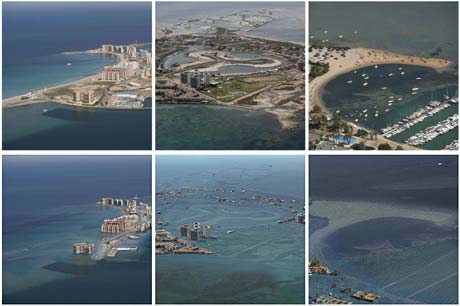
Spain shown perils of climate change

Guardian (Environment): It's an apocalyptic view of the future, a stark warning to Spain of what the country could look like if action is not taken to reduce the effects of climate change. The warning comes in a book, Photoclima, launched this week by Greenpeace in which images of some of Spain's most emblematic places have been altered to show what they could look like in the future. Using statistics from the UN panel on climate change and a touch of digital makeup Greenpeace hopes to scare Spain into taking action.

La Manga del Mar in Murcia.

Digitally retouched picture of La Manga del Mar in Murcia to show before (top) and after (below) a rise in sea level. Photograph: Pedro Armestre/AFP/Getty Images

We see the Ebro river in Zaragoza as a dried-up riverbed in 2070, by which time the fields of Valencia, which have provided Spain with oranges for centuries, will have all but disappeared. Perhaps the most dramatic image is that of La Manga de Mar Menor in Murcia, where hotels and apartment blocks abut the Mediterranean. In a few decades, according to Greenpeace, most of this will be underwater.

According to the group's director in Spain, Juan López de Uralde, the intention was not to use "scientific rigour" but to "create alarm and a call to action". Mr Uralde is highly critical of the level of debate on climate change in Spain, where he says the last few weeks have seen a "frivolous" discussion on "marginal aspects" of climate change.

For example, when Al Gore visited Spain last month to highlight the dangers of climate change, the leader of the opposition People's party, Mariano Rajoy, openly questioned his judgment. "Listen," said Mr Rajoy, "I've brought here 10 of the world's most important scientists and not one of them can guarantee what the weather will be like tomorrow ... How can anyone say what will happen to the world in 300 years?

Saturday, October 27, 2007

What turns fires into disasters? Politics and planning

Treehugger: Steve Erie is director of the Urban Studies and Planning Programming at the University of California San Diego. He is writing a book: Paradise Plundered, explaining how the hills around San Diego got developed.

Erie says that "Developers own most of the city councils. In Poway, in Escondido, what they do is put homeowners in harm's way. They're able to control zoning processes, and they're frequently behind initiatives that say no new taxes, no new fire services. It's insanity." "Politicians here have never met a developer they didn't like. It's a company town and it is largely run by the building industry and local politicians do their bidding." Meanwhile, the builders don't build any more fire protection than they have to because people aren't willing to pay for it. ::The Star

fire3.jpg

Around Los Angeles, researchers have found that about two-thirds of new building in Southern California over the past decade was on land susceptible to wildfires, said Mike Davis, a historian at the University of California at Irvine and author of a social history of Los Angeles.

"It gives you some parameters for understanding the current situation," Davis said. "Another way to look at it is you simply drive out the San Gorgonio Pass, where the winds blow over 50 mph over a hundred days a year and you have new houses standing next to 50-year-old chaparral. "You might as well be building next to leaking gasoline cans." ::Washington Post

2007-10-27_103554.jpg
John Gress - Reuters

Back in San Diego, former fire chief Jeff Bowman is nervous. According to the LA Times, Bowman works as a consultant to fire departments and municipalities. With 16 years as chief in Anaheim and four in San Diego before quitting over staffing and resource issues, he's got strong opinions on San Diego's long, proud culture of skimping on services to keep taxes low.

Although the city of San Diego has a fire department, the county doesn't, leaving many suburban and rural areas to rely on volunteer departments. The city has but one firefighting helicopter and just 975 firefighters for 330 square miles and 1.3 million residents. Compare that, he says, with San Francisco, which has 1,600 firefighters for 60 square miles and 850,000 people.

"San Diego practices the biggest don't-tax-me campaign I've seen," says Bowman, a proud, lifelong Republican. Fine, he says, don't raise taxes. But reevaluate how money is spent and redistribute it to public safety. ::LA Times

Monday, October 15, 2007

Climate change moves to the board room

Toronto Globe & Mail, via Harvard Business Review: From a piece by Michael Porter and Forest Reinhardt.

Start treating carbon emissions as costly
If they aren't already, they soon will be, and you need to assess your vulnerability to climate-related environmental and economic shocks. Just as having too many employees in your shipping department is operationally ineffective, so is excess carbon emissions in your shipping operations.

Evaluate your vulnerability to climate-related effects
These can include regional shifts in the availability of energy and water, the reliability of infrastructures and supply chains, and the prevalence of infectious diseases.

Look for opportunities to enhance or extend your competitive positioning
This may come by creating products that exploit climate-induced demand, as hybrid car manufacturers have done. Or, you might restructure your operations to take advantage of climate change. In outbound logistics, for example, firms might replace physical books or manuals with electronic ones and, in after-sales services, they could supplant physical visits by service technicians with remote diagnostics and treatment programs.

Calculate your ratio of profits to total emissions in your value chain
This simple ratio can be a very telling indicator of potential climate impact, as it measures your overall corporate footprint, including suppliers. If new regulations put a tax of $10 per ton of emissions, how would that affect your firm? Again look for advantages: Forestry companies may find it as valuable to plant trees and remove carbon dioxide from the air as it is to cut trees down and produce paper or plywood.

Rethink your web of suppliers and how you get products to customers
"For example, modern supply chains, with their transportation-intensive, just-in-time inventory management systems, may no longer be optimal in a world with more costly emissions. Similarly, e-commerce, with its proliferation of small shipments, may face real limits," they stress.

Relentlessly seek strategic advantage
Remember as you address climate change to keep strategic advantage in mind. Emission-intensive activities that add little value to your operations and customers are candidates for elimination, and those that are important to value may become strategic if you can reduce your exposure relative to competitors and find a way to maintain that difference. Wal-Mart, they note, seems to be making a strategic bet that it can reduce its carbon emissions more than competitors and keep it lower.